Open on EUR-Lex ↗
◷
New version applies from 26/08/2009. 43 provisions change. Later versions: 19/12/2011, 21/11/2012, 01/07/2013, 23/10/2013, 22/07/2014, 15/05/2015, 01/01/2018, 22/05/2018, 01/11/2020. Annex I changes in this version: compare with the current text.

Annex I

Annex I

ANNEX I

PROVISIONS CONCERNING THE COMMUNITY MODEL DRIVING LICENCE

1.

The card shall be made of polycarbonate.

Methods for testing the characteristics of driving licences for the purpose of confirming their compliance with the international standards shall be in accordance with ISO 10373.

2.

The threats to the physical security of driving licences are:

—

production of false cards: creating a new object which bears great resemblance to the document, either by making it from scratch or by copying an original document,

—

material alteration: changing a property of an original document, e.g. modifying some of the data printed on the document;

The overall security lies in the system in its entirety, consisting of the application process, the transmission of data, the card body material, the printing technique, a minimum set of different security features and the personalisation process.

(a)

The material used for driving licences shall be made secure against forgery by using the following techniques (mandatory security features):

card bodies shall be UV dull,

a security background pattern designed to be resistant to counterfeit by scanning, printing or copying, using rainbow printing with multicolour security inks and positive and negative guilloche printing. The pattern shall not be composed of the primary colours (CMYK), shall contain complex pattern designs in a minimum of two special colours and shall include micro lettering,

optical variable elements providing adequate protection against copying and tampering of the photograph,

laser engraving,

in the area of the photograph the security design background and photograph should overlap on at least its border (weakening pattern).

(b)

In addition, the material used for driving licences shall be made secure against forgery by using at least three of the following techniques (additional security features):

colour-shifting inks*,

termochromic ink*,

custom holograms*,

variable laser images*,

ultraviolet fluorescent ink, visible and transparent,

iridescent printing,

digital watermark in the background,

infrared or phosphorescent pigments,

tactile characters, symbols or patterns*.

(c)

Member States are free to introduce additional security features. As a basis, the techniques indicated with an asterisk are to be preferred as they enable the law enforcement officers to check the validity of the card without any special means.

3.

Page 1 shall contain:

(a)

the words ‘Driving Licence’ printed in large type in the language or languages of the Member State issuing the licence;

(b)

the name of the Member State issuing the licence (optional);

(c)

the distinguishing sign of the Member State issuing the licence, printed in negative in a blue rectangle and encircled by twelve yellow stars; the distinguishing signs shall be as follows:

B

:

Belgium

CZ

:

Czech Republic

DK

:

Denmark

D

:

Germany

EST

:

Estonia

GR

:

Greece

E

:

Spain

F

:

France

IRL

:

Ireland

I

:

Italy

CY

:

Cyprus

LV

:

Latvia

LT

:

Lithuania

L

:

Luxembourg

H

:

Hungary

M

:

Malta

NL

:

The Netherlands

A

:

Austria

PL

:

Poland

P

:

Portugal

SLO

:

Slovenia

SK

:

Slovakia

FIN

:

Finland

S

:

Sweden

UK

:

The United Kingdom;

(d)

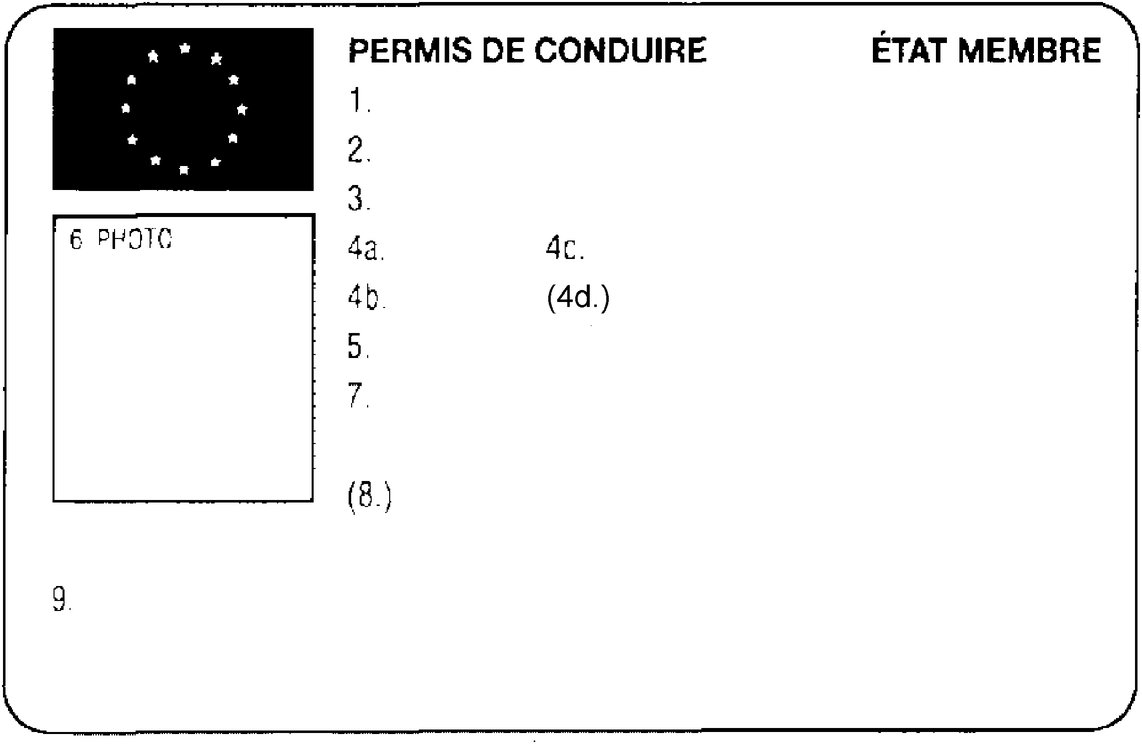
information specific to the licence issued, numbered as follows:

surname of the holder;

other name(s) of the holder;

date and place of birth;

date of issue of the licence;

date of expiry of the licence or a dash if the licence is valid indefinitely under the provision of Article 7(2)(c);

the name of the issuing authority (may be printed on page 2);

a different number from the one under heading 5, for administrative purposes (optional);

number of the licence;

photograph of the holder;

signature of the holder;

permanent place of residence, or postal address (optional);

category of vehicle(s) the holder is entitled to drive (national categories shall be printed in a different type from harmonised categories);

(e)

the words ‘European Communities model’ in the language(s) of the Member State issuing the licence and the words ‘Driving Licence’ in the other languages of the Community, printed in pink to form the background of the licence: Permiso de Conducción Řidičský průkaz Kørekort Führerschein Juhiluba Άδεια Οδήγησης Driving Licence Permis de conduire Ceadúas Tiomána Patente di guida Vadītāja apliecība Vairuotojo pažymėjimas Vezetői engedély Liċenzja tas-Sewqan Rijbewijs Prawo Jazdy Carta de Condução Vodičský preukaz Vozniško dovoljenje Ajokortti Körkort;

(f)

Colour references:

blue: Pantone Reflex Blue,

yellow: Pantone Yellow.

Page 2 shall contain:

(a)

The codes shall be as follows:

category of vehicle(s) the holder is entitled to drive (national categories shall be printed in a different type from harmonised categories);

date of first issue of each category (this date must be repeated on the new licence in the event of subsequent replacement or exchange);

date of expiry of each category;

additional information/restriction(s), in code form, facing the (sub)category affected.

codes 01 to 99

:

harmonised Community codes

DRIVER (Medical reasons)

01.

Sight correction and/or protection 01.01 Glasses 01.02 Contact lense(s) 01.03 Protective glass 01.04 Opaque lense 01.05 Eye cover 01.06 Glasses or contact lenses

02.

Hearing aid/communication aid 02.01 Hearing aid for one ear 02.02 Hearing aid for two ears

03.

Prosthesis/orthosis for the limbs 03.01 Upper limb prosthesis/orthosis 03.02 Lower limb prosthesis/orthosis

05.

Limited use (subcode use obligatory, driving subject to restrictions for medical reasons) 05.01 Limited to day time journeys (for example: one hour after sunrise and one hour before sunset) 05.02 Limited to journeys within a radius of ... km from holder's place of residence or only inside city/region 05.03 Driving without passengers 05.04 Limited to journeys with a speed not greater than ... km/h 05.05 Driving authorised solely when accompanied by a holder of a driving licence 05.06 Without trailer 05.07 No driving on motorways 05.08 No alcohol

VEHICLE ADAPTATIONS

10.

Modified transmission 10.01 Manual transmission 10.02 Automatic transmission 10.03 Electronically operated transmission 10.04 Adjusted gear-shift lever 10.05 Without secondary gearbox

15.

Modified clutch 15.01 Adjusted gear-shift lever 15.02 Manual clutch 15.03 Automatic clutch 15.04 Partitioning in front of/fold away/detached clutch pedal

20.

Modified braking systems 20.01 Adjusted brake pedal 20.02 Enlarged brake pedal 20.03 Brake pedal suitable for use by left foot 20.04 Brake pedal by sole 20.05 Tilted brake pedal 20.06 Manual (adapted) service brake 20.07 Maximum use of reinforced service brake 20.08 Maximum use of emergency brake integrated in the service brake 20.09 Adjusted parking brake 20.10 Electrically operated parking brake 20.11 (Adjusted) foot operated parking brake 20.12 Partitioning in front of/fold away/detached brake pedal 20.13 Brake operated by knee 20.14 Electrically operated service brake

25.

Modified accelerator systems 25.01 Adjusted accelerator pedal 25.02 Accelerator pedal by sole 25.03 Tilted accelerator pedal 25.04 Manual accelerator 25.05 Accelerator at knee 25.06 Servo accelerator (electronic, pneumatic, etc.) 25.07 Accelerator pedal on the left of brake pedal 25.08 Accelerator pedal on the left 25.09 Partitioning in front of/fold away/detached accelerator pedal

30.

Modified combined braking and accelerator systems 30.01 Parallel pedals 30.02 Pedals at (or almost at) the same level 30.03 Accelerator and brake with sliding 30.04 Accelerator and brake with sliding and orthesis 30.05 Fold away/detached accelerator and brake pedals 30.06 Raised floor 30.07 Partitioning on the side of the brake pedal 30.08 Partitioning for prosthesis on the side of the brake pedal 30.09 Partitioning in front of the accelerator and brake pedals 30.10 Heel/leg support 30.11 Electrically operated accelerator and brake

35.

Modified control layouts (Lights switches, windscreen wiper/washer, horn, direction indicators, etc.) 35.01 Control devices operable without negative influence on the steering and handling 35.02 Control devices operable without releasing the steering wheel and accessories (knob, fork, etc.) 35.03 Control devices operable without releasing the steering wheel and accessories (knob, fork, etc.) with the left hand 35.04 Control devices operable without releasing the steering wheel and accessories (knob, fork, etc.) with the right hand 35.05 Control devices operable without releasing the steering wheel and accessories (knob, fork, etc.) and the combined accelerator and braking mechanismss

40.

Modified steering 40.01 Standard assisted steering 40.02 Reinforced assisted steering 40.03 Steering with backup system 40.04 Lengthened steering column 40.05 Adjusted steering wheel (Larger and/or thicker steering wheel section, reduced diameter steering wheel, etc.) 40.06 Tilted steering wheel 40.07 Vertical steering wheel 40.08 Horizontal steering wheel 40.09 Foot operated driving 40.10 Alternative adjusted steering (joy-stick, etc.) 40.11 Knob on the steering wheel 40.12 Hand orthesis on the steering wheel 40.13 With orthesis tenodese

42.

Modified rearview mirror(s) 42.01 External (left or) right-side rear-view mirror 42.02 External rear-view mirror set on the wing 42.03 Additional inside rear-view mirror permitting view of traffic 42.04 Panoramic inside rear-view mirror 42.05 Blind spot rear-view mirror 42.06 Electrically operated outside rear-view mirror(s)

43.

Modified driver seat 43.01 Driver seat at a good viewing height and in normal distance from the steering wheel and the pedal 43.02 Driver seat adjusted to body shape 43.03 Driver seat with lateral support for good sitting stability 43.04 Driver seat with armrest 43.05 Lengthening of sliding driver's seat 43.06 Seat-belt adjustment 43.07 Harness-type seat-belt

44.

Modifications to motorcycles (subcode use obligatory) 44.01 Single operated brake 44.02 (Adjusted) hand operated brake (front wheel) 44.03 (Adjusted) foot operated brake (back wheel) 44.04 (Adjusted) accelerator handle 44.05 (Adjusted) manual transmission and manual clutch 44.06 (Adjusted) rear-view mirror(s) 44.07 (Adjusted) commands (direction indicators, braking light, ...) 44.08 Seat height allowing the driver, in sitting position, to have two feet on the road at the same time

45.

Motorcycle with side-car only

50.

Restricted to a specific vehicle/chassis number (vehicle identification number, VIN)

51.

Restricted to a specific vehicle/registration plate (vehicle registration number, VRN)

ADMINISTRATIVE MATTERS

70.

Exchange of licence No ... issued by ... (EU/UN distinguishing sign in the case of a third country; e.g: 70.0123456789.NL)

71.

Duplicate of licence No ... (EU/UN distinguishing sign in the case of a third country; e.g: 71.987654321.HR)

72.

Restricted to category A vehicles having a maximum cylinder capacity of 125 cc and maximum power of 11 KW (A1)

73.

Restricted to category B vehicles of the motor tricycle or quadricycle type (B1)

74.

Restricted to category C vehicles the maximum authorised mass of which does not exceed 7 500 kg (C1)

75.

Restricted to category D vehicles with not more than 16 seats, excluding the driver's seat (D1)

76.

Restricted to category C vehicles the maximum authorised mass of which does not exceed 7 500 kg (C1), attached to a trailer the maximum authorised mass of which exceeds 750 kg, provided that the maximum authorised mass of the vehicle train thus formed does not exceed 12 000 kg, and that the maximum authorised mass of the trailer does not exceed the unladen mass of the drawing vehicle (C1E)

77.

Restricted to category D vehicles with not more than 16 passenger seats, excluding the driver's seat (D1), attached to a trailer the maximum authorised mass of which exceeds 750 kg provided that (a) the maximum authorised mass of the vehicle train thus formed does not exceed 12 000 kg and the maximum authorised mass of the trailer does not exceed the unladen mass of the drawing vehicle and (b) the trailer is not used to carry passengers (D1E)

78.

Restricted to vehicles with automatic transmission

79.

(...) Restricted to vehicles which comply with the specifications indicated in brackets, in the context of the application of Article 10(1) of Directive 91/439/EEC

90.01

:

to the left

90.02

:

to the right

90.03

:

left

90.04

:

right

90.05

:

hand

90.06

:

foot

90.07

:

usable

95.

Driver holding CPC meeting the obligation of professional aptitude provided for by Directive 2003/59/EC until ... [e.g.: 95.01.01.2012]

96.

Driver having completed training or having passed a test of skills and behaviour in accordance with the provisions of Annex V.

codes 100 and above:

:

national codes valid only for driving in the territory of the Member State which issued the licence.

Where a code applies to all categories for which the licence is issued, it may be printed under headings 9, 10 and 11;

in implementation of section 4(a) of this Annex, a space reserved for the possible entry by the host Member State of information essential for administering the licence;

a space reserved for the possible entry by the Member State which issues the licence of information essential for administering the licence or related to road safety (optional). If the information relates to one of the headings defined in this Annex, it should be preceded by the number of the heading in question.

With the specific written agreement of the holder, information which is not related to the administration of the driving licence or road safety may also be added in this space; such addition shall not alter in any way the use of the model as a driving licence;

(b)

an explanation of the numbered items which appear on pages 1 and 2 of the licence (at least items 1, 2, 3, 4 (a), 4 (b), 4 (c), 5, 10, 11 and 12) If a Member State wishes to make the entries in a national language other than one of the following languages: Czech, Danish, Dutch, English, Estonian, Finnish, French, German, Greek, Hungarian, Italian, Latvian, Lithuanian, Maltese, Polish, Portuguese, Slovak, Slovenian, Spanish or Swedish, it shall draw up a bilingual version of the licence using one of the aforementioned languages, without prejudice to the other provisions of this Annex;

(c)

a space shall be reserved on the Community model licence to allow for the possible introduction of a microchip or similar computer device.

4. Special provisions

(a)

Where the holder of a driving licence issued by a Member State in accordance with this Annex has his normal place of residence in another Member State, that Member State may enter in the licence such information as is essential for administering it, provided that it also enters this type of information in the licences which it issues and provided that there remains enough space for the purpose.

(b)

After consulting the Commission, Member States may add colours or markings, such as bar codes and national symbols, without prejudice to the other provisions of this Annex. In the context of mutual recognition of licences, the bar code may not contain information other than what can already be read on the driving licence or which is essential to the process of issuing the licence.

COMMUNITY MODEL DRIVING LICENCE

Page 1 DRIVING LICENCE [MEMBER STATE]
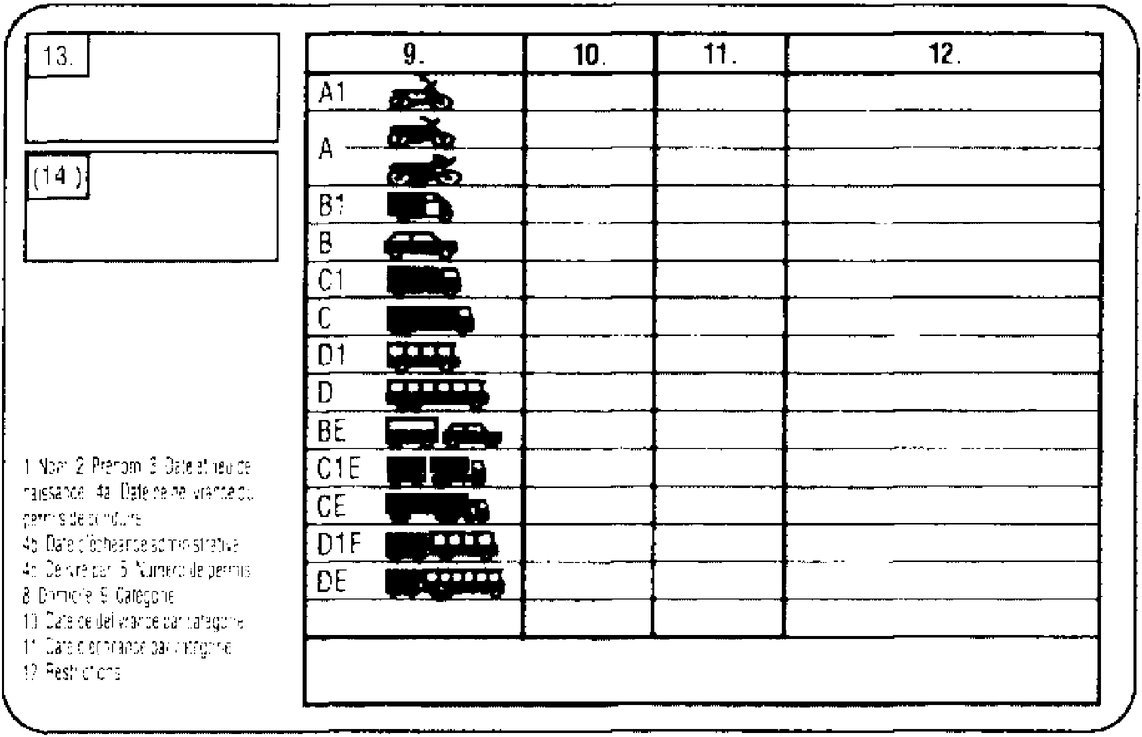
Page 2

1. Name 2. First name 3. Date and place of birth 4a. Date of issue of driving licence 4b. Official date of expiry 4c. Issued by 5. Serial number of licence 8. Place of residence 9. Category (1) 10. Date of issue, by category 11. Date of expiry, by category 12. Restrictions

SPECIMEN MODEL LICENCE

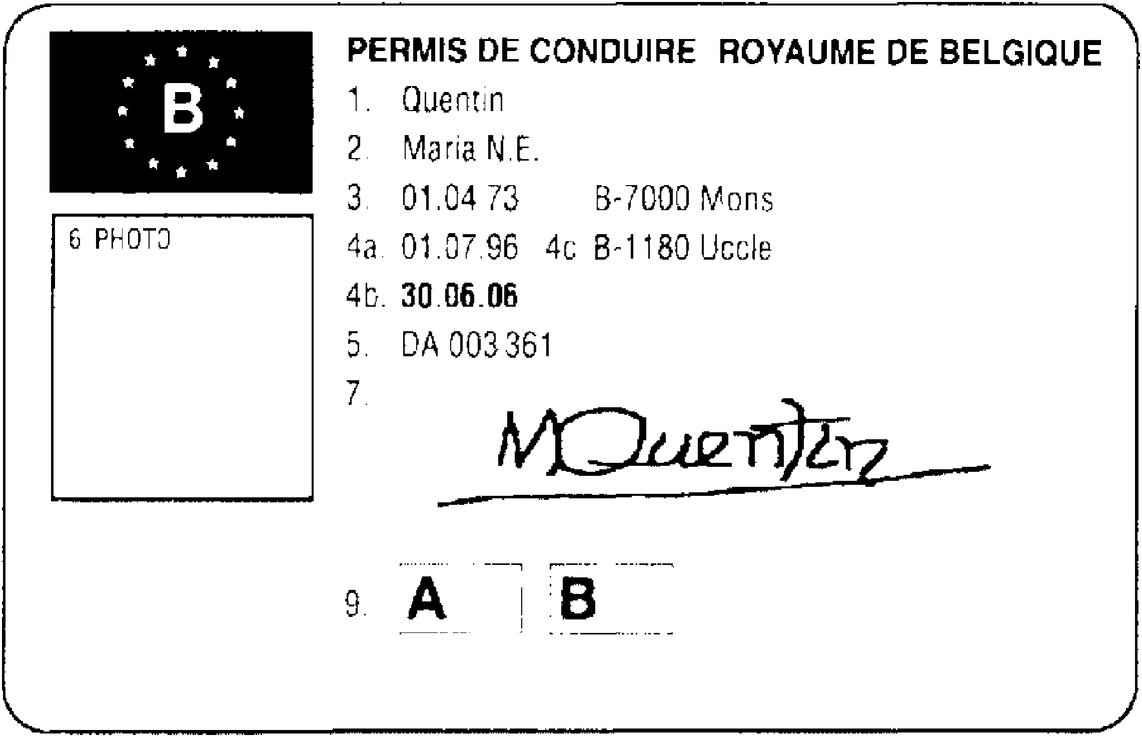
BELGIAN LICENCE (for information)
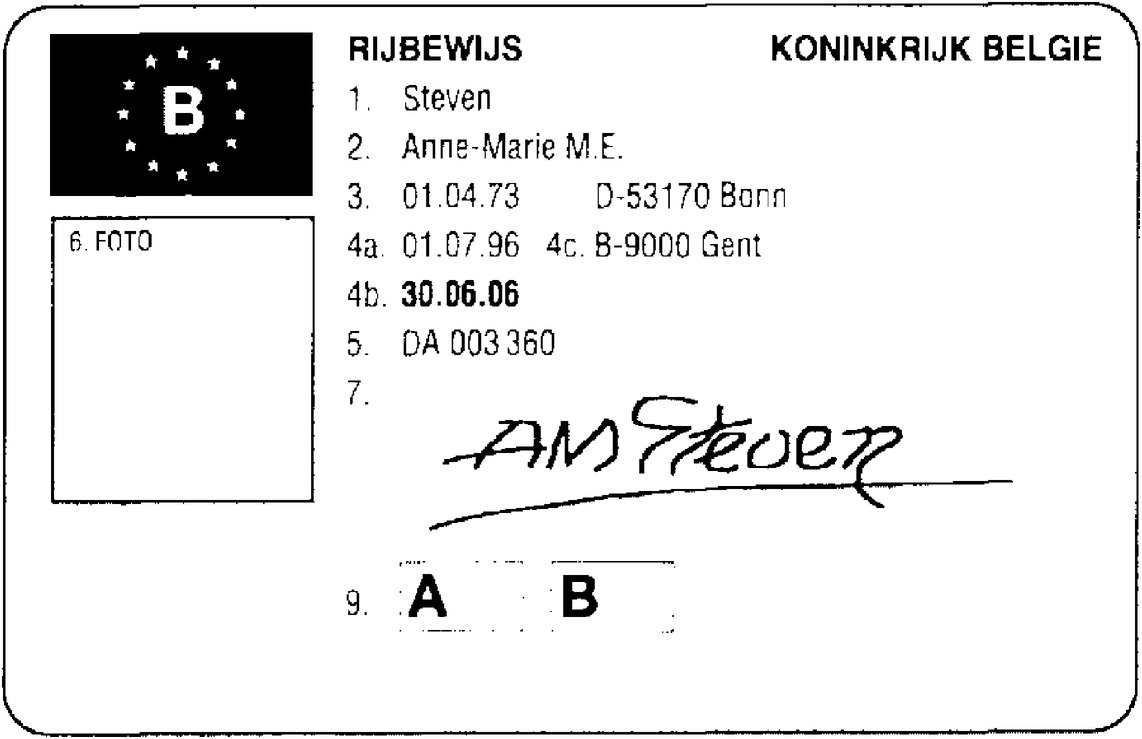
(1)

Note: a pictogram and a line for category AM will be added.

Note: the term ‘A2’ will be added to the section on motorcycle categories.

Official text · the act as published Open full page ↗
9 queries · page built in 33 msInventory f82bbfa3