For substances which have been incorporated in this Annex as a consequence of restrictions adopted in the framework of Directive 76/769/EEC (Entries 1 to 58), the restrictions shall not apply to storage, keeping, treatment, filling into containers, or transfer from one container to another of these substances for export, unless the manufacture of the substances is prohibited.
Column 1 Designation of the substance, of the group of substances or of the mixture | Column 2 Conditions of restriction |
1. Polychlorinated terphenyls (PCTs) | Shall not be placed on the market, or used: — as substances, — in mixtures, including waste oils, or in equipment, in concentrations greater than 50 mg/kg (0,005 % by weight). |
2. Chloroethene (vinyl chloride) CAS No 75-01-4 EC No 200-831-0 | Shall not be used as propellant in aerosols for any use. Aerosols dispensers containing the substance as propellant shall not be placed on the market. |
▼M6 | |
►M3 3. Liquid substances or mixtures ►M3 — ◄ fulfilling the criteria for any of the following hazard classes or categories set out in Annex I to Regulation (EC) No 1272/2008: (a) hazard classes 2.1 to 2.4, 2.6 and 2.7, 2.8 types A and B, 2.9, 2.10, 2.12, 2.13 categories 1 and 2, 2.14 categories 1 and 2, 2.15 types A to F; (b) hazard classes 3.1 to 3.6, 3.7 adverse effects on sexual function and fertility or on development, 3.8 effects other than narcotic effects, 3.9 and 3.10; (c) hazard class 4.1; (d) hazard class 5.1. ◄ | 1. Shall not be used in: — ornamental articles intended to produce light or colour effects by means of different phases, for example in ornamental lamps and ashtrays, — tricks and jokes, — games for one or more participants, or any article intended to be used as such, even with ornamental aspects, 2. Articles not complying with paragraph 1 shall not be placed on the market. ►M61 3. Shall not be placed on the market if they contain a colouring agent, unless required for fiscal reasons, or perfume, or both, if they: — can be used as fuel in decorative oil lamps for supply to the general public, and — present an aspiration hazard and are labelled with H304. ◄ 4. Decorative oil lamps for supply to the general public shall not be placed on the market unless they conform to the European Standard on Decorative oil lamps (EN 14059) adopted by the European Committee for Standardisation (CEN). ►M61 5. Without prejudice to the implementation of other Union provisions relating to the classification, labelling and packaging of substances and mixtures, suppliers shall ensure, before the placing on the market, that the following requirements are met: (a) lamp oils, labelled with H304, intended for supply to the general public are visibly, legibly and indelibly marked as follows: ‘Keep lamps filled with this liquid out of the reach of children’; and, by 1 December 2010, ‘Just a sip of lamp oil – or even sucking the wick of lamps – may lead to life-threatening lung damage’; (b) grill lighter fluids, labelled with H304, intended for supply to the general public are legibly and indelibly marked by 1 December 2010 as follows: ‘Just a sip of grill lighter fluid may lead to life threatening lung damage’; (c) lamps oils and grill lighters, labelled with H304, intended for supply to the general public are packaged in black opaque containers not exceeding 1 litre by 1 December 2010. ◄ ►M61 ◄ ►M61 ◄ |
▼M5 | |
4. Tris (2,3 dibromopropyl) phosphate CAS No 126-72-7 | 1. Shall not be used in textile articles, such as garments, undergarments and linen, intended to come into contact with the skin. 2. Articles not complying with paragraph 1 shall not be placed on the market. |
5. Benzene CAS No 71-43-2 EC No 200-753-7 | 1. Shall not be used in toys or parts of toys where the concentration of benzene in the free state is greater than 5 mg/kg (0,0005 %) of the weight of the toy or part of toy. 2. Toys and parts of toys not complying with paragraph 1 shall not be placed on the market. 3. Shall not be placed on the market, or used, — as a substance, — as a constituent of other substances, or in mixtures, in concentrations equal to, or greater than 0,1 % by weight. 4. However, paragraph 3 shall not apply to: (a) motor fuels which are covered by Directive 98/70/EC; (b) substances and mixtures for use in industrial processes not allowing for the emission of benzene in quantities in excess of those laid down in existing legislation; ►M33 (c) natural gas placed on the market for use by consumers, provided that the concentration of benzene remains below 0,1 % volume/volume. ◄ |
6. Asbestos fibres (a) Crocidolite CAS No 12001-28-4 (b) Amosite CAS No 12172-73-5 (c) Anthophyllite CAS No 77536-67-5 (d) Actinolite CAS No 77536-66-4 (e) Tremolite CAS No 77536-68-6 (f) Chrysotile CAS No 12001-29-5 CAS No 132207-32-0 | ►M37 1. The manufacture, placing on the market and use of these fibres and of articles and mixtures containing these fibres added intentionally is prohibited. However, if the use of diaphragms containing chrysotile for electrolysis installations in use on 13 July 2016 had been exempted by a Member State in accordance with the version of this paragraph in force until that date, the first subparagraph shall not apply until 1 July 2025 to the use in those installations of such diaphragms or of chrysotile used exclusively in the maintenance of such diaphragms, provided that such use is carried out in compliance with the conditions of a permit set in accordance with Directive 2010/75/EU of the European Parliament and of the Council (*17). Any downstream user benefiting from such an exemption shall send, by 31 January of each calendar year to the Member State in which the relevant electrolysis installation is located, a report indicating the amount of chrysotile used in diaphragms pursuant to the exemption. The Member State shall transmit a copy to the European Commission. Where, in order to protect the health and safety of workers, a Member State requires monitoring of chrysotile in air by downstream users, the results shall be included in that report. ◄ 2. The use of articles containing asbestos fibres referred to in paragraph 1 which were already installed and/or in service before 1 January 2005 shall continue to be permitted until they are disposed of or reach the end of their service life. However, Member States may, for reasons of protection of human health, restrict, prohibit or make subject to specific conditions, the use of such articles before they are disposed of or reach the end of their service life. Member States may allow placing on the market of articles in their entirety containing asbestos fibres referred to in paragraph 1 which were already installed and/or in service before 1 January 2005, under specific conditions ensuring a high level of protection of human health. Member States shall communicate these national measures to the Commission by 1 June 2011. The Commission shall make this information publicly available. 3. Without prejudice to the application of other Community provisions on the classification, packaging and labelling of substances and mixtures, the placing on the market and use of articles containing these fibres, as permitted according to the preceding derogations, shall be permitted only if suppliers ensure before the placing on the market that articles bear a label in accordance with Appendix 7 to this Annex. |
7. Tris(aziridinyl)phosphinoxide CAS No 545-55-1 EC No 208-892-5 | 1. Shall not be used in textile articles, such as garments, undergarments and linen, intended to come into contact with the skin. 2. Articles not complying with paragraph 1 shall not be placed on the market. |
8. Polybromobiphenyls; Polybrominatedbiphenyls (PBB) CAS No 59536-65-1 | 1. Shall not be used in textile articles, such as garments, undergarments and linen, intended to come into contact with the skin. 2. Articles not complying with paragraph 1 shall not be placed on the market. |
9. (a) Soap bark powder (Quillaja saponaria) and its derivatives containing saponines CAS No 68990-67-0 EC 273-620-4 (b) Powder of the roots of Helleborus viridis and Helleborus niger (c) Powder of the roots of Veratrum album and Veratrum nigrum (d) Benzidine and/or its derivatives CAS No 92-87-5 EC No 202-199-1 (e) o-Nitrobenzaldehyde CAS No 552-89-6 EC No 209-025-3 (f) Wood powder | 1. Shall not be used, in jokes and hoaxes or in mixtures or articles intended to be used as such, for instance as a constituent of sneezing powder and stink bombs. 2. Jokes and hoaxes, or mixtures or articles intended to be used as such, not complying with paragraph 1 shall not be placed on the market. 3. However, paragraphs 1 and 2 shall not apply to stink bombs containing not more than 1,5 ml of liquid. |
10. (a) Ammonium sulphide CAS No 12135-76-1 EC No 235-223-4 (b) Ammonium hydrogen sulphide CAS No 12124-99-1 EC No 235-184-3 (c) Ammonium polysulphide CAS No 9080-17-5 EC No 232-989-1 | 1. Shall not be used, in jokes and hoaxes or in mixtures or articles intended to be used as such, for instance as a constituent of sneezing powder and stink bombs. 2. Jokes and hoaxes, or mixtures or articles intended to be used as such, not complying with paragraph 1 shall not be placed on the market. 3. However, paragraphs 1 and 2 shall not apply to stink bombs containing not more than 1,5 ml of liquid. |
11. Volatile esters of bromoacetic acids: (a) Methyl bromoacetate CAS No 96-32-2 EC No 202-499-2 (b) Ethyl bromoacetate CAS No 105-36-2 EC No 203-290-9 (c) Propyl bromoacetate CAS No 35223-80-4 (d) Butyl bromoacetate CAS No 18991-98-5 EC No 242-729-9 | 1. Shall not be used, in jokes and hoaxes or in mixtures or articles intended to be used as such, for instance as a constituent of sneezing powder and stink bombs. 2. Jokes and hoaxes, or mixtures or articles intended to be used as such, not complying with paragraph 1 shall not be placed on the market. 3. However, paragraphs 1 and 2 shall not apply to stink bombs containing not more than 1,5 ml of liquid. |
12. 2-Naphthylamine CAS No 91-59-8 EC No 202-080-4 and its salts 13. Benzidine CAS No 92-87-5 EC No 202-199-1 and its salts 14. 4-Nitrobiphenyl CAS No 92-93-3 Einecs EC No 202-204-7 15. 4-Aminobiphenyl xenylamine CAS No 92-67-1 Einecs EC No 202-177-1 and its salts | The following shall apply to entries 12 to 15: Shall not be placed on the market, or used, as substances or in mixtures in concentrations greater than 0,1 % by weight. |
16. Lead carbonates: (a) Neutral anhydrous carbonate (PbCO3) CAS No 598-63-0 EC No 209-943-4 (b) Trilead-bis(carbonate)-dihydroxide 2Pb CO3-Pb(OH)2 CAS No 1319-46-6 EC No 215-290-6 | Shall not be placed on the market, or used, as substances or in mixtures, where the substance or mixture is intended for use as paint. ►M21 However, Member States may, in accordance with the provisions of International Labour Organization (ILO) Convention 13, permit the use on their territory of the substance or mixture for the restoration and maintenance of works of art and historic buildings and their interiors, as well as the placing on the market for such use. Where a Member State makes use of this derogation, it shall inform the Commission thereof. ◄ |
17. Lead sulphates: (a) PbSO4 CAS No 7446-14-2 EC No 231-198-9 (b) Pbx SO4 CAS No 15739-80-7 EC No 239-831-0 | Shall not be placed on the market, or used, as substances or in mixtures, where the substance or mixture is intended for use as paint. ►M21 However, Member States may, in accordance with the provisions of International Labour Organization (ILO) Convention 13, permit the use on their territory of the substance or mixture for the restoration and maintenance of works of art and historic buildings and their interiors, as well as the placing on the market for such use. Where a Member State makes use of this derogation, it shall inform the Commission thereof. ◄ |
18. Mercury compounds | Shall not be placed on the market, or used, as substances or in mixtures where the substance or mixture is intended for use: (a) to prevent the fouling by micro-organisms, plants or animals of: — the hulls of boats, — cages, floats, nets and any other appliances or equipment used for fish or shellfish farming, — any totally or partly submerged appliances or equipment; (b) in the preservation of wood; (c) in the impregnation of heavy-duty industrial textiles and yarn intended for their manufacture; (d) in the treatment of industrial waters, irrespective of their use. |
18a. Mercury CAS No 7439-97-6 EC No 231-106-7 | 1. Shall not be placed on the market: (a) in fever thermometers; (b) in other measuring devices intended for sale to the general public (such as manometers, barometers, sphygmomanometers, thermometers other than fever thermometers). 2. The restriction in paragraph 1 shall not apply to measuring devices that were in use in the Community before 3 April 2009. However Member States may restrict or prohibit the placing on the market of such measuring devices. 3. The restriction in paragraph 1(b) shall not apply to: (a) measuring devices more than 50 years old on 3 October 2007; (b) barometers (except barometers within point (a)) until 3 October 2009. ►M19 ◄ ►M19 5. The following mercury-containing measuring devices intended for industrial and professional uses shall not be placed on the market after 10 April 2014: (a) barometers; (b) hygrometers; (c) manometers; (d) sphygmomanometers; (e) strain gauges to be used with plethysmographs; (f) tensiometers; (g) thermometers and other non-electrical thermometric applications. The restriction shall also apply to measuring devices under points (a) to (g) which are placed on the market empty if intended to be filled with mercury. 6. The restriction in paragraph 5 shall not apply to: (a) sphygmomanometers to be used: (i) in epidemiological studies which are ongoing on 10 October 2012; (ii) as reference standards in clinical validation studies of mercury-free sphygmomanometers; (b) thermometers exclusively intended to perform tests according to standards that require the use of mercury thermometers until 10 October 2017; (c) mercury triple point cells which are used for the calibration of platinum resistance thermometers. 7. The following mercury-using measuring devices intended for professional and industrial uses shall not be placed on the market after 10 April 2014: (a) mercury pycnometers; (b) mercury metering devices for determination of the softening point. 8. The restrictions in paragraphs 5 and 7 shall not apply to: (a) measuring devices more than 50 years old on 3 October 2007; (b) measuring devices which are to be displayed in public exhibitions for cultural and historical purposes. ◄ |
19. Arsenic compounds | 1. Shall not be placed on the market, or used, as substances or in mixtures where the substance or mixture is intended for use to prevent the fouling by micro-organisms, plants or animals of: — the hulls of boats, — cages, floats, nets and any other appliances or equipment used for fish or shellfish farming, — any totally or partly submerged appliances or equipment. 2. Shall not be placed on the market, or used, as substances or in mixtures where the substance or mixture is intended for use in the treatment of industrial waters, irrespective of their use. 3. Shall not be used in the preservation of wood. Furthermore, wood so treated shall not be placed on the market. 4. By way of derogation from paragraph 3: (a) Relating to the substances and mixtures for the preservation of wood: these may only be used in industrial installations using vacuum or pressure to impregnate wood if they are solutions of inorganic compounds of the copper, chromium, arsenic (CCA) type C and if they are authorised in accordance with Article 5(1) of Directive 98/8/EC. Wood so treated shall not be placed on the market before fixation of the preservative is completed. (b) Wood treated with CCA solution in accordance with point (a) may be placed on the market for professional and industrial use provided that the structural integrity of the wood is required for human or livestock safety and skin contact by the general public during its service life is unlikely: — as structural timber in public and agricultural buildings, office buildings, and industrial premises, — in bridges and bridgework, — as constructional timber in freshwater areas and brackish waters, for example jetties and bridges, — as noise barriers, — in avalanche control, — in highway safety fencing and barriers, — as debarked round conifer livestock fence posts, — in earth retaining structures, — as electric power transmission and telecommunications poles, — as underground railway sleepers. (c) Without prejudice to the application of other Community provisions on the classification, packaging and labelling of substances and mixtures, suppliers shall ensure before the placing on the market that all treated wood placed on the market is individually labelled ‘For professional and industrial installation and use only, contains arsenic’. In addition, all wood placed on the market in packs shall also bear a label stating ‘Wear gloves when handling this wood. Wear a dust mask and eye protection when cutting or otherwise crafting this wood. Waste from this wood shall be treated as hazardous by an authorised undertaking’. (d) Treated wood referred to under point (a) shall not be used: — in residential or domestic constructions, whatever the purpose, — in any application where there is a risk of repeated skin contact, — in marine waters, — for agricultural purposes other than for livestock fence posts and structural uses in accordance with point (b), — in any application where the treated wood may come into contact with intermediate or finished products intended for human and/or animal consumption. 5. Wood treated with arsenic compounds that was in use in the Community before 30 September 2007, or that was placed on the market in accordance with paragraph 4 may remain in place and continue to be used until it reaches the end of its service life. 6. Wood treated with CCA type C that was in use in the Community before 30 September 2007, or that was placed on the market in accordance with paragraph 4: — may be used or reused subject to the conditions pertaining to its use listed under points 4(b), (c) and (d), — may be placed on the market subject to the conditions pertaining to its use listed under points 4(b), (c) and (d). 7. Member States may allow wood treated with other types of CCA solutions that was in use in the Community before 30 September 2007: — to be used or reused subject to the conditions pertaining to its use listed under points 4 (b), (c) and (d), — to be placed on the market subject to the conditions pertaining to its use listed under points 4(b), (c) and (d). |
20. Organostannic compounds | 1. Shall not be placed on the market, or used, as substances or in mixtures where the substance or mixture is acting as biocide in free association paint. 2. Shall not be placed on the market, or used, as substances or in mixtures where the substance or mixture acts as biocide to prevent the fouling by micro-organisms, plants or animals of: (a) all craft irrespective of their length intended for use in marine, coastal, estuarine and inland waterways and lakes; (b) cages, floats, nets and any other appliances or equipment used for fish or shellfish farming; (c) any totally or partly submerged appliance or equipment. 3. Shall not be placed on the market, or used, as substances or in mixtures where the substance or mixture is intended for use in the treatment of industrial waters. ►M6 4. Tri-substituted organostannic compounds: (a) Tri-substituted organostannic compounds such as tributyltin (TBT) compounds and triphenyltin (TPT) compounds shall not be used after 1 July 2010 in articles where the concentration in the article, or part thereof, is greater than the equivalent of 0,1 % by weight of tin. (b) Articles not complying with point (a) shall not be placed on the market after 1 July 2010, except for articles that were already in use in the Community before that date. 5. Dibutyltin (DBT) compounds: (a) Dibutyltin (DBT) compounds shall not be used after 1 January 2012 in mixtures and articles for supply to the general public where the concentration in the mixture or the article, or part thereof, is greater than the equivalent of 0,1 % by weight of tin. (b) Articles and mixtures not complying with point (a) shall not be placed on the market after 1 January 2012, except for articles that were already in use in the Community before that date. (c) By way of derogation, points (a) and (b) shall not apply until 1 January 2015 to the following articles and mixtures for supply to the general public: — one-component and two-component room temperature vulcanisation sealants (RTV-1 and RTV-2 sealants) and adhesives, — paints and coatings containing DBT compounds as catalysts when applied on articles, — soft polyvinyl chloride (PVC) profiles whether by themselves or coextruded with hard PVC, — fabrics coated with PVC containing DBT compounds as stabilisers when intended for outdoor applications, — outdoor rainwater pipes, gutters and fittings, as well as covering material for roofing and façades, (d) By way of derogation, points (a) and (b) shall not apply to materials and articles regulated under Regulation (EC) No 1935/2004. 6. Dioctyltin (DOT) compound: (a) Dioctyltin (DOT) compounds shall not be used after 1 January 2012 in the following articles for supply to, or use by, the general public, where the concentration in the article, or part thereof, is greater than the equivalent of 0,1 % by weight of tin: — textile articles intended to come into contact with the skin, — gloves, — footwear or part of footwear intended to come into contact with the skin, — wall and floor coverings, — childcare articles, — female hygiene products, — nappies, — two-component room temperature vulcanisation moulding kits (RTV-2 moulding kits). (b) Articles not complying with point (a) shall not be placed on the market after 1 January 2012, except for articles that were already in use in the Community before that date. ◄ |
21. Di-μ-oxo-di-n-butylstanniohydroxyborane/Dibutyltin hydrogen borate C8H19BO3Sn (DBB) CAS No 75113-37-0 EC No 401-040-5 | Shall not be placed on the market, or used, as a substance, or in mixtures in a concentration equal to, or greater than 0,1 % by weight. However, the first paragraph shall not apply to this substance (DBB) or mixtures containing it if these are intended solely for conversion into articles, among which this substance will no longer feature in a concentration equal to or greater than 0,1 %. |
▼M61 ————— | |
▼M5 | |
23. Cadmium CAS No 7440-43-9 EC No 231-152-8 and its compounds | For the purpose of this entry, the codes and chapters indicated in square brackets are the codes and chapters of the tariff and statistical nomenclature of Common Customs Tariff as established by Council Regulation (EEC) No 2658/87 (*1). ►M13 1. Shall not be used in mixtures and articles produced from the following synthetic organic polymers (hereafter referred to as plastic material): — polymers or copolymers of vinyl chloride (PVC) [3904 10] [3904 21] — polyurethane (PUR) [3909 50] — low-density polyethylene (LDPE), with the exception of low-density polyethylene used for the production of coloured masterbatch [3901 10] — cellulose acetate (CA) [3912 11] — cellulose acetate butyrate (CAB) [3912 11] — epoxy resins [3907 30] — melamine-formaldehyde (MF) resins [3909 20] — urea-formaldehyde (UF) resins [3909 10] — unsaturated polyesters (UP) [3907 91] — polyethylene terephthalate (PET) [3907 60] — polybutylene terephthalate (PBT) — transparent/general-purpose polystyrene [3903 11] — acrylonitrile methylmethacrylate (AMMA) — cross-linked polyethylene (VPE) — high-impact polystyrene — polypropylene (PP) [3902 10] Mixtures and articles produced from plastic material as listed above shall not be placed on the market if the concentration of cadmium (expressed as Cd metal) is equal to or greater than 0,01 % by weight of the plastic material. By way of derogation, the second subparagraph shall not apply to articles placed on the market before 10 December 2011. The first and second subparagraphs apply without prejudice to Council Directive 94/62/EC (*13) and acts adopted on its basis. By 19 November 2012, in accordance with Article 69, the Commission shall ask the European Chemicals Agency to prepare a dossier conforming to the requirements of Annex XV in order to assess whether the use of cadmium and its compounds in plastic material, other than that listed in subparagraph 1, should be restricted. ►M35 2. Shall not be used or placed on the market in paints with codes [3208] [3209] in a concentration (expressed as Cd metal) equal to or greater than 0,01 % by weight. For paints with codes [3208] [3209] with a zinc content exceeding 10 % by weight of the paint, the concentration of cadmium (expressed as Cd metal) shall not be equal to or greater than 0,1 % by weight. Painted articles shall not be placed on the market if the concentration of cadmium (expressed as Cd metal) is equal to or greater than 0,1 % by weight of the paint on the painted article. ◄ 3. By way of derogation, paragraphs 1 and 2 shall not apply to articles coloured with mixtures containing cadmium for safety reasons. 4. By way of derogation, paragraph 1, second subparagraph shall not apply to: — mixtures produced from PVC waste, hereinafter referred to as ‘recovered PVC’, — mixtures and articles containing recovered PVC if their concentration of cadmium (expressed as Cd metal) does not exceed 0,1 % by weight of the plastic material in the following rigid PVC applications: — (a) profiles and rigid sheets for building applications; (b) doors, windows, shutters, walls, blinds, fences, and roof gutters; (c) decks and terraces; (d) cable ducts; (e) pipes for non-drinking water if the recovered PVC is used in the middle layer of a multilayer pipe and is entirely covered with a layer of newly produced PVC in compliance with paragraph 1 above. Suppliers shall ensure, before the placing on the market of mixtures and articles containing recovered PVC for the first time, that these are visibly, legibly and indelibly marked as follows: ‘Contains recovered PVC’ or with the following pictogram: \mathrm{PVC} In accordance with Article 69 of this Regulation, the derogation granted in paragraph 4 will be reviewed, in particular with a view to reducing the limit value for cadmium and to reassess the derogation for the applications listed in points (a) to (e), by 31 December 2017. ◄ 5. For the purpose of this entry, ‘cadmium plating’ means any deposit or coating of metallic cadmium on a metallic surface. Shall not be used for cadmium plating metallic articles or components of the articles used in the following sectors/applications: (a) equipment and machinery for: — food production [8210] [8417 20] [8419 81] [8421 11] [8421 22] [8422] [8435] [8437] [8438] [8476 11] — agriculture [8419 31] [8424 81] [8432] [8433] [8434] [8436] — cooling and freezing [8418] — printing and book-binding [8440] [8442] [8443] (b) equipment and machinery for the production of: — household goods [7321] [8421 12] [8450] [8509] [8516] — furniture [8465] [8466] [9401] [9402] [9403] [9404] — sanitary ware [7324] — central heating and air conditioning plant [7322] [8403] [8404] [8415] In any case, whatever their use or intended final purpose, the placing on the market of cadmium-plated articles or components of such articles used in the sectors/applications listed in points (a) and (b) above and of articles manufactured in the sectors listed in point (b) above is prohibited. 6. The provisions referred to in paragraph 5 shall also be applicable to cadmium-plated articles or components of such articles when used in the sectors/applications listed in points (a) and (b) below and to articles manufactured in the sectors listed in (b) below: (a) equipment and machinery for the production of: — paper and board [8419 32] [8439] [8441] textiles and clothing [8444] [8445] [8447] [8448] [8449] [8451] [8452] (b) equipment and machinery for the production of: — industrial handling equipment and machinery [8425] [8426] [8427] [8428] [8429] [8430] [8431] — road and agricultural vehicles [chapter 87] — rolling stock [chapter 86] — vessels [chapter 89] 7. However, the restrictions in paragraphs 5 and 6 shall not apply to: — articles and components of the articles used in the aeronautical, aerospace, mining, offshore and nuclear sectors whose applications require high safety standards and in safety devices in road and agricultural vehicles, rolling stock and vessels, — electrical contacts in any sector of use, where that is necessary to ensure the reliability required of the apparatus on which they are installed. ►M13 8. Shall not be used in brazing fillers in concentration equal to or greater than 0,01 % by weight. Brazing fillers shall not be placed on the market if the concentration of cadmium (expressed as Cd metal) is equal to or greater than 0,01 % by weight. For the purpose of this paragraph brazing shall mean a joining technique using alloys and undertaken at temperatures above 450 °C. 9. By way of derogation, paragraph 8 shall not apply to brazing fillers used in defence and aerospace applications and to brazing fillers used for safety reasons. 10. Shall not be used or placed on the market if the concentration is equal to or greater than 0,01 % by weight of the metal in: (i) metal beads and other metal components for jewellery making; (ii) metal parts of jewellery and imitation jewellery articles and hair accessories, including: — bracelets, necklaces and rings, — piercing jewellery, — wrist-watches and wrist-wear, — brooches and cufflinks. ►C5 11. By way of derogation, paragraph 10 shall not apply to articles placed on the market before 10 December 2011 and jewellery more than 50 years old on 10 December 2011. ◄ ◄ |
24. Monomethyl — tetrachlorodiphenyl methane Trade name: Ugilec 141 CAS No 76253-60-6 | 1. Shall not be placed on the market, or used, as a substance or in mixtures. Articles containing the substance shall not be placed on the market. 2. By way of derogation, paragraph 1 shall not apply: (a) in the case of plant and machinery already in service on 18 June 1994, until such plant and machinery is disposed of; (b) in the case of the maintenance of plant and machinery already in service within a Member State on 18 June 1994. For the purposes of point (a) Member States may, on grounds of human health protection and environmental protection, prohibit within their territory the use of such plant or machinery before it is disposed of. |
25. Monomethyl-dichloro-diphenyl methane Trade name: Ugilec 121 Ugilec 21 | Shall not be placed on the market, or used, as a substance or in mixtures. Articles containing the substance shall not be placed on the market. |
26. Monomethyl-dibromo-diphenyl methane bromobenzylbromotoluene, mixture of isomers Trade name: DBBT CAS No 99688-47-8 | Shall not be placed on the market, or used, as a substance or in mixtures. Articles containing the substance shall not be placed on the market. |
27. Nickel CAS No 7440-02-0 EC No 231-111-4 and its compounds | 1. Shall not be used: (a) in any post assemblies which are inserted into pierced ears and other pierced parts of the human body unless the rate of nickel release from such post assemblies is less than 0,2 μg/cm2/week (migration limit); (b) in articles intended to come into direct and prolonged contact with the skin such as: — earrings, — necklaces, bracelets and chains, anklets, finger rings, — wrist-watch cases, watch straps and tighteners, — rivet buttons, tighteners, rivets, zippers and metal marks, when these are used in garments, if the rate of nickel release from the parts of these articles coming into direct and prolonged contact with the skin is greater than 0,5 μg/cm2/week. (c) in articles referred to in point (b) where these have a non-nickel coating unless such coating is sufficient to ensure that the rate of nickel release from those parts of such articles coming into direct and prolonged contact with the skin will not exceed 0,5 μg/cm2/week for a period of at least two years of normal use of the article. 2. Articles which are the subject of paragraph 1 shall not be placed on the market unless they conform to the requirements set out in that paragraph. 3. The standards adopted by the European Committee for Standardisation (CEN) shall be used as the test methods for demonstrating the conformity of articles to paragraphs 1 and 2. |
►M49 28. Substances which are classified as carcinogen category 1A or 1B in Part 3 of Annex VI to Regulation (EC) No 1272/2008 and are listed in Appendix 1 or Appendix 2, respectively. 29. Substances which are classified as germ cell mutagen category 1A or 1B in Part 3 of Annex VI to Regulation (EC) No 1272/2008 and are listed in Appendix 3 or Appendix 4, respectively. 30. Substances which are classified as reproductive toxicant category 1A or 1B in Part 3 of Annex VI to Regulation (EC) No 1272/2008 and are listed in Appendix 5 or Appendix 6, respectively. ◄ | Without prejudice to the other parts of this Annex the following shall apply to entries 28 to 30: 1. Shall not be placed on the market, or used, — as substances, — as constituents of other substances, or, — in mixtures, for supply to the general public when the individual concentration in the substance or mixture is equal to or greater than: — either the relevant specific concentration limit specified in Part 3 of Annex VI to Regulation (EC) No 1272/2008, or, ►M3 — the relevant generic concentration limit specified in Part 3 of Annex I of Regulation (EC) No 1272/2008. ◄ Without prejudice to the implementation of other Community provisions relating to the classification, packaging and labelling of substances and mixtures, suppliers shall ensure before the placing on the market that the packaging of such substances and mixtures is marked visibly, legibly and indelibly as follows: ‘Restricted to professional users’. 2. By way of derogation, paragraph 1 shall not apply to: (a) medicinal or veterinary products as defined by Directive 2001/82/EC and Directive 2001/83/EC; (b) cosmetic products as defined by Directive 76/768/EEC; (c) the following fuels and oil products: — motor fuels which are covered by Directive 98/70/EC, — mineral oil products intended for use as fuel in mobile or fixed combustion plants, — fuels sold in closed systems (e.g. liquid gas bottles); ►M3 (d) artists’ paints covered by Regulation (EC) No 1272/2008; ◄ ►M14 (e) the substances listed in Appendix 11, column 1, for the applications or uses listed in Appendix 11, column 2. Where a date is specified in column 2 of Appendix 11, the derogation shall apply until the said date; ◄ ►M61 (f) devices covered by Regulation (EU) 2017/745. ◄ |
31. (a) Creosote; wash oil CAS No 8001-58-9 EC No 232-287-5 (b) Creosote oil; wash oil CAS No 61789-28-4 EC No 263-047-8 (c) Distillates (coal tar), naphthalene oils; naphthalene oil CAS No 84650-04-4 EC No 283-484-8 (d) Creosote oil, acenaphthene fraction; wash oil CAS No 90640-84-9 EC No 283-484-8EC No 292-605-3 (e) Distillates (coal tar), upper; heavy anthracene oil CAS No 65996-91-0 EC No 266-026-1 (f) Anthracene oil CAS No 90640-80-5 EC No 292-602-7 (g) Tar acids, coal, crude; crude phenols CAS No 65996-85-2 EC No 266-019-3 (h) Creosote, wood CAS No 8021-39-4 EC No 232-419-1 (i) Low temperature tar oil, alkaline; extract residues (coal), low temperature coal tar alkaline CAS No 122384-78-5 EC No 310-191-5 | 1. Shall not be placed on the market, or used, as substances or in mixtures where the substance or mixture is intended for the treatment of wood. Furthermore, wood so treated shall not be placed on the market. 2. By way of derogation from paragraph 1: (a) The substances and mixtures may be used for wood treatment in industrial installations or by professionals covered by Community legislation on the protection of workers for in situ retreatment only if they contain: (i) benzo[a]pyrene at a concentration of less than 50 mg/kg (0,005 % by weight), and (ii) water extractable phenols at a concentration of less than 3 % by weight. Such substances and mixtures for use in wood treatment in industrial installations or by professionals: — may be placed on the market only in packaging of a capacity equal to or greater than 20 litres, — shall not be sold to consumers. Without prejudice to the application of other Community provisions on the classification, packaging and labelling of substances and mixtures, suppliers shall ensure before the placing on the market that the packaging of such substances and mixtures is visibly, legibly and indelibly marked as follows: ‘For use in industrial installations or professional treatment only’. (b) Wood treated in industrial installations or by professionals according to subparagraph (a) which is placed on the market for the first time or retreated in situ may be used for professional and industrial use only, for example on railways, in electric power transmission and telecommunications, for fencing, for agricultural purposes (for example stakes for tree support) and in harbours and waterways. (c) The prohibition in paragraph 1 on the placing on the market shall not apply to wood which has been treated with substances listed in entry 31 (a) to (i) before 31 December 2002 and is placed on the second-hand market for re-use. 3. Treated wood referred to under paragraph 2(b) and (c) shall not be used: — inside buildings, whatever their purpose, — in toys, — in playgrounds, — in parks, gardens, and outdoor recreational and leisure facilities where there is a risk of frequent skin contact, — in the manufacture of garden furniture such as picnic tables, — for the manufacture and use and any re-treatment of: — — containers intended for growing purposes, — packaging that may come into contact with raw materials, intermediate or finished products destined for human and/or animal consumption, — other materials which may contaminate the articles mentioned above. |
32. Chloroform CAS No 67-66-3 EC No 200-663-8 34. 1,1,2-Trichloroethane CAS No 79-00-5 EC No 201-166-9 35. 1,1,2,2-Tetrachloroethane CAS No 79-34-5 EC No 201-197-8 36. 1,1,1,2-Tetrachloroethane CAS No 630-20-6 37. Pentachloroethane CAS No 76-01-7 EC No 200-925-1 38. 1,1-Dichloroethene CAS No 75-35-4 EC No 200-864-0 | Without prejudice to the other parts of this Annex, the following shall apply to entries 32 to 38. 1. Shall not be placed on the market, or used, — as substances, — as constituents of other substances, or in mixtures in concentrations equal to or greater than 0,1 % by weight, where the substance or mixture is intended for supply to the general public and/or is intended for diffusive applications such as in surface cleaning and cleaning of fabrics. 2. Without prejudice to the application of other Community provisions on the classification, packaging and labelling of substances and mixtures, suppliers shall ensure before the placing on the market that the packaging of such substances and mixtures containing them in concentrations equal to or greater than 0,1 % by weight is visibly, legibly and indelibly marked as follows: ‘For use in industrial installations only’. By way of derogation this provision shall not apply to: (a) medicinal or veterinary products as defined by Directive 2001/82/EC and Directive 2001/83/EC; (b) cosmetic products as defined by Directive 76/768/EEC. |
►M3 40. Substances classified as flammable gases category 1 or 2, flammable liquids categories 1, 2 or 3, flammable solids category 1 or 2, substances and mixtures which, in contact with water, emit flammable gases, category 1, 2 or 3, pyrophoric liquids category 1 or pyrophoric solids category 1, regardless of whether they appear in Part 3 of Annex VI ►M21 to Regulation (EC) No 1272/2008 ◄ or not. ◄ | 1. Shall not be used, as substance or as mixtures in aerosol dispensers where these aerosol dispensers are intended for supply to the general public for entertainment and decorative purposes such as the following: — metallic glitter intended mainly for decoration, — artificial snow and frost, — ‘whoopee’ cushions, — silly string aerosols, — imitation excrement, — horns for parties, — decorative flakes and foams, — artificial cobwebs, — stink bombs. 2. Without prejudice to the application of other Community provisions on the classification, packaging and labelling of substances, suppliers shall ensure before the placing on the market that the packaging of aerosol dispensers referred to above is marked visibly, legibly and indelibly with: ‘For professional users only’. 3. By way of derogation, paragraphs 1 and 2 shall not apply to the aerosol dispensers referred to Article 8 (1a) of Council Directive 75/324/EEC (*2). 4. The aerosol dispensers referred to in paragraphs 1 and 2 shall not be placed on the market unless they conform to the requirements indicated. |
41. Hexachloroethane CAS No 67-72-1 EC No 200-666-4 | Shall not be placed on the market, or used, as substance or in mixtures, where the substance or mixture is intended for the manufacturing or processing of non-ferrous metals. |
▼M21 ————— | |
▼M5 | |
43. Azocolourants and Azodyes | 1. Azodyes which, by reductive cleavage of one or more azo groups, may release one or more of the aromatic amines listed in Appendix 8, in detectable concentrations, i.e. above 30 mg/kg (0,003 % by weight) in the articles or in the dyed parts thereof, according to the testing methods listed in Appendix 10, shall not be used, in textile and leather articles which may come into direct and prolonged contact with the human skin or oral cavity, such as: — clothing, bedding, towels, hairpieces, wigs, hats, nappies and other sanitary items, sleeping bags, — footwear, gloves, wristwatch straps, handbags, purses/wallets, briefcases, chair covers, purses worn round the neck, — textile or leather toys and toys which include textile or leather garments, — yarn and fabrics intended for use by the final consumer. 2. Furthermore, the textile and leather articles referred to in paragraph 1 shall not be placed on the market unless they conform to the requirements set out in that paragraph. 3. Azodyes, which are contained in Appendix 9, ‘List of azodyes’ shall not be placed on the market, or used, as substances, or in mixtures in concentrations greater than 0,1 % by weight, where the substance or the mixture is intended for colouring textile and leather articles. |
▼M9 ————— | |
▼M5 | |
45. Diphenylether, octabromo derivative C12H2Br8O | 1. Shall not be placed on the market, or used: — as a substance, — as a constituent of other substances, or in mixtures, in concentrations greater than 0,1 % by weight. 2. Articles shall not be placed on the market if they, or flame-retardant parts thereof, contain this substance in concentrations greater than 0,1 % by weight. 3. By way of derogation, paragraph 2 shall not apply: — to articles that were in use in the Community before 15 August 2004, — to electrical and electronic equipment within the scope of Directive 2002/95/EC. |
46. (a) Nonylphenol C6H4(OH)C9H19 (b) Nonylphenol ethoxylates (C2H4O)nC15H24O | Shall not be placed on the market, or used, as substances or in mixtures in concentrations equal to or greater than 0,1 % by weight for the following purposes: (1) industrial and institutional cleaning except: — controlled closed dry cleaning systems where the washing liquid is recycled or incinerated, — cleaning systems with special treatment where the washing liquid is recycled or incinerated. (2) domestic cleaning; (3) textiles and leather processing except: — processing with no release into waste water, — systems with special treatment where the process water is pre-treated to remove the organic fraction completely prior to biological waste water treatment (degreasing of sheepskin); (4) emulsifier in agricultural teat dips; (5) metal working except: uses in controlled closed systems where the washing liquid is recycled or incinerated; (6) manufacturing of pulp and paper; (7) cosmetic products; (8) other personal care products except: spermicides; (9) co-formulants in pesticides and biocides. However national authorisations for pesticides or biocidal products containing nonylphenol ethoxylates as co-formulant, granted before 17 July 2003, shall not be affected by this restriction until their date of expiry. |
▼M34 | |
46a. Nonylphenol ethoxylates (NPE) (C2H4O)nC15H24O | 1. Shall not be placed on the market after 3 February 2021 in textile articles which can reasonably be expected to be washed in water during their normal lifecycle, in concentrations equal to or greater than 0,01 % by weight of that textile article or of each part of the textile article. 2. Paragraph 1 shall not apply to the placing on the market of second-hand textile articles or of new textile articles produced, without the use of NPE, exclusively from recycled textiles. 3. For the purposes of paragraphs 1 and 2, ‘textile article’ means any unfinished, semi-finished or finished product which is composed of at least 80 % textile fibres by weight, or any other product that contains a part which is composed of at least 80 % textile fibres by weight, including products such as clothing, accessories, interior textiles, fibres, yarn, fabrics and knitted panels. |
▼M5 | |
47. Chromium VI compounds | 1. Cement and cement-containing mixtures shall not be placed on the market, or used, if they contain, when hydrated, more than 2 mg/kg (0,0002 %) soluble chromium VI of the total dry weight of the cement. 2. If reducing agents are used, then without prejudice to the application of other Community provisions on the classification, packaging and labelling of substances and mixtures, suppliers shall ensure before the placing on the market that the packaging of cement or cement-containing mixtures is visibly, legibly and indelibly marked with information on the packing date, as well as on the storage conditions and the storage period appropriate to maintaining the activity of the reducing agent and to keeping the content of soluble chromium VI below the limit indicated in paragraph 1. 3. By way of derogation, paragraphs 1 and 2 shall not apply to the placing on the market for, and use in, controlled closed and totally automated processes in which cement and cement-containing mixtures are handled solely by machines and in which there is no possibility of contact with the skin. ►M21 4. The standard adopted by the European Committee for Standardization (CEN) for testing the water-soluble chromium (VI) content of cement and cement-containing mixtures shall be used as the test method for demonstrating conformity with paragraph 1. ◄ ►M25 5. Leather articles coming into contact with the skin shall not be placed on the market where they contain chromium VI in concentrations equal to or greater than 3 mg/kg (0,0003 % by weight) of the total dry weight of the leather. 6. Articles containing leather parts coming into contact with the skin shall not be placed on the market where any of those leather parts contains chromium VI in concentrations equal to or greater than 3 mg/kg (0,0003 % by weight) of the total dry weight of that leather part. 7. Paragraphs 5 and 6 shall not apply to the placing on the market of second-hand articles which were in end-use in the Union before 1 May 2015. ◄ |
48. Toluene CAS No 108-88-3 EC No 203-625-9 | Shall not be placed on the market, or used, as a substance or in mixtures in a concentration equal to or greater than 0,1 % by weight where the substance or mixture is used in adhesives or spray paints intended for supply to the general public. |
49. Trichlorobenzene CAS No 120-82-1 EC No 204-428-0 | Shall not be placed on the market, or used, as a substance or in mixtures in a concentration equal to or greater than 0,1 % by weight for any use except: — as an intermediate of synthesis, or, — as a process solvent in closed chemical applications for chlorination reactions, or, — in the manufacture of 1,3,5-triamino — 2,4,6-trinitrobenzene (TATB). |
50. Polycyclic-aromatic hydrocarbons (PAH) (a) Benzo[a]pyrene (BaP) CAS No 50-32-8 (b) Benzo[e]pyrene (BeP) CAS No 192-97-2 (c) Benzo[a]anthracene (BaA) CAS No 56-55-3 (d) Chrysen (CHR) CAS No 218-01-9 (e) Benzo[b]fluoranthene (BbFA) CAS No 205-99-2 (f) Benzo[j]fluoranthene (BjFA) CAS No 205-82-3 (g) Benzo[k]fluoranthene (BkFA) CAS No 207-08-9 (h) Dibenzo[a,h]anthracene (DBAhA) CAS No 53-70-3 | 1. From 1 January 2010, extender oils shall not be placed on the market, or used for the production of tyres or parts of tyres if they contain: — more than 1 mg/kg (0,0001 % by weight) BaP, or, — more than 10 mg/kg (0,001 % by weight) of the sum of all listed PAHs. The standard EN 16143:2013 (Petroleum products — Determination of content of Benzo(a)pyrene (BaP) and selected polycyclic aromatic hydrocarbons (PAH) in extender oils — Procedure using double LC cleaning and GC/MS analysis) shall be used as the test method for demonstrating conformity with the limits referred to in the first subparagraph. Until 23 September 2016, the limits referred to in the first subparagraph may be regarded as kept, if the polycyclic aromatics (PCA) extract is less than 3 % by weight as measured by the Institute of Petroleum standard IP 346:1998 (Determination of PCA in unused lubricating base oils and asphaltene free petroleum fractions — Dimethyl sulphoxide extraction refractive index method), provided that compliance with the limits of BaP and of the listed PAHs, as well as the correlation of the measured values with the PCA extract, is measured by the manufacturer or importer every six months or after each major operational change, whichever is earlier. 2. Furthermore, tyres and treads for retreading manufactured after 1 January 2010 shall not be placed on the market if they contain extender oils exceeding the limits indicated in paragraph 1. These limits shall be regarded as kept, if the vulcanised rubber compounds do not exceed the limit of 0,35 % Bay protons as measured and calculated by ISO 21461 (Rubber vulcanised — Determination of aromaticity of oil in vulcanised rubber compounds). 3. By way of derogation, paragraph 2 shall not apply to retreaded tyres if their tread does not contain extender oils exceeding the limits referred to in paragraph 1. 4. For the purpose of this entry ‘tyres’ shall mean tyres for vehicles covered by: — Directive 2007/46/EC of the European Parliament and of the Council of 5 September 2007 establishing a framework for the approval of motor vehicles and their trailers (*4), — Directive 2003/37/EC of the European Parliament and of the Council of 26 May 2003 on type-approval of agricultural or forestry tractors, their trailers and interchangeable towed machinery, together with their systems, components and separate technical units (*5), and — Directive 2002/24/EC of the European Parliament and of the Council of 18 March 2002 relating to the type-approval of two or three-wheel motor vehicles and repealing Council Directive 92/61/EEC (*6). ►M24 5. Articles shall not be placed on the market for supply to the general public, if any of their rubber or plastic components that come into direct as well as prolonged or short-term repetitive contact with the human skin or the oral cavity, under normal or reasonably foreseeable conditions of use, contain more than 1 mg/kg (0,0001 % by weight of this component) of any of the listed PAHs. Such articles include amongst others: — sport equipment such as bicycles, golf clubs, racquets — household utensils, trolleys, walking frames — tools for domestic use — clothing, footwear, gloves and sportswear — watch-straps, wrist-bands, masks, head-bands 6. Toys, including activity toys, and childcare articles, shall not be placed on the market, if any of their rubber or plastic components that come into direct as well as prolonged or short-term repetitive contact with the human skin or the oral cavity, under normal or reasonably foreseeable conditions of use, contain more than 0,5 mg/kg (0,00005 % by weight of this component) of any of the listed PAHs. 7. By way of derogation from paragraphs 5 and 6, these paragraphs shall not apply to articles placed on the market for the first time before 27 December 2015. 8. By 27 December 2017, the Commission shall review the limit values in paragraphs 5 and 6 in the light of new scientific information, including migration of PAHs from the articles referred to therein, and information on alternative raw materials and, if appropriate, modify these paragraphs accordingly. ◄ ►M65 9. Granules or mulches shall not be placed on the market for use as infill material in synthetic turf pitches or in loose form on playgrounds or in sport applications if they contain more than 20 mg/kg (0,002 % by weight) of the sum of all listed PAHs. 10. Granules or mulches shall not be used as infill material in synthetic turf pitches or in loose form on playgrounds or in sport applications if they contain more than 20 mg/kg (0,002 % by weight) of the sum of all listed PAHs. 11. Granules or mulches placed on the market for use as infill material in synthetic turf pitches or in loose form on playgrounds or in sport applications shall be marked with a unique identification number of the batch. 12. Paragraphs 9 to 11 shall apply from 10 August 2022. 13. Granules or mulches that are in use in the Union on 9 August 2022 as infill material in synthetic turf pitches or in loose form on playgrounds or in sport applications may remain in place and continue to be used there for the same purpose. 14. For the purposes of paragraphs 9 to 13: (a) ‘granules’ are mixtures that appear as solid particles in the size range from 1 to 4 mm, which are made from rubber or other vulcanised or polymeric material of recycled or virgin origin, or obtained from a natural source; (b) ‘mulches’ are mixtures that appear as flake-shaped solid particles in the size range from 4 to 130 mm length and 10 to 15 mm width, which are made from rubber or other vulcanised or polymeric material of recycled or virgin origin, or obtained from a natural source; (c) ‘infill material in synthetic turf pitches’ consists of granules used in synthetic turf pitches to improve the sport technical performance characteristics of the turf system; (d) ‘use in loose form on playgrounds or in sport applications’ is any use of granules or mulches in loose form on playgrounds or for sport purposes other than as infill material in synthetic turf pitches. ◄ |
▼M80 | |
50a. Polycyclic aromatic hydrocarbons (PAHs) (a) Acenaphthene, CAS No 83-32-9, EC No 201-469-6 (b) Acenaphthylene, CAS No 208-96-8, EC No 205-917-1 (c) Anthracene, CAS No 120-12-7, EC No 204-371-1 (d) Benzo[a]anthracene, CAS No 56-55-3, EC No 200-280-6 (e) Benzo[a]pyrene, CAS No 50-32-8, EC No 200-028-5 (Benzo[def]chrysene) (f) Benzo[b]fluoranthene, CAS No 205-99-2, EC No 205-911-9 (Benzo[e]acephenanthrylene) (g) Benzo[e]pyrene, CAS No 192-97-2 EC, No 205-892-7 (h) Benzo[ghi]perylene, CAS No 191-24-2, EC No 205-883-8 (i) Benzo[j]fluoranthene, CAS No 205-82-3, EC No 205-910-3 (j) Benzo[k]fluoranthene, CAS No 207-08-9, EC No 205-916-6 (k) Chrysene, CAS No 218-01-9, EC No 205-923-4 (l) Dibenzo[a,h]anthracene, CAS No 53-70-3, EC No 200-181-8 (m) Fluoranthene, CAS No 206-44-0, EC No 205-912-4 (n) Fluorene, CAS No 86-73-7, EC No 201-695-5 (o) Indeno[1,2,3cd]pyrene, CAS No 193-39-5, EC No 205-893-2 (p) Naphthalene, CAS No 91-20-3, EC No 202-049-5 (q) Phenanthrene, CAS No 85-01-8, EC No 201-581-5 (r) Pyrene, CAS No 129-00-0, EC No 204-927-3 | Shall not be placed on the market or used, on their own or as constituents of other substances, in clay targets for shooting from 22 April 2026 if they contain more than 50 mg/kg (0,005 % by weight of dry mass of the clay target) of the sum of all listed PAHs. |
▼M52 | |
51. Bis(2-ethylhexyl) phthalate (DEHP) CAS No.: 117-81-7 EC No.: 204-211-0 Dibutyl phthalate (DBP) CAS No.: 84-74-2 EC No.: 201-557-4 Benzyl butyl phthalate (BBP) CAS No.: 85-68-7 EC No.: 201-622-7 Diisobutyl phthalate (DIBP) CAS No.: 84-69-5 EC No.: 201-553-2 | 1. Shall not be used as substances or in mixtures, individually or in any combination of the phthalates listed in column 1 of this entry, in a concentration equal to or greater than 0,1 % by weight of the plasticised material, in toys and childcare articles. 2. Shall not be placed on the market in toys or childcare articles, individually or in any combination of the first three phthalates listed in column 1 of this entry, in a concentration equal to or greater than 0,1 % by weight of the plasticised material. In addition, DIBP shall not be placed on the market after 7 July 2020 in toys or childcare articles, individually or in any combination with the first three phthalates listed in column 1 of this entry, in a concentration equal to or greater than 0,1 % by weight of the plasticised material. 3. Shall not be placed on the market after 7 July 2020 in articles, individually or in any combination of the phthalates listed in column 1 of this entry, in a concentration equal to or greater than 0,1 % by weight of the plasticised material in the article. 4. Paragraph 3 shall not apply to: (a) articles exclusively for industrial or agricultural use, or for use exclusively in the open air, provided that no plasticised material comes into contact with human mucous membranes or into prolonged contact with human skin; (b) aircraft, placed on the market before 7 January 2024, or articles, whenever placed on the market, for use exclusively in the maintenance or repair of those aircraft, where those articles are essential for the safety and airworthiness of the aircraft; (c) motor vehicles within the scope of Directive 2007/46/EC, placed on the market before 7 January 2024, or articles, whenever placed on the market, for use exclusively in the maintenance or repair of those vehicles, where the vehicles cannot function as intended without those articles; (d) articles placed on the market before 7 July 2020; (e) measuring devices for laboratory use, or parts thereof; (f) materials and articles intended to come into contact with food within the scope of Regulation (EC) No 1935/2004 or Commission Regulation (EU) No 10/2011 (*21); (g) medical devices within the scope of Directives 90/385/EEC, 93/42/EEC or 98/79/EC, or parts thereof; (h) electrical and electronic equipment within the scope of Directive 2011/65/EU; (i) the immediate packaging of medicinal products within the scope of Regulation (EC) No 726/2004, Directive 2001/82/EC or Directive 2001/83/EC; (j) toys and childcare articles covered by paragraphs 1 or 2. 5. For the purposes of paragraphs 1, 2, 3 and 4(a), (a) ‘plasticised material’ means any of the following homogeneous materials: — polyvinyl chloride (PVC), polyvinylidene chloride (PVDC),polyvinyl acetate (PVA), polyurethanes, — any other polymer (including, inter alia, polymer foams and rubber material) except silicone rubber and natural latex coatings, — surface coatings, non-slip coatings, finishes, decals, printed designs, — adhesives, sealants, paints and inks. (b) ‘prolonged contact with human skin’ means continuous contact of more than 10 minutes duration or intermittent contact over a period of 30 minutes, per day. (c) ‘childcare article’ shall mean any product intended to facilitate sleep, relaxation, hygiene, the feeding of children or sucking on the part of children. 6. For the purposes of paragraph 4(b), ‘aircraft’ means one of the following: (a) a civil aircraft produced in accordance with a type certificate issued under Regulation (EC) No 216/2008 or with a design approval issued under the national regulations of a contracting State of the International Civil Aviation Organisation (ICAO), or for which a certificate of airworthiness has been issued by an ICAO contracting State under Annex 8 to the Convention on International Civil Aviation, signed on December 7, 1944, in Chicago; (b) a military aircraft. |
▼M5 | |
52. The following phthalates (or other CAS- and EC numbers covering the substance): (a) Di-‘isononyl’ phthalate (DINP) CAS No 28553-12-0 and 68515-48-0 EC No 249-079-5 and 271-090-9 (b) Di-‘isodecyl’ phthalate (DIDP) CAS No 26761-40-0 and 68515-49-1 EC No 247-977-1 and 271-091-4 (c) Di-n-octyl phthalate (DNOP) CAS No 117-84-0 EC No 204-214-7 | 1. Shall not be used as substances or in mixtures, in concentrations greater than 0,1 % by weight of the plasticised material, in toys and childcare articles which can be placed in the mouth by children. 2. Such toys and childcare articles containing these phthalates in a concentration greater than 0,1 % by weight of the plasticised material shall not be placed on the market. ►M30 ◄ 4. For the purpose of this entry ‘childcare article’ shall mean any product intended to facilitate sleep, relaxation, hygiene, the feeding of children or sucking on the part of children. |
▼M9 ————— | |
▼M5 | |
54. 2-(2-methoxyethoxy)ethanol (DEGME) CAS No 111-77-3 EC No 203-906-6 | Shall not be placed on the market after 27 June 2010, for supply to the general public, as a constituent of paints, paint strippers, cleaning agents, self-shining emulsions or floor sealants in concentrations equal to or greater than 0,1 % by weight. |
55. 2-(2-butoxyethoxy)ethanol (DEGBE) CAS No 112-34-5 EC No 203-961-6 | 1. Shall not be placed on the market for the first time after 27 June 2010, for supply to the general public, as a constituent of spray paints or spray cleaners in aerosol dispensers in concentrations equal to or greater than 3 % by weight. 2. Spray paints and spray cleaners in aerosol dispensers containing DEGBE and not conforming to paragraph 1 shall not be placed on the market for supply to the general public after 27 December 2010. 3. Without prejudice to other Community legislation concerning the classification, packaging and labelling of substances and mixtures, suppliers shall ensure before the placing on the market that paints other than spray paints containing DEGBE in concentrations equal to or greater than 3 % by weight of that are placed on the market for supply to the general public are visibly, legibly and indelibly marked by 27 December 2010 as follows: ‘Do not use in paint spraying equipment’. |
►M21 56. Methylenediphenyl diisocyanate (MDI) CAS No 26447-40-5 EC No 247-714-0 including the following specific isomers: (a) 4,4’-Methylenediphenyl diisocyanate: CAS No 101-68-8 EC No 202-966-0; (b) 2,4’-Methylenediphenyl diisocyanate: CAS No 5873-54-1 EC No 227-534-9; (c) 2,2’-Methylenediphenyl diisocyanate: CAS No 2536-05-2 EC No 219-799-4 ◄ | 1. Shall not be placed on the market after 27 December 2010, as a constituent of mixtures in concentrations equal to or greater than 0,1 % by weight of MDI for supply to the general public, unless suppliers shall ensure before the placing on the market that the packaging: (a) contains protective gloves which comply with the requirements of Council Directive 89/686/EEC (*9); (b) is marked visibly, legibly and indelibly as follows, and without prejudice to other Community legislation concerning the classification, packaging and labelling of substances and mixtures: ‘— Persons already sensitised to diisocyanates may develop allergic reactions when using this product. — Persons suffering from asthma, eczema or skin problems should avoid contact, including dermal contact, with this product. — This product should not be used under conditions of poor ventilation unless a protective mask with an appropriate gas filter (i.e. type A1 according to standard EN 14387) is used.’ 2. By way of derogation, paragraph 1(a) shall not apply to hot melt adhesives. |
57. Cyclohexane CAS No 110-82-7 EC No 203-806-2 | 1. Shall not be placed on the market for the first time after 27 June 2010, for supply to the general public, as a constituent of neoprene-based contact adhesives in concentrations equal to or greater than 0,1 % by weight in package sizes greater than 350 g. 2. Neoprene-based contact adhesives containing cyclohexane and not conforming to paragraph 1 shall not be placed on the market for supply to the general public after 27 December 2010. 3. Without prejudice to other Community legislation concerning the classification, packaging and labelling of substances and mixtures, suppliers shall ensure before the placing on the market that neoprene-based contact adhesives containing cyclohexane in concentrations equal to or greater than 0,1 % by weight that are placed on the market for supply to the general public after 27 December 2010 are visibly, legibly and indelibly marked as follows: ‘— This product is not to be used under conditions of poor ventilation. — This product is not to be used for carpet laying.’. |
58. Ammonium nitrate (AN) CAS No 6484-52-2 EC No 229-347-8 | 1. Shall not be placed on the market for the first time after 27 June 2010 as a substance, or in mixtures that contain more than 28 % by weight of nitrogen in relation to ammonium nitrate, for use as a solid fertiliser, straight or compound, unless the fertiliser complies with the technical provisions for ammonium nitrate fertilisers of high nitrogen content set out in Annex III to Regulation (EC) No 2003/2003 of the European Parliament and of the Council (*10). ►M54 ◄ |
▼M6 | |
59. Dichloromethane CAS No 75-09-2 EC No: 200-838-9 | 1. Paint strippers containing dichloromethane in a concentration equal to or greater than 0,1 % by weight shall not be: (a) placed on the market for the first time for supply to the general public or to professionals after 6 December 2010; (b) placed on the market for supply to the general public or to professionals after 6 December 2011; (c) used by professionals after 6 June 2012. For the purposes of this entry: (i) ‘professional’ means any natural or legal person, including workers and self-employed workers undertaking paint stripping in the course of their professional activity outside an industrial installation; (ii) ‘industrial installation’ means a facility used for paint stripping activities. 2. By way of derogation from paragraph 1, Member States may allow on their territories and for certain activities the use, by specifically trained professionals, of paint strippers containing dichloromethane and may allow the placing on the market of such paint strippers for supply to those professionals. Member States making use of this derogation shall define appropriate provisions for the protection of the health and safety of those professionals using paint strippers containing dichloromethane and shall inform the Commission thereof. Those provisions shall include a requirement that a professional shall hold a certificate that is accepted by the Member State in which that professional operates, or provide other documentary evidence to that effect, or be otherwise approved by that Member State, so as to demonstrate proper training and competence to safely use paint strippers containing dichloromethane. The Commission shall prepare a list of the Member States which have made use of the derogation in this paragraph and make it publicly available over the Internet. 3. A professional benefiting from the derogation referred to in paragraph 2 shall operate only in Member States which have made use of that derogation. The training referred to in paragraph 2 shall cover as a minimum: (a) awareness, evaluation and management of risks to health, including information on existing substitutes or processes, which under their conditions of use are less hazardous to the health and safety of workers; (b) use of adequate ventilation; (c) use of appropriate personal protective equipment that complies with Directive 89/686/EEC. Employers and self-employed workers shall preferably replace dichloromethane with a chemical agent or process which, under its conditions of use, presents no risk, or a lower risk, to the health and safety of workers. Professional shall apply all relevant safety measures in practice, including the use of personal protective equipment. 4. Without prejudice to other Community legislation on workers protection, paint strippers containing dichloromethane in concentrations equal to or greater than 0,1 % by weight may be used in industrial installations only if the following minimum conditions are met: (a) effective ventilation in all processing areas, in particular for the wet processing and the drying of stripped articles: local exhaust ventilation at strip tanks supplemented by forced ventilation in those areas, so as to minimise exposure and to ensure compliance, where technically feasible, with relevant occupational exposure limits; (b) measures to minimise evaporation from strip tanks comprising: lids for covering strip tanks except during loading and unloading; suitable loading and unloading arrangements for strip tanks; and wash tanks with water or brine to remove excess solvent after unloading; (c) measures for the safe handling of dichloromethane in strip tanks comprising: pumps and pipework for transferring paint stripper to and from strip tanks; and suitable arrangements for safe cleaning of tanks and removal of sludge; (d) personal protective equipment that complies with Directive 89/686/EEC comprising: suitable protective gloves, safety goggles and protective clothing; and appropriate respiratory protective equipment where compliance with relevant occupational exposure limits cannot be otherwise achieved; (e) adequate information, instruction and training for operators in the use of such equipment. 5. Without prejudice to other Community provisions concerning the classification, labelling and packaging of substances and mixtures, by 6 December 2011 paint strippers containing dichloromethane in a concentration equal to or greater than 0,1 % by weight shall be visibly, legibly and indelibly marked as follows: ‘Restricted to industrial use and to professionals approved in certain EU Member States — verify where use is allowed.’ |
▼M12 | |
60. Acrylamide CAS No 79-06-1 | Shall not be placed on the market or used as a substance or constituent of mixtures in a concentration, equal to or greater than 0,1 % by weight for grouting applications after 5 November 2012. |
▼M16 | |
61. Dimethylfumarate (DMF) CAS No 624-49-7 EC 210-849-0 | Shall not be used in articles or any parts thereof in concentrations greater than 0,1 mg/kg. Articles or any parts thereof containing DMF in concentrations greater than 0,1 mg/kg shall not be placed on the market. |
▼M20 | |
62. (a) Phenylmercury acetate EC No: 200-532-5 CAS No: 62-38-4 (b) Phenylmercury propionate EC No: 203-094-3 CAS No: 103-27-5 (c) Phenylmercury 2-ethylhexanoate EC No: 236-326-7 CAS No: 13302-00-6 (d) Phenylmercury octanoate EC No: - CAS No: 13864-38-5 (e) Phenylmercury neodecanoate EC No: 247-783-7 CAS No: 26545-49-3 | 1. Shall not be manufactured, placed on the market or used as substances or in mixtures after 10 October 2017 if the concentration of mercury in the mixtures is equal to or greater than 0,01 % by weight. 2. Articles or any parts thereof containing one or more of these substances shall not be placed on the market after 10 October 2017 if the concentration of mercury in the articles or any part thereof is equal to or greater than 0,01 % by weight. |
▼M18 | |
63. Lead CAS No 7439-92-1 EC No 231-100-4 and its compounds | 1. Shall not be placed on the market or used in any individual part of jewellery articles if the concentration of lead (expressed as metal) in such a part is equal to or greater than 0,05 % by weight. 2. For the purposes of paragraph 1: (i) ‘jewellery articles’ shall include jewellery and imitation jewellery articles and hair accessories, including: (a) bracelets, necklaces and rings; (b) piercing jewellery; (c) wrist watches and wrist-wear; (d) brooches and cufflinks; (ii) ‘any individual part’ shall include the materials from which the jewellery is made, as well as the individual components of the jewellery articles. 3. Paragraph 1 shall also apply to individual parts when placed on the market or used for jewellery-making. 4. By way of derogation, paragraph 1 shall not apply to: (a) crystal glass as defined in Annex I (categories 1, 2, 3 and 4) to Council Directive 69/493/EEC (*14); (b) internal components of watch timepieces inaccessible to consumers; (c) non-synthetic or reconstructed precious and semiprecious stones (CN code 7103, as established by Regulation (EEC) No 2658/87), unless they have been treated with lead or its compounds or mixtures containing these substances; (d) enamels, defined as vitrifiable mixtures resulting from the fusion, vitrification or sintering of minerals melted at a temperature of at least 500 °C. 5. By way of derogation, paragraph 1 shall not apply to jewellery articles placed on the market for the first time before 9 October 2013 and jewellery articles produced before 10 December 1961. ►M31 6. By 9 October 2017, the Commission shall re-evaluate paragraphs 1 to 5 of this entry in the light of new scientific information, including the availability of alternatives and the migration of lead from the articles referred to in paragraph 1 and, if appropriate, modify this entry accordingly. ◄ ►M31 7. Shall not be placed on the market or used in articles supplied to the general public, if the concentration of lead (expressed as metal) in those articles or accessible parts thereof is equal to or greater than 0,05 % by weight, and those articles or accessible parts thereof may, during normal or reasonably foreseeable conditions of use, be placed in the mouth by children. That limit shall not apply where it can be demonstrated that the rate of lead release from such an article or any such accessible part of an article, whether coated or uncoated, does not exceed 0,05 μg/cm2 per hour (equivalent to 0,05 μg/g/h), and, for coated articles, that the coating is sufficient to ensure that this release rate is not exceeded for a period of at least two years of normal or reasonably foreseeable conditions of use of the article. For the purposes of this paragraph, it is considered that an article or accessible part of an article may be placed in the mouth by children if it is smaller than 5 cm in one dimension or has a detachable or protruding part of that size. 8. By way of derogation, paragraph 7 shall not apply to: (a) jewellery articles covered by paragraph 1; (b) crystal glass as defined in Annex I (categories 1, 2, 3 and 4) to Directive 69/493/EEC; (c) non-synthetic or reconstructed precious and semi-precious stones (CN code 7103 as established by Regulation (EEC) No 2658/87) unless they have been treated with lead or its compounds or mixtures containing these substances; (d) enamels, defined as vitrifiable mixtures resulting from the fusion, vitrification or sintering of mineral melted at a temperature of at least 500 °C; (e) keys and locks, including padlocks; (f) musical instruments; (g) articles and parts of articles comprising brass alloys, if the concentration of lead (expressed as metal) in the brass alloy does not exceed 0,5 % by weight; (h) the tips of writing instruments; (i) religious articles; (j) portable zinc-carbon batteries and button cell batteries; (k) articles within the scope of: (i) Directive 94/62/EC; (ii) Regulation (EC) No 1935/2004; (iii) Directive 2009/48/EC of the European Parliament and of the Council (*15); (iv) Directive 2011/65/EU of the European Parliament and of the Council (*16) 9. By 1 July 2019, the Commission shall re-evaluate paragraphs 7 and 8(e), (f), (i) and (j) of this entry in the light of new scientific information, including the availability of alternatives and the migration of lead from the articles referred to in paragraph 7, including the requirement on coating integrity, and, if appropriate, modify this entry accordingly. 10. By way of derogation paragraph 7 shall not apply to articles placed on the market for the first time before 1 June 2016. ◄ ►M63 11. Doing either of the following acts after 15 February 2023 in or within 100 metres of wetlands is prohibited: (a) discharging gunshot containing a concentration of lead (expressed as metal) equal to or greater than 1 % by weight; (b) carrying any such gunshot where this occurs while out wetland shooting or as part of going wetland shooting. For the purposes of the first subparagraph: (a) ‘within 100 metres of wetlands’ means within 100 metres outward from any outer boundary point of a wetland; (b) ‘wetland shooting’ means shooting in or within 100 metres of wetlands; (c) if a person is found carrying gunshot in or within 100 metres of wetlands while out shooting or as part of going shooting, the shooting concerned shall be presumed to be wetland shooting unless that person can demonstrate that it was some other type of shooting. The restriction laid down in the first subparagraph shall not apply in a Member State if that Member State notifies the Commission in accordance with paragraph 12 that it intends to make use of the option granted by that paragraph. 12. If at least 20 % in total of the territory, excluding the territorial waters, of a Member State are wetlands, that Member State may, in place of the restriction laid down in the first subparagraph of paragraph 11, prohibit the following acts throughout the whole of its territory from 15 February 2024: (a) the placing on the market of gunshot containing a concentration of lead (expressed as metal) equal to or greater than 1 % by weight; (b) the discharging of any such gunshot; (c) carrying any such gunshot while out shooting or as part of going shooting. Any Member State intending to make use of the option granted by the first subparagraph shall notify the Commission of this intention by 15 August 2021. The Member State shall communicate the text of the national measures adopted by it to the Commission without delay and in any event by 15 August 2023. The Commission shall make publicly available without delay any such notices of intention and texts of national measures received by it. 13. For the purposes of paragraphs 11 and 12: (a) ‘wetlands’ means areas of marsh, fen, peatland or water, whether natural or artificial, permanent or temporary, with water that is static or flowing, fresh, brackish or salt, including areas of marine water the depth of which at low tide does not exceed 6 metres; (b) ‘gunshot’ means pellets used or intended for use in a single charge or cartridge in a shotgun; (c) ‘shotgun’ means a smooth-bore gun, excluding airguns; (d) ‘shooting’ means any shooting with a shotgun; (e) ‘carrying’ means any carrying on the person or carrying or transporting by any other means; (f) in determining whether a person found with gunshot is carrying gunshot ‘as part of going shooting’: (i) regard shall be had to all the circumstances of the case; (ii) the person found with the gunshot need not necessarily be the same person as the person shooting. 14. Member States may maintain national provisions for protection of the environment or human health in force on 15 February 2021 and restricting lead in gunshot more severely than provided for in paragraph 11. The Member State shall communicate the text of those national provisions to the Commission without delay. The Commission shall make publicly available without delay any such texts of national provisions received by it. ◄ ►M72 15. Shall not be placed on the market or used in articles produced from polymers or copolymers of vinyl chloride (‘PVC’), if the concentration of lead is equal to or greater than 0,1 % by weight of the PVC material. 16. Paragraph 15 shall apply with effect from 29 November 2024. 17. By way of derogation, paragraph 15 shall not apply to PVC articles containing recovered flexible PVC until 28 May 2025. 18. By way of derogation, paragraph 15 shall not apply to the following PVC articles containing recovered rigid PVC until 28 May 2033, if the concentration of lead is lower than 1,5 % by weight of the recovered rigid PVC: (a) profiles and sheets for exterior applications in buildings and civil engineering works, excluding decks and terraces; (b) profiles and sheets for decks and terraces, provided that the recovered PVC is used in a middle layer and is entirely covered with a layer of PVC or other material for which the concentration of lead is lower than 0,1 % by weight; (c) profiles and sheets for use in concealed spaces or voids in buildings and civil engineering works (where they are inaccessible during normal use, excluding maintenance, for example, cable ducts); (d) profiles and sheets for interior building applications, provided that the entire surface of the profile or sheet facing the occupied areas of a building after installation is produced using PVC or other material for which the concentration of lead is lower than 0,1 % by weight; (e) multi-layer pipes (excluding pipes for drinking water), provided that the recovered PVC is used in a middle layer and is entirely covered with a layer of PVC or other material for which the concentration of lead is lower than 0,1 % by weight; (f) fittings, excluding fittings for pipes for drinking water. From 28 May 2026, rigid PVC recovered from the categories of articles referred to in points (a) to (d) shall only be used for the production of new articles of any of those categories. Suppliers of PVC articles containing recovered rigid PVC with a concentration of lead equal to or greater than 0,1 % by weight of the PVC material shall ensure, before placing those articles on the market, that they are visibly, legibly and indelibly marked with the statement: ‘Contains ≥ 0,1 % lead’. Where the marking cannot be provided on the article due to the nature of the article, it shall be on the packaging of the article. Suppliers of PVC articles containing recovered rigid PVC shall submit to national enforcement authorities upon request documentary evidence to substantiate the claims on the recovered origin of the PVC in those articles. Certificates issued by schemes to provide proof of traceability and recycled content, such as those developed according to EN 15343:2007 or equivalent recognised standards, may be used to substantiate such claims for PVC articles produced in the Union. Claims made on the recovered origin of the PVC in imported articles shall be accompanied by a certificate that provides equivalent proof of traceability and recycled content, issued by an independent third party. By 28 May 2028, the Commission shall review this paragraph in light of new scientific information and, if appropriate, modify it accordingly. 19. By way of derogation, paragraph 15 shall not apply to: (a) PVC-silica separators in lead acid batteries, until 28 May 2033; (b) articles covered by paragraph 1, in accordance with paragraphs 2 to 5, and by paragraph 7 in accordance with paragraphs 8 and 10; (c) articles within the scope of: (i) Regulation (EC) No 1935/2004; (ii) Directive 2011/65/EU; (iii) Directive 94/62/EC; (iv) Directive 2009/48/EC. 20. By way of derogation, paragraph 15 shall not apply to PVC articles placed on the market until 28 November 2024. ◄ |
▼M27 | |
64. 1,4-dichlorobenzene CAS No 106-46-7 EC No 203-400-5 | Shall not be placed on the market or used, as a substance or as a constituent of mixtures in a concentration equal to or greater than 1 % by weight, where the substance or the mixture is placed on the market for use or used as an air freshener or deodoriser in toilets, homes, offices or other indoor public areas. |
▼M38 | |
65. Inorganic ammonium salts | 1. Shall not be placed on the market, or used, in cellulose insulation mixtures or cellulose insulation articles after 14 July 2018 unless the emission of ammonia from those mixtures or articles results in a concentration of less than 3 ppm by volume (2,12 mg/m3) under the test conditions specified in paragraph 4. A supplier of a cellulose insulation mixture containing inorganic ammonium salts shall inform the recipient or consumer of the maximum permissible loading rate of the cellulose insulation mixture, expressed in thickness and density. A downstream user of a cellulose insulation mixture containing inorganic ammonium salts shall ensure that the maximum permissible loading rate communicated by the supplier is not exceeded. 2. By way of derogation, paragraph 1 shall not apply to placing on the market of cellulose insulation mixtures intended to be used solely for the production of cellulose insulation articles, or to the use of those mixtures in the production of cellulose insulation articles. 3. In the case of a Member State that, on 14 July 2016, has national provisional measures in place that have been authorised by the Commission pursuant to Article 129(2)(a), the provisions of paragraphs 1 and 2 shall apply from that date. 4. Compliance with the emission limit specified in the first subparagraph of paragraph 1 shall be demonstrated in accordance with Technical Specification CEN/TS 16516, adapted as follows: (a) the duration of the test shall be at least 14 days instead of 28 days; (b) the ammonia gas emission shall be measured at least once per day throughout the test; (c) the emission limit shall not be reached or exceeded in any measurement taken during the test; (d) the relative humidity shall be 90 % instead of 50 %; (e) an appropriate method to measure the ammonia gas emission shall be used; (f) the loading rate, expressed in thickness and density, shall be recorded during the sampling of the cellulose insulation mixtures or articles to be tested. |
▼M40 | |
66. Bisphenol A CAS No 80-05-7 EC No 201-245-8 | Shall not be placed on the market in thermal paper in a concentration equal to or greater than 0,02 % by weight after 2 January 2020. |
▼M61 ————— | |
▼M66 | |
68. Linear and branched perfluorocarboxylic acids of the formula CnF2n +1-C(= O)OH where n = 8, 9, 10, 11, 12, or 13 (C9-C14 PFCAs), including their salts, and any combinations thereof; Any C9-C14 PFCA-related substance having a perfluoro group with the formula CnF2n +1- directly attached to another carbon atom, where n = 8, 9, 10, 11, 12, or 13, including their salts and any combinations thereof; Any C9-C14 PFCA-related substance having a perfluoro group with the formula CnF2n +1- that it is not directly attached to another carbon atom, where n = 9, 10, 11, 12, 13 or 14 as one of the structural elements, including their salts and any combinations thereof. The following substances are excluded from this designation — CnF2n +1-X, where X = F, Cl, or Br — where n = 9, 10, 11, 12, 13 or 14, including any combinations thereof, — CnF2n +1-C(= O)OX' where n> 13 and X'=any group, including salts. ______________________________ | 1. Shall not be manufactured, or placed on the market as substances on their own from 25 February 2023. 2. Shall not, from 25 February 2023, be used in, or placed on the market in: (a) another substance, as a constituent; (b) a mixture; (c) an article, except if the concentration in the substance, the mixture, or the article is below 25 ppb for the sum of C9-C14 PFCAs and their salts or 260 ppb for the sum of C9-C14 PFCA-related substances. 3. By way of derogation to paragraph 2, the concentration limit shall be 10 ppm for the sum of C9-C14 PFCAs, their salts and C9-C14 PFCA related substances, where they are present in a substance to be used as a transported isolated intermediate, provided that the conditions in points (a) to (f) of Article 18(4) of this Regulation are met for the manufacturing of fluorochemicals with a perfluoro carbon chain length equal to or shorter than 6 atoms. The Commission shall review this limit no later than 25 August 2023. 4. Paragraph 2 shall apply from 4 July 2023 to: (i) textiles for oil- and water-repellency for the protection of workers from dangerous liquids that comprise risks to their health and safety; (ii) the manufacture of polytetrafluoroethylene (PTFE) and polyvinylidene fluoride (PVDF) for the production of: — high performance, corrosion resistant gas filter membranes, water filter membranes and membranes for medical textiles; — industrial waste heat exchanger equipment; — industrial sealants capable of preventing leakage of volatile organic compounds and PM 2,5 particulates 5. By way of derogation to paragraph 2, the use of C9-C14 PFCAs, their salts and C9-C14 PFCA-related substances shall be allowed until 4 July 2025 for: (i) photolithography or etch processes in semiconductor manufacturing; (ii) photographic coatings applied to films; (iii) invasive and implantable medical devices; (iv) fire-fighting foam for liquid fuel vapour suppression and liquid fuel fire (Class B fires) already installed in systems, including both mobile and fixed systems, subject to the following conditions: — fire-fighting foam that contains or may contain C9-C14 PFCAs, their salts and C9-C14 PFCA-related substances shall not be used for training; — fire-fighting foam that contains or may contain C9-C14 PFCAs, their salts and C9-C14 PFCA-related substances shall not be used for testing unless all releases are contained; — from 1 January 2023, uses of fire-fighting foam that contains or may contain C9-C14 PFCAs, their salts and C9-C14 PFCA-related substances shall only be allowed to sites where all releases can be contained; — fire-fighting foam stockpiles that contain or may contain C9-C14 PFCAs, their salts and C9-C14 PFCA-related substances shall be managed in accordance with Article 5 of Regulation (EU) 2019/1021. 6. Paragraph 2(c) shall not apply to articles placed on the market before 25 February 2023. 7. Paragraph 2 shall not apply to the can coating for pressurised metered-dose inhalers until 25 August 2028. 8. Paragraph 2 (c) shall apply from 31 December 2023 to: (a) semiconductors on their own; (b) semiconductors incorporated in semi-finished and finished electronic equipment. 9. Paragraph 2(c) shall apply from 31 December 2030 to semiconductors used in spare or replacement parts for finished electronic equipment placed on the market before 31 December 2023. 10. ►C9 Until 25 August 2024, the concentration limit referred to in paragraph 2 shall be 2 000 ppb for the sum of C9-C14 PFCAs in fluoroplastics and fluoroelastomers that contain perfluoroalkoxy groups. From 26 August 2024, the concentration limit shall be 100 ppb for the sum of C9-C14 PFCAs in fluoroplastics and fluoroelastomers that contain perfluoroalkoxy groups. ◄ All emissions of C9-C14 PFCAs during the manufacture and use of fluoroplastics and fluoroelastomers that contain perfluoroalkoxy groups shall be avoided and, if not possible, reduced as far as technically and practically possible. This derogation shall not apply to articles referred to in paragraph 2(c). The Commission shall review this derogation no later than 25 August 2024. 11. The concentration limit referred to in paragraph 2 shall be 1 000 ppb for the sum of C9-C14 PFCAs, where these are present in PTFE micro powders produced by ionising irradiation or by thermal degradation, as well as in mixtures and articles for industrial and professional uses containing PTFE micro powders. All emissions of C9-C14 PFCAs during the manufacture and use of PTFE micro powders shall be avoided and, if not possible, reduced as far as technically and practically possible. The Commission shall review this derogation no later than 25 August 2024. 12. For the purposes of this entry, C9-C14 PFCA-related substances are substances that, based on their molecular structure, are considered to have the potential to degrade or be transformed to C9-C14 PFCAs. |
▼C6 | |
69. Methanol CAS No 67-56-1 EC No 200-659-6 | Shall not be placed on the market to the general public after 9 May 2019 in windscreen washing or defrosting fluids, in a concentration equal to or greater than 0,6 % by weight. |
▼M77 | |
70. Octamethylcyclotetrasiloxane (D4) CAS No 556-67-2 EC No 209-136-7 Decamethylcyclopentasiloxane (D5) CAS No 541-02-6 EC No 208-764-9 Dodecamethylcyclohexasiloxane (D6) CAS No 540-97-6 EC No 208-762-8 | 1. Shall not be placed on the market (a) as a substance on its own; (b) as a constituent of other substances; or (c) in mixtures; in a concentration equal to or greater than 0,1 % by weight of the respective substance after 6 June 2026. 2. Shall not be used as a solvent for the dry cleaning of textiles, leather and fur after 6 June 2026. 3. By way of derogation: (a) for D4 and D5 in wash-off cosmetic products, paragraph 1, point (c), shall apply after 31 January 2020. For the purposes of this point, ‘wash-off cosmetic products’ means cosmetic products as defined in Article 2(1), point (a), of Regulation (EC) No 1223/2009 of the European Parliament and of the Council (*30) that, under normal conditions of use, are washed off with water after application; (b) for all cosmetic products other than the ones mentioned in paragraph 3(a), paragraph 1 shall apply after 6 June 2027; (c) for devices as defined in Article 1(4) of Regulation (EU) 2017/745 of the European Parliament and of the Council (*28) and in Article 1(2) of Regulation (EU) 2017/746 of the European Parliament and the Council (*27), paragraph 1 shall apply after 6 June 2031; (d) for medicinal products, as defined in Article 1, point 2, of Directive 2001/83/EC, and for veterinary medicinal products, as defined in Article 4(1) of Regulation (EU) 2019/6 (*24), paragraph 1 shall apply after 6 June 2031; (e) for D5 as a solvent in the dry cleaning of textiles, leather and fur, paragraphs 1 and 2 shall apply after 6 June 2034. 4. By way of derogation, paragraph 1 shall not apply to the: (a) placing on the market of D4, D5 and D6 for the following industrial uses: — as a monomer in the production of silicone polymer, — as an intermediate in the production of other silicon substances, — as a monomer in polymerisation, — in the formulation or (re)packing of mixtures, — in the production of articles, — in non-metal surface treatment; (b) placing on the market of D5 and D6 for use as devices, as defined in Article 1(4) of Regulation (EU) 2017/745, for the treatment and care of scars and wounds, the prevention of wounds and the care of stoma; (c) placing on the market of D5 for professional use in the cleaning or restoration of art and antiques; (d) placing on the market of D4, D5 and D6 for use as laboratory reagent in research and development activities carried out under controlled conditions. 5. By way of derogation, paragraph 1, point (b), shall not apply to the placing on the market of D4, D5 and D6: — as a constituent of a silicone polymer on its own, — as a constituent of a silicone polymer in a mixture derogated under paragraph 6. 6. By way of derogation, paragraph 1, point (c), shall not apply to the placing on the market of mixtures that contain D4, D5 or D6 as residues from silicone polymers, under the following conditions: (a) D4, D5 or D6 in a concentration equal to or less than 1 % by weight of the respective substance in the mixture, for use in adhesion, sealing, gluing and casting; (b) D4 in a concentration equal to or less than 0,5 % by weight, or D5 or D6 in a concentration equal to or less than 0,3 % by weight of either substance in the mixture for use as protective coatings (including marine coatings); (c) D4, D5 or D6 in a concentration equal to or less than 0,2 % by weight of the respective substance in the mixture, for use as devices as defined in Article 1(4) of Regulation (EU) 2017/745 and in Article 1(2) of Regulation (EU) 2017/746, other than the devices referred to in paragraph 6(d); (d) D5 in a concentration equal to or less than 0,3 % by weight in the mixture or D6 in a concentration equal to or less than 1 % by weight in the mixture, for use as devices as defined in Article 1(4) of Regulation (EU) 2017/745, for dental impression; (e) D4 in a concentration equal to or less than 0,2 % by weight in the mixture, or D5 or D6 in a concentration equal to or less than 1 % by weight of either substance in the mixture for use as silicone insoles for horses, or as horseshoes; (f) D4, D5 or D6 in a concentration equal to or less than 0,5 % by weight of the respective substance in the mixture, for use as adhesion promoters; (g) D4, D5 or D6 in a concentration equal to or less than 1 % by weight of the respective substance in the mixture, for use in 3D-printing; (h) D5 in a concentration equal to or less than 1 % by weight in the mixture or D6 in a concentration equal to or less than 3 % by weight in the mixture, for rapid prototyping and mould making, or high performance uses stabilised by quartz filler; (i) D5 or D6 in a concentration equal to or less than 1 % by weight of either substance in the mixture, for use in pad printing, or manufacturing of printing pads; (j) D6 in a concentration equal to or less than 1 % by weight of the mixture, for professional use in the cleaning or restoration of art and antiques. 7. By way of derogation, paragraphs 1 and 2 shall not apply to the placing on the market for use, or to the use, of D5 as a solvent in strictly controlled closed dry cleaning systems for textile, leather and fur, where the cleaning solvent is recycled or incinerated. |
▼M47 | |
71. 1-methyl-2-pyrrolidone (NMP) CAS No 872-50-4 EC No 212-828-1 | 1. Shall not be placed on the market as a substance on its own or in mixtures in a concentration equal to or greater than 0,3 % after 9 May 2020 unless manufacturers, importers and downstream users have included in the relevant chemical safety reports and safety data sheets, Derived No-Effect Levels (DNELs) relating to exposure of workers of 14,4 mg/m3 for exposure by inhalation and 4,8 mg/kg/day for dermal exposure. 2. Shall not be manufactured, or used, as a substance on its own or in mixtures in a concentration equal to or greater than 0,3 % after 9 May 2020 unless manufacturers and downstream users take the appropriate risk management measures and provide the appropriate operational conditions to ensure that exposure of workers is below the DNELs specified in paragraph 1. 3. By way of derogation from paragraphs 1 and 2, the obligations laid down therein shall apply from 9 May 2024 in relation to placing on the market for use, or use, as a solvent or reactant in the process of coating wires. |
▼M50 | |
72. The substances listed in column 1 of the Table in Appendix 12 | 1. Shall not be placed on the market after 1 November 2020 in any of the following: (a) clothing or related accessories; (b) textiles other than clothing which, under normal or reasonably foreseeable conditions of use, come into contact with human skin to an extent similar to clothing; (c) footwear; if the clothing, related accessory, textile other than clothing or footwear is for use by consumers and the substance is present in a concentration, measured in homogeneous material, equal to or greater than that specified for that substance in Appendix 12. 2. By way of derogation, in relation to the placing on the market of formaldehyde [CAS No 50-00-0] in jackets, coats or upholstery, the relevant concentration for the purposes of paragraph 1 shall be 300 mg/kg during the period between 1 November 2020 and 1 November 2023. The concentration specified in Appendix 12 shall apply thereafter. 3. Paragraph 1 shall not apply to: (a) clothing, related accessories or footwear, or parts of clothing, related accessories or footwear, made exclusively of natural leather, fur or hide; (b) non-textile fasteners and non-textile decorative attachments; (c) second-hand clothing, related accessories, textiles other than clothing or footwear (d) wall-to-wall carpets and textile floor coverings for indoor use, rugs and runners. 4. Paragraph 1 shall not apply to clothing, related accessories, textiles other than clothing, or footwear within the scope of Regulation (EU) 2016/425 of the European Parliament and of the Council (*) or Regulation (EU) 2017/745 of the European Parliament and of the Council (**). 5. Paragraph 1(b) shall not apply to disposable textiles. ‘Disposable textiles’ means textiles that are designed to be used only once or for a limited time and are not intended for subsequent use for the same or a similar purpose. 6. Paragraphs 1 and 2 shall apply without prejudice to the application of any stricter restrictions set out in this Annex or in other applicable Union legislation. 7. The Commission shall review the exemption in paragraph 3(d) and, if appropriate, modify that point accordingly. (*) Regulation (EU) 2016/425 of the European Parliament and of the Council of of 9 March 2016 on personal protective equipment and repealing Council Directive 89/686/EEC (OJ L 81, 31.3.2016, p. 51). (**) Regulation (EU) 2017/745 of the European Parliament and of the Council of 5 April 2017 on medical devices, amending Directive 2001/83/EC, Regulation (EC) No 178/2002 and Regulation (EC) No 1223/2009 and repealing Council Directives 90/385/EEC and 93/42/EEC (OJ L 117, 5.5.2017, p. 1). |
▼M53 | |
73. (3,3,4,4,5,5,6,6,7,7,8,8,8-tridecafluorooctyl) silanetriol Any of its mono-, di- or tri-O-(alkyl) derivatives (TDFAs) | 1. Shall not be placed on the market for supply to the general public after 2 January 2021 individually or in any combination, in a concentration equal to or greater than 2 ppb by weight of the mixtures containing organic solvents, in spray products. 2. For the purpose of this entry, ‘spray products’ means aerosol dispensers, pump sprays, trigger sprays, marketed for proofing or impregnation spray applications. 3. Without prejudice to the implementation of other Union provisions concerning the classification, packaging and labelling of substances and mixtures, the packaging of spray products containing (3,3,4,4,5,5,6,6,7,7,8,8,8-tridecafluorooctyl) silanetriol and/or TDFAs combined with organic solvents as referred to in paragraph 1 and placed on the market for professional use shall be marked clearly and indelibly: ‘for professional users only’ and ‘Fatal if inhaled’ with the pictogram GHS06. 4. Section 2.3 of Safety Data Sheets shall contain the following information: ‘mixtures of (3,3,4,4,5,5,6,6,7,7,8,8,8-tridecafluorooctyl) silanetriol and/or any of its mono-, di- or tri-O-(alkyl) derivatives in a concentration equal to or greater than 2 ppb and organic solvents in spray products, are for professional users only and marked “Fatal if inhaled”’. 5. Organic solvents referred to in paragraph 1, 3, and 4 include organic solvents used as aerosol propellants. |
▼M59 | |
74. Diisocyanates, O = C=N-R-N = C=O, with R an aliphatic or aromatic hydrocarbon unit of unspecified length | 1. Shall not be used as substances on their own, as a constituent in other substances or in mixtures for industrial and professional use(s) after 24 August 2023, unless: (a) the concentration of diisocyanates individually and in combination is less than 0,1 % by weight, or (b) the employer or self-employed ensures that industrial or professional user(s) have successfully completed training on the safe use of diisocyanates prior to the use of the substance(s) or mixture(s). 2. Shall not be placed on the market as substances on their own, as a constituent in other substances or in mixtures for industrial and professional use(s) after 24 February 2022, unless: (a) the concentration of diisocyanates individually and in combination is less than 0,1 % by weight, or (b) the supplier ensures that the recipient of the substance(s) or mixture(s) is provided with information on the requirements referred to in point (b) of paragraph 1 and the following statement is placed on the packaging, in a manner that is visibly distinct from the rest of the label information: ‘As from 24 August 2023 adequate training is required before industrial or professional use’. 3. For the purpose of this entry ‘industrial and professional user(s)’ means any worker or self-employed worker handling diisocyanates on their own, as a constituent in other substances or in mixtures for industrial and professional use(s) or supervising these tasks. 4. The training referred to in point (b) of paragraph 1 shall include the instructions for the control of dermal and inhalation exposure to diisocyanates at the workplace without prejudice to any national occupational exposure limit value or other appropriate risk management measures at national level. Such training shall be conducted by an expert on occupational safety and health with competence acquired by relevant vocational training. That training shall cover as a minimum: (a) the training elements in point (a) of paragraph 5 for all industrial and professional use(s). (b) the training elements in points (a) and (b) of paragraph 5 for the following uses: — handling open mixtures at ambient temperature (including foam tunnels); — spraying in a ventilated booth; — application by roller; — application by brush; — application by dipping and pouring; — mechanical post treatment (e.g. cutting) of not fully cured articles which are not warm anymore; — cleaning and waste; — any other uses with similar exposure through the dermal and/or inhalation route; (c) the training elements in points (a), (b) and (c) of paragraph 5 for the following uses: — handling incompletely cured articles (e.g. freshly cured, still warm); — foundry applications; — maintenance and repair that needs access to equipment; — open handling of warm or hot formulations (> 45 °C); — spraying in open air, with limited or only natural ventilation (includes large industry working halls) and spraying with high energy (e.g. foams, elastomers); — and any other uses with similar exposure through the dermal and/or inhalation route. 5. Training elements: (a) general training, including on-line training, on: — chemistry of diisocyanates; — toxicity hazards (including acute toxicity); — exposure to diisocyanates; — occupational exposure limit values; — how sensitisation can develop; — odour as indication of hazard; — importance of volatility for risk; — viscosity, temperature, and molecular weight of diisocyanates; — personal hygiene; — personal protective equipment needed, including practical instructions for its correct use and its limitations; — risk of dermal contact and inhalation exposure; — risk in relation to application process used; — skin and inhalation protection scheme; — ventilation; — cleaning, leakages, maintenance; — discarding empty packaging; — protection of bystanders; — identification of critical handling stages; — specific national code systems (if applicable); — behaviour-based safety; — certification or documented proof that training has been successfully completed (b) intermediate level training, including on-line training, on: — additional behaviour-based aspects; — maintenance; — management of change; — evaluation of existing safety instructions; — risk in relation to application process used; — certification or documented proof that training has been successfully completed (c) advanced training, including on-line training, on: — any additional certification needed for the specific uses covered; — spraying outside a spraying booth; — open handling of hot or warm formulations (> 45 °C); — certification or documented proof that training has been successfully completed 6. The training shall comply with the provisions set by the Member State in which the industrial or professional user(s) operate. Member States may implement or continue to apply their own national requirements for the use of the substance(s) or mixture(s), as long as the minimum requirements set out in paragraphs 4 and 5 are met. 7. The supplier referred to in point (b) of paragraph 2 shall ensure that the recipient is provided with training material and courses pursuant to paragraphs 4 and 5 in the official language(s) of the Member State(s) where the substance(s) or mixture(s) are supplied. The training shall take into consideration the specificity of the products supplied, including composition, packaging, and design. 8. The employer or self-employed shall document the successful completion of the training referred to in paragraphs 4 and 5. The training shall be renewed at least every five years. 9. Member States shall include in their reports pursuant to Article 117(1) the following information: (a) any established training requirements and other risk management measures related to the industrial and professional uses of diisocyanates foreseen in national law; (b) the number of cases of reported and recognised occupational asthma and occupational respiratory and dermal diseases in relation to diisocyanates; (c) national exposure limits for diisocyanates, if there are any; (d) information about enforcement activities related to this restriction. 10. This restriction shall apply without prejudice to other Union legislation on the protection of safety and health of workers at the workplace. |
▼M60 | |
75. Substances falling within one or more of the following points: (a) substances classified as any of the following in Part 3 of Annex VI to Regulation (EC) No 1272/2008: — carcinogen category 1A, 1B or 2, or germ cell mutagen category 1A, 1B or 2, but excluding any such substances classified due to effects only following exposure by inhalation — reproductive toxicant category 1A, 1B or 2 but excluding any such substances classified due to effects only following exposure by inhalation — skin sensitiser category 1, 1A or 1B — skin cworrosive category 1, 1A, 1B or 1C or skin irritant category 2 — serious eye damage category 1 or eye irritant category 2 (b) substances listed in Annex II to Regulation (EC) No 1223/2009 of the European Parliament and of the Council (*22) (c) substances listed in Annex IV to Regulation (EC) No 1223/2009 for which a condition is specified in at least one of the columns g, h and i of the table in that Annex (d) substances listed in Appendix 13 to this Annex. The ancillary requirements in paragraphs 7 and 8 of column 2 of this entry apply to all mixtures for use for tattooing purposes, whether or not they contain a substance falling within points (a) to (d) of this column of this entry. | 1. Shall not be placed on the market in mixtures for use for tattooing purposes, and mixtures containing any such substances shall not be used for tattooing purposes, after 4 January 2022 if the substance or substances in question is or are present in the following circumstances: (a) in the case of a substance classified in Part 3 of Annex VI to Regulation (EC) No 1272/2008 as carcinogen category 1A, 1B or 2, or germ cell mutagen category 1A, 1B or 2, the substance is present in the mixture in a concentration equal to or greater than 0,00005 % by weight; (b) in the case of a substance classified in Part 3 of Annex VI to Regulation (EC) No 1272/2008 as reproductive toxicant category 1A, 1B or 2, the substance is present in the mixture in a concentration equal to or greater than 0,001 % by weight; (c) in the case of a substance classified in Part 3 of Annex VI to Regulation (EC) No 1272/2008 as skin sensitiser category 1, 1A or 1B, the substance is present in the mixture in a concentration equal to or greater than 0,001 % by weight; (d) in the case of a substance classified in Part 3 of Annex VI to Regulation (EC) No 1272/2008 as skin corrosive category 1, 1A, 1B or 1C or skin irritant category 2, or as serious eye damage category 1 or eye irritant category 2, the substance is present in the mixture in a concentration equal to or greater than: (i) 0,1 % by weight, if the substance is used solely as a pH regulator; (ii) 0,01 % by weight, in all other cases; (e) in the case of a substance listed in Annex II to Regulation (EC) No 1223/2009 (*22), the substance is present in the mixture in a concentration equal to or greater than 0,00005 % by weight; (f) in the case of a substance for which a condition of one or more of the following kinds is specified in column g (Product type, Body parts) of the table in Annex IV to Regulation (EC) No 1223/2009, the substance is present in the mixture in a concentration equal to or greater than 0,00005 % by weight: (i) ‘Rinse-off products’; (ii) ‘Not to be used in products applied on mucous membranes’; (iii) ‘Not to be used in eye products’; (g) in the case of a substance for which a condition is specified in column h (Maximum concentration in ready for use preparation) or column i (Other) of the table in Annex IV to Regulation (EC) No 1223/2009, the substance is present in the mixture in a concentration, or in some other way, that does not accord with the condition specified in that column; (h) in the case of a substance listed in Appendix 13 to this Annex, the substance is present in the mixture in a concentration equal to or greater than the concentration limit specified for that substance in that Appendix. 2. For the purposes of this entry use of a mixture ‘for tattooing purposes’ means injection or introduction of the mixture into a person’s skin, mucous membrane or eyeball, by any process or procedure (including procedures commonly referred to as permanent make-up, cosmetic tattooing, micro-blading and micro-pigmentation), with the aim of making a mark or design on his or her body. 3. If a substance not listed in Appendix 13 falls within more than one of points (a) to (g) of paragraph 1, the strictest concentration limit laid down in the points in question shall apply to that substance. If a substance listed in Appendix 13 also falls within one or more of points (a) to (g) of paragraph 1, the concentration limit laid down in point (h) of paragraph 1 shall apply to that substance. 4. By way of derogation, paragraph 1 shall not apply to the following substances until 4 January 2023: (a) Pigment Blue 15:3 (CI 74160, EC No 205-685-1, CAS No 147-14-8); (b) Pigment Green 7 (CI 74260, EC No 215-524-7, CAS No 1328-53-6). 5. If Part 3 of Annex VI to Regulation (EC) No 1272/2008 is amended after 4 January 2021 to classify or re-classify a substance such that the substance then becomes caught by point (a), (b), (c) or (d) of paragraph 1 of this entry, or such that it then falls within a different one of those points from the one within which it fell previously, and the date of application of that new or revised classification is after the date referred to in paragraph 1 or, as the case may be, paragraph 4 of this entry, that amendment shall, for the purposes of applying this entry to that substance, be treated as taking effect on the date of application of that new or revised classification. 6. If Annex II or Annex IV to Regulation (EC) No 1223/2009 is amended after 4 January 2021 to list or change the listing of a substance such that the substance then becomes caught by point (e), (f) or (g) of paragraph 1 of this entry, or such that it then falls within a different one of those points from the one within which it fell previously, and the amendment takes effect after the date referred to in paragraph 1 or, as the case may be, paragraph 4 of this entry, that amendment shall, for the purposes of applying this entry to that substance, be treated as taking effect from the date falling 18 months after entry into force of the act by which that amendment was made. 7. Suppliers placing a mixture on the market for use for tattooing purposes shall ensure that, after 4 January 2022, the mixture is marked with the following information: (a) the statement ‘Mixture for use in tattoos or permanent make-up’; (b) a reference number to uniquely identify the batch; (c) the list of ingredients in accordance with the nomenclature established in the glossary of common ingredient names pursuant to Article 33 of Regulation (EC) No 1223/2009, or in the absence of a common ingredient name, the IUPAC name. In the absence of a common ingredient name or IUPAC name, the CAS and EC number. Ingredients shall be listed in descending order by weight or volume of the ingredients at the time of formulation. ‘Ingredient’ means any substance added during the process of formulation and present in the mixture for use for tattooing purposes. Impurities shall not be regarded as ingredients. If the name of a substance, used as ingredient within the meaning of this entry, is already required to be stated on the label in accordance with Regulation (EC) No 1272/2008, that ingredient does not need to be marked in accordance with this Regulation; (d) the additional statement ‘pH regulator’ for substances falling under point (d)(i) of paragraph 1; (e) the statement "Contains nickel. Can cause allergic reactions." if the mixture contains nickel below the concentration limit specified in Appendix 13; (f) the statement "Contains chromium (VI). Can cause allergic reactions." if the mixture contains chromium (VI) below the concentration limit specified in Appendix 13; (g) safety instructions for use insofar as they are not already required to be stated on the label by Regulation (EC) No 1272/2008. The information shall be clearly visible, easily legible and marked in a way that is indelible. The information shall be written in the official language(s) of the Member State(s) where the mixture is placed on the market, unless the Member State(s) concerned provide(s) otherwise. Where necessary because of the size of the package, the information listed in the first subparagraph, except for point (a), shall be included instead in the instructions for use. Before using a mixture for tattooing purposes, the person using the mixture shall provide the person undergoing the procedure with the information marked on the package or included in the instructions for use pursuant to this paragraph. 8. Mixtures that do not contain the statement ‘Mixture for use in tattoos or permanent make-up’ shall not be used for tattooing purposes. 9. This entry does not apply to substances that are gases at temperature of 20 °C and pressure of 101,3 kPa, or generate a vapour pressure of more than 300 kPa at temperature of 50 °C, with the exception of formaldehyde (CAS No 50-00-0, EC No 200-001-8). 10. This entry does not apply to the placing on the market of a mixture for use for tattooing purposes, or to the use of a mixture for tattooing purposes, when placed on the market exclusively as a medical device or an accessory to a medical device, within the meaning of Regulation (EU) 2017/745, or when used exclusively as a medical device or an accessory to a medical device, within the same meaning. Where the placing on the market or use may not be exclusively as a medical device or an accessory to a medical device, the requirements of Regulation (EU) 2017/745 and of this Regulation shall apply cumulatively. |
▼M67 | |
76. N,N-dimethylformamide CAS No 68-12-2 EC. No 200-679-5 | 1. Shall not be placed on the market as a substance on its own, as a constituent of other substances, or in mixtures in a concentration equal to or greater than 0,3 % after 12 December 2023 unless manufacturers, importers and downstream users have included in the relevant chemical safety reports and safety data sheets, Derived No-Effect Levels (DNELs) relating to exposure of workers of 6 mg/m3 for exposure by inhalation and 1,1 mg/kg/day for dermal exposure. 2. Shall not be manufactured, or used, as a substance on its own, as a constituent of other substances, or in mixtures in a concentration equal to or greater than 0,3 % after 12 December 2023 unless manufacturers and downstream users take the appropriate risk management measures and provide the appropriate operational conditions to ensure that exposure of workers is below the DNELs specified in paragraph 1. 3. By way of derogation from paragraphs 1 and 2, the obligations laid down therein shall apply from 12 December 2024 in relation to placing on the market for use, or use, as a solvent in direct or transfer polyurethane coating processes of textiles and paper material or the production of polyurethane membranes, and from 12 December 2025 in relation to placing on the market for use, or use, as a solvent in the dry and wet spinning processes of synthetic fibres. |
▼M74 | |
77. Formaldehyde CAS No 50-00-0 EC No 200-001-8 and formaldehyde-releasing substances | 1. Shall not be placed on the market in articles, after 6 August 2026, if, under the test conditions specified in Appendix 14, the concentration of formaldehyde released from those articles exceeds: (a) 0,062 mg/m3 for furniture and wood-based articles; (b) 0,080 mg/m3 for articles other than furniture and wood-based articles. The first subparagraph shall not apply to: (a) articles in which formaldehyde or formaldehyde releasing substances are exclusively naturally present in the materials from which the articles are produced; (b) articles that are exclusively for outdoor use under foreseeable conditions; (c) articles in constructions, that are exclusively used outside the building shell and vapour barrier and that do not emit formaldehyde into indoor air; (d) articles exclusively for industrial or professional use unless formaldehyde released from them leads to exposure of the general public under foreseeable conditions of use; (e) articles for which the restriction laid down in entry 72 applies; (f) articles that are biocidal products within the scope of Regulation (EU) No 528/2012 of the European Parliament and of the Council (*23); (g) devices within the scope of Regulation (EU) 2017/745; (h) personal protective equipment within the scope of Regulation (EU) 2016/425; (i) articles intended to come into contact directly or indirectly with food within the scope of Regulation (EC) No 1935/2004; (j) second-hand articles. 2. Shall not be placed on the market in road vehicles after 6 August 2027 if, under the test conditions specified in Appendix 14, the concentration of formaldehyde in the interior of those vehicles exceeds 0,062 mg/m3. The first subparagraph shall not apply to: (a) road vehicles exclusively for industrial or professional use unless the concentration of formaldehyde in the interior of those vehicles leads to exposure of the general public under foreseeable conditions of use; (b) second-hand vehicles. |
▼M75 | |
78. Synthetic polymer microparticles: polymers that are solid and which fulfil both of the following conditions: (a) are contained in particles and constitute at least 1 % by weight of those particles; or build a continuous surface coating on particles; (b) at least 1 % by weight of the particles referred to in point (a) fulfil either of the following conditions: (i) all dimensions of the particles are equal to or less than 5 mm; (ii) the length of the particles is equal to or less than 15 mm and their length to diameter ratio is greater than 3. The following polymers are excluded from this designation: (a) polymers that are the result of a polymerisation process that has taken place in nature, independently of the process through which they have been extracted, which are not chemically modified substances; (b) polymers that are degradable as proved in accordance with Appendix 15; (c) polymers that have a solubility greater than 2 g/L as proved in accordance with Appendix 16; (d) polymers that do not contain carbon atoms in their chemical structure. | 1. ►C10 Shall not be placed on the market on their own or, where the synthetic polymer microparticles are present to confer a sought-after characteristic, in mixtures in a concentration equal to or greater than 0,01 % by weight. ◄ 2. For the purposes of this entry, the following definitions apply: (a) ‘particle’ means a minute piece of matter, other than single molecules, with defined physical boundaries; (b) ‘solid’ means a substance or mixture other than a liquid or gas; (c) ‘gas’ means a substance or mixture which at 50 °C has a vapour pressure greater than 300 kPa (absolute), or is completely gaseous at 20 °C at a standard pressure of 101,3 kPa; (d) ‘liquid’ means a substance or mixture that meets any of the following conditions: (i) the substance or mixture at 50 °C has a vapour pressure of not more than 300 kPa, is not completely gaseous at 20 °C and at a standard pressure of 101,3 kPa, and has a melting point or initial melting point of 20 °C or less at a standard pressure of 101,3 kPa; (ii) the substance or mixture fulfils the criteria in the American Society for Testing and Materials (ASTM) D 4359-90 Standard Test Method for Determining Whether a Material Is a Liquid or a Solid; (iii) the substance or mixture passes the fluidity test (penetrometer test) described in chapter 2.3.4 of Part 2 of Annex A to the European Agreement concerning the International Carriage of Dangerous Goods by Road (ADR) concluded at Geneva on 30 September 1957; (e) ‘make-up product’ means any substance or mixture intended to be placed in contact with specific external parts of the human body, namely the epidermis, eye brows and eye lashes, with a view to, exclusively or mainly, changing their appearance; 3. Where the concentration of synthetic polymer microparticles covered by this entry cannot be determined by available analytical methods or accompanying documentation, in order to verify the compliance with the concentration limit referred to in paragraph 1, only the particles of at least the following size shall be taken into account: (a) 0,1 μm for any dimension, for particles where all dimensions are equal to or smaller than 5 mm; (b) 0,3 μm in length, for particles that have a length that is equal to or smaller than 15 mm and a length to diameter ratio greater than 3. 4. Paragraph 1 shall not apply to the placing on the market of: (a) ►C10 synthetic polymer microparticles on their own or in mixtures, for use at industrial sites; ◄ ►M85 (b) ‘medicinal products’ as defined by Directive 2001/83/EC or ‘veterinary medicinal products’ as defined by Regulation (EU) 2019/6 (*24); ◄ (c) EU fertilising products within the scope of Regulation (EU) 2019/1009 of the European Parliament and of the Council (*25); (d) food additives within the scope of Regulation (EC) No 1333/2008 of the European Parliament and of the Council (*26); (e) in vitro diagnostic devices, including devices within the scope of Regulation (EU) 2017/746 of the European Parliament and of the Council (*27); (f) food within the meaning of Article 2 of Regulation (EC) No 178/2002, not covered by point (d) of this paragraph, and feed as defined in Article 3(4) of that Regulation; ►M85 (g) synthetic polymer microparticles, on their own or in mixtures, for use in product and process orientated research and development, in quantities of 1 tonne per year or less. ◄ 5. ►C10 Paragraph 1 shall not apply to the placing on the market of the following synthetic polymer microparticles on their own or in mixtures: ◄ (a) synthetic polymer microparticles which are contained by technical means so that releases to the environment are prevented when used in accordance with the instructions for use during the intended end use; (b) synthetic polymer microparticles the physical properties of which are permanently modified during intended end use in such a way that the polymer no longer falls within the scope of this entry; (c) synthetic polymer microparticles which are permanently incorporated into a solid matrix during intended end use. 6. Paragraph 1 shall apply as follows regarding the following uses: (a) from 17 October 2029 to synthetic polymer microparticles for use in the encapsulation of fragrances; (b) from 17 October 2027 for ‘rinse-off products’ as defined in point (1)(a) of the Preamble to Annexes II to VI to Regulation (EC) No 1223/2009 unless such products are covered by point (a) of this paragraph or contain synthetic polymer microparticles for use as an abrasive, i.e. namely to exfoliate, polish or clean (‘microbeads’); (c) from 17 October 2035 for lip products as defined in point (1)(e) of the Preamble to Annexes II to VI to Regulation (EC) No 1223/2009, nail products as defined in point (1)(g) of the Preamble to Annexes II to VI to that Regulation, and make-up products within the scope of that Regulation, unless such products are covered by points (a) or (b) of this paragraph or contain microbeads; (d) from 17 October 2029 for leave-on products, as defined in point (1)(b) of the Preamble to Annexes II to VI to Regulation (EC) No 1223/2009, unless such products are covered by points (a) or (c) of this paragraph; (e) from 17 October 2028 for detergents, as defined in Article 2(1) of Regulation (EC) No 648/2004, waxes, polishes and air care products, unless those products are covered by point (a) of this paragraph or contain microbeads; (f) from 17 October 2029 for ‘devices’, within the scope of Regulation (EU) 2017/745 of the European Parliament and of the Council (*28), unless those devices contain microbeads; (g) from 17 October 2028 for ‘fertilising products’, as defined in Article 2, point (1), of Regulation (EU) 2019/1009, which do not fall within the scope of that Regulation; (h) from 17 October 2031 for plant protection products within the meaning of Article 2(1) of Regulation (EC) No 1107/2009 of the European Parliament and of the Council (*29) and seeds treated with those products, and biocidal products as defined in Article 3(1), point (a), of Regulation (EU) No 528/2012 of the European Parliament and of the Council (*23); (i) from 17 October 2028 for products for agricultural and horticultural uses not covered by points (g) or (h); (j) from 17 October 2031 for granular infill for use on synthetic sports surfaces. 7. From 17 October 2025 suppliers of synthetic polymer microparticles referred to in paragraph 4, point (a), shall provide the following information: (a) instructions for use and disposal explaining to industrial downstream users how to prevent releases of synthetic polymer microparticles to the environment; (b) the following statement: ►C10 ‘The synthetic polymer microparticles supplied are subject to conditions laid down by entry 78 of Annex XVII to Regulation (EC) No 1907/2006 of the European Parliament and of the Council’; ◄ (c) the information on quantity or, as applicable, concentration of synthetic polymer microparticles in the substance or mixture; (d) generic information on the identity of the polymers contained in the substance or mixture that enables manufacturers, industrial downstream users and other suppliers to comply with their obligations laid down in paragraphs 11 and 12. 8. From 17 October 2026 suppliers of products containing synthetic polymer microparticles referred to in paragraph 4, point (e), and from 17 October 2025 suppliers of products containing synthetic polymer microparticles referred to in paragraph 4, point (d), and paragraph 5, shall provide instructions for use and disposal explaining to professional users and the general public how to prevent releases of synthetic polymer microparticles to the environment. 9. From 17 October 2031 until 16 October 2035 suppliers of products referred to in paragraph 6, point (c), containing synthetic polymer microparticles shall provide the following statement: ‘This product contains microplastics.’ However, products placed on the market before 17 October 2031 are not required to bear that statement until 17 December 2031. 10. The information referred to in paragraphs 7, 8 and 9 shall be provided in the form of clearly visible, legible and indelible text or, where appropriate regarding the information in paragraphs 7 and 8, in the form of pictograms. The text or pictograms shall be placed on the label, the packaging, or the package leaflet of the products containing synthetic polymer microparticles or, regarding the information in paragraph 7, on the safety data sheet. In addition to the text or pictograms, suppliers may provide a digital tool that gives access to an electronic version of that information. Where instructions for use and disposal are provided in accordance with paragraphs 7, 8 and 9 in the form of a text, they shall be in the official languages of the Member States where the substance or mixture is placed on the market, unless the Member States concerned provide otherwise. 11. Starting from 2026 manufacturers and industrial downstream users of synthetic polymer microparticles in the form of pellets, flakes, and powders used as feedstock in plastic manufacturing at industrial sites, and, starting from 2027, other manufacturers of synthetic polymer microparticles and other industrial downstream users using synthetic polymer microparticles at industrial sites shall submit the following information to the Agency by 31 May of each year: (a) a description of the uses of synthetic polymer microparticles in the previous calendar year; (b) for each use of synthetic polymer microparticles, generic information on the identity of the polymers used; (c) for each use of synthetic polymer microparticles, an estimate of the quantity of synthetic polymer microparticles released to the environment in the previous calendar year, which shall include also the quantity of synthetic polymer microparticles released to the environment during transportation. (d) for each use of synthetic polymer microparticles, a reference to the derogation laid down in paragraph 4, point (a). 12. From 2027, suppliers of products containing synthetic polymer microparticles referred to in paragraphs 4, points (b), (d) and (e), and paragraph 5, placed on the market for the first time to professional users and the general public, shall submit the following information to the Agency by 31 May of each year: (a) a description of the end uses for which the synthetic polymer microparticles were placed on the market in the previous calendar year; (b) for each end use for which the synthetic polymer microparticles were placed on the market, generic information on the identity of the polymers placed on the market in the previous calendar year; (c) for each end use for which the synthetic polymer microparticles were placed on the market, an estimate of the quantity of synthetic polymer microparticles released to the environment in the previous calendar year, which shall include also the quantity of synthetic polymer microparticles released to the environment during transportation. (d) for each use of synthetic polymer microparticles, a reference to the applicable derogation or derogations laid down in paragraph 4, point (b), (d) or (e), or 5 point (a), (b) or (c). 13. The Agency shall make the information submitted under paragraphs 11 and 12 available to the Member States. 14. Manufacturers, importers and industrial downstream users of products containing synthetic polymer microparticles shall provide specific information on the identity of polymers covered by this entry contained in those products and the function of those polymers in the products to competent authorities upon their request. The specific information on the polymer identity shall be sufficient to unequivocally identify polymers and shall at least include the information laid down in points 2.1 to 2.2.3 and points 2.3.5, 2.3.6 and 2.3.7 of Annex VI, where applicable. If the information is not available to industrial downstream users, they shall request it from their supplier within 7 days from the receipt of the request from the competent authorities and shall inform the authorities of the request made without delay. Having received the request referred to in the second subparagraph, the suppliers shall provide the requested information within 30 days to the industrial downstream user or directly to the competent authority requesting it. Where the supplier provides the information to the industrial downstream user, the industrial downstream user shall forward that information to the competent authorities without delay. Where the supplier provides the information directly to the authority, it shall without delay inform the industrial downstream user concerned to that effect. 15. Manufacturers, importers and industrial downstream users of products containing polymers claimed to be excluded from the designation of synthetic polymer microparticles on grounds of degradability or solubility shall provide, without delay, information proving that those polymers are degradable in accordance with Appendix 15 or soluble in accordance with Appendix 16, as applicable, to competent authorities upon their request. 16. Paragraph 1 shall not apply to placing on the market of synthetic polymers microparticles, on their own or in mixtures, placed on the market before 17 October 2023. However, the first subparagraph shall not apply to the placing on the market of synthetic polymers microparticles for uses listed in paragraph 6. |
Appendices 1 to 6
FOREWORD
Explanations of column headings
Substances:
The name corresponds to the International Chemical Identification used for the substance in Part 3 of Annex VI to Regulation (EC) No 1272/2008 of the European Parliament and of the Council on classification, labelling and packaging of substances and mixtures, amending and repealing Directives 67/548/EEC and 1999/45/EC, and amending Regulation (EC) No 1907/2006.
Whenever possible, substances are designated by their IUPAC names. Substances listed in Einecvs (European Inventory of Existing Commercial Chemical Substances), Elincs (European List of Notified Substances) or the list of ‘No-longer-polymers’ are designated using the names in these lists. Other names, such as usual or common names, are included in some cases. Whenever possible, plant protection products and biocides are designated by their ISO names.
Entries for groups of substances:
A number of group entries are included in Part 3 of Annex VI to Regulation (EC) No 1272/2008. In these cases, the classification requirements will apply to all substances covered by the description.
In some cases, there are classification requirements for specific substances that would be covered by the group entry. In such cases a specific entry is included in Part 3 of Annex VI to Regulation (EC) No 1272/2008 for the substance and the group entry will be annotated with the phrase ‘except those specified elsewhere in Annex VI to Regulation (EC) No 1272/2008’.
In some cases, individual substances may be covered by more than one group entry. In these cases, the classification of the substance reflects the classification for each of the two group entries. In cases where different classifications for the same hazard are given, the most severe classification will be applied.
Index number:
The Index number is the identification code given to the substance in Part 3 of Annex VI to Regulation (EC) No 1272/2008. Substances are listed in the Appendix according to this index number.
EC numbers:
The EC number, i.e. Einecs, Elincs or NLP, is the official number of the substance within the European Union. The Einecs number can be obtained from the European Inventory of Existing Commercial Chemical Substance (Einecs). The Elincs number can be obtained from the European List of Notified Substances. The NLP number can be obtained from the list of ‘No-longer-polymers’. These lists are published by the Office for Official Publications of the European Communities.
The EC number is a seven-digit system of the type XXX-XXX-X which starts at 200-001-8 (Einecs), at 400-010-9 (Elincs) and at 500-001-0 (NLP). This number is indicated in the column entitled ‘EC No’.
CAS number:
Chemical Abstracts Service (CAS) numbers have been defined for substances to help in their identification.
Notes:
The full text of the notes can be found in Part 1 of Annex VI to Regulation (EC) No 1272/2008.
The notes to be taken into account for the purposes of this Regulation are the following:
Note A:
Without prejudice to Article 17(2) of Regulation (EC) No 1272/2008, the name of the substance must appear on the label in the form of one of the designations given in Part 3 of Annex VI to that Regulation.
In that Part, use is sometimes made of a general description such as ‘… compounds’ or ‘… salts’. In this case, the supplier who places such a substance on the market is required to state on the label the correct name, due account being taken of Section 1.1.1.4 of Annex VI to Regulation (EC) No 1272/2008.
Note B:
Some substances (acids, bases, etc.) are placed on the market in aqueous solutions at various concentrations and, therefore, these solutions require different classification and labelling since the hazards vary at different concentrations.
Note C:
Some organic substances may be marketed either in a specific isomeric form or as a mixture of several isomers.
Note D:
Certain substances which are susceptible to spontaneous polymerisation or decomposition are generally placed on the market in a stabilised form. It is in this form that they are listed in Part 3 of Annex VI to Regulation (EC) No 1272/2008.
However, such substances are sometimes placed on the market in a non-stabilised form. In this case, supplier who places such a substance on the market must state on the label the name of the substance followed by the words ‘non-stabilised’.
Note J:
The classification as a carcinogen or mutagen need not apply if it can be shown that the substance contains less than 0,1 % w/w benzene (EC No 200-753-7).
Note K:
The classification as a carcinogen or mutagen need not apply if it can be shown that the substance contains less than 0,1 % w/w 1,3-butadiene (EC No 203-450-8).
Note L:
The classification as a carcinogen need not apply if it can be shown that the substance contains less than 3 % DMSO extract as measured by IP 346.
Note M:
The classification as a carcinogen need not apply if it can be shown that the substance contains less than 0,005 % w/w benzo[a]-pyrene (EC No 200-028-5).
Note N:
The classification as a carcinogen need not apply if the full refining history is known and it can be shown that the substance from which it is produced is not a carcinogen.
Note P:
The classification as a carcinogen or mutagen need not apply if it can be shown that the substance contains less than 0,1 % w/w benzene (EC No 200-753-7).
Note R:
The classification as a carcinogen need not apply to fibres with a length weighted geometric mean diameter, less two standard errors, greater than 6μm.
Appendix 1
Entry 28 – Carcinogens: Category 1 A
Substances | Index No | EC No | CAS No | Notes |
Chromium (VI) trioxide | 024-001-00-0 | 215-607-8 | 1333-82-0 | ►M5 — ◄ |
Zinc chromates including zinc potassium chromate | 024-007-00-3 | |||
▼M14 | ||||
Nickel monoxide; [1] | 028-003-00-2 | 215-215-7 [1] | 1313-99-1 [1] | |
Nickel oxide; [2] | 234-323-5 [2] | 11099-02-8 [2] | ||
Bunsenite; [3] | - [3] | 34492-97-2 [3] | ||
Nickel dioxide | 028-004-00-8 | 234-823-3 | 12035-36-8 | |
Dinickel trioxide | 028-005-00-3 | 215-217-8 | 1314-06-3 | |
Nickel (II) sulfide; [1] | 028-006-00-9 | 240-841-2 [1] | 16812-54-7 [1] | |
Nickel sulfide; [2] | 234-349-7 [2] | 11113-75-0 [2] | ||
Millerite; [3] | - [3] | 1314-04-1 [3] | ||
Trinickel disulfide; | 028-007-00-4 | |||
Nickel subsulfide; [1] | 234-829-6 [1] | 12035-72-2 [1] | ||
Heazlewoodite; [2] | - [2] | 12035-71-1 [2] | ||
▼M14 | ||||
Nickel dihydroxide; [1] | 028-008-00-X | 235-008-5 [1] | 12054-48-7 [1] | |
Nickel hydroxide; [2] | 234-348-1 [2] | 11113-74-9 [2] | ||
Nickel sulfate | 028-009-00-5 | 232-104-9 | 7786-81-4 | |
Nickel carbonate; | 028-010-00-0 | |||
Basic nickel carbonate; | ||||
Carbonic acid, nickel (2+) salt; [1] | 222-068-2 [1] | 3333-67-3 [1] | ||
Carbonic acid, nickel salt; [2] | 240-408-8 [2] | 16337-84-1 [2] | ||
[μ-[carbonato(2-)-O:O′]] dihydroxy trinickel; [3] | 265-748-4 [3] | 65405-96-1 [3] | ||
[carbonato(2-)] tetrahydroxytrinickel; [4] | 235-715-9 [4] | 12607-70-4 [4] | ||
Nickel dichloride | 028-011-00-6 | 231-743-0 | 7718-54-9 | |
Nickel dinitrate; [1] | 028-012-00-1 | 236-068-5 [1] | 13138-45-9 [1] | |
Nitric acid, nickel salt; [2] | 238-076-4 [2] | 14216-75-2 [2] | ||
Nickel matte | 028-013-00-7 | 273-749-6 | 69012-50-6 | |
Slimes and sludges, copper electrolytic refining, decopperised, nickel sulphate | 028-014-00-2 | 295-859-3 | 92129-57-2 | |
Slimes and sludges, copper electrolyte refining, decopperised | 028-015-00-8 | 305-433-1 | 94551-87-8 | |
Nickel diperchlorate; Perchloric acid, nickel (II) salt | 028-016-00-3 | 237-124-1 | 13637-71-3 | |
Nickel dipotassium bis(sulfate); [1] | 028-017-00-9 | 237-563-9 [1] | 13842-46-1 [1] | |
Diammonium nickel bis(sulfate); [2] | 239-793-2 [2] | 15699-18-0 [2] | ||
Nickel bis(sulfamidate); Nickel sulfamate | 028-018-00-4 | 237-396-1 | 13770-89-3 | |
Nickel bis(tetrafluoroborate) | 028-019-00-X | 238-753-4 | 14708-14-6 | |
Nickel diformate; [1] | 028-021-00-0 | 222-101-0 [1] | 3349-06-2 [1] | |
Formic acid, nickel salt; [2] | 239-946-6 [2] | 15843-02-4 [2] | ||
Formic acid, copper nickel salt; [3] | 268-755-0 [3] | 68134-59-8 [3] | ||
Nickel di(acetate); [1] | 028-022-00-6 | 206-761-7 [1] | 373-02-4 [1] | |
Nickel acetate; [2] | 239-086-1 [2] | 14998-37-9 [2] | ||
Nickel dibenzoate | 028-024-00-7 | 209-046-8 | 553-71-9 | |
Nickel bis(4-cyclohexylbutyrate) | 028-025-00-2 | 223-463-2 | 3906-55-6 | |
Nickel (II) stearate; Nickel (II) octadecanoate | 028-026-00-8 | 218-744-1 | 2223-95-2 | |
Nickel dilactate | 028-027-00-3 | — | 16039-61-5 | |
Nickel (II) octanoate | 028-028-00-9 | 225-656-7 | 4995-91-9 | |
Nickel difluoride; [1] | 028-029-00-4 | 233-071-3 [1] | 10028-18-9 [1] | |
Nickel dibromide; [2] | 236-665-0 [2] | 13462-88-9 [2] | ||
Nickel diiodide; [3] | 236-666-6 [3] | 13462-90-3 [3] | ||
Nickel potassium fluoride; [4] | - [4] | 11132-10-8 [4] | ||
Nickel hexafluorosilicate | 028-030-00-X | 247-430-7 | 26043-11-8 | |
Nickel selenate | 028-031-00-5 | 239-125-2 | 15060-62-5 | |
Nickel hydrogen phosphate; [1] | 028-032-00-0 | 238-278-2 [1] | 14332-34-4 [1] | |
Nickel bis(dihydrogen phosphate); [2] | 242-522-3 [2] | 18718-11-1 [2] | ||
Trinickel bis(orthophosphate); [3] | 233-844-5 [3] | 10381-36-9 [3] | ||
Dinickel diphosphate; [4] | 238-426-6 [4] | 14448-18-1 [4] | ||
Nickel bis(phosphinate); [5] | 238-511-8 [5] | 14507-36-9 [5] | ||
Nickel phosphinate; [6] | 252-840-4 [6] | 36026-88-7 [6] | ||
Phosphoric acid, calcium nickel salt; [7] | - [7] | 17169-61-8 [7] | ||
Diphosphoric acid, nickel (II) salt; [8] | - [8] | 19372-20-4 [8] | ||
Diammonium nickel hexacyanoferrate | 028-033-00-6 | — | 74195-78-1 | |
Nickel dicyanide | 028-034-00-1 | 209-160-8 | 557-19-7 | |
Nickel chromate | 028-035-00-7 | 238-766-5 | 14721-18-7 | |
Nickel (II) silicate; [1] | 028-036-00-2 | 244-578-4 [1] | 21784-78-1 [1] | |
Dinickel orthosilicate; [2] | 237-411-1 [2] | 13775-54-7 [2] | ||
Nickel silicate (3:4); [3] | 250-788-7 [3] | 31748-25-1 [3] | ||
Silicic acid, nickel salt; [4] | 253-461-7 [4] | 37321-15-6 [4] | ||
Trihydrogen hydroxybis[orthosilicato(4-)]trinickelate(3-); [5] | 235-688-3 [5] | 12519-85-6 [5] | ||
Dinickel hexacyanoferrate | 028-037-00-8 | 238-946-3 | 14874-78-3 | |
Trinickel bis(arsenate); Nickel (II) arsenate | 028-038-00-3 | 236-771-7 | 13477-70-8 | |
Nickel oxalate; [1] | 028-039-00-9 | 208-933-7 [1] | 547-67-1 [1] | |
Oxalic acid, nickel salt; [2] | 243-867-2 [2] | 20543-06-0 [2] | ||
Nickel telluride | 028-040-00-4 | 235-260-6 | 12142-88-0 | |
Trinickel tetrasulfide | 028-041-00-X | — | 12137-12-1 | |
Trinickel bis(arsenite) | 028-042-00-5 | — | 74646-29-0 | |
Cobalt nickel gray periclase; | 028-043-00-0 | |||
C.I. Pigment Black 25; | ||||
C.I. 77332; [1] | 269-051-6 [1] | 68186-89-0 [1] | ||
Cobalt nickel dioxide; [2] | 261-346-8 [2] | 58591-45-0 [2] | ||
Cobalt nickel oxide; [3] | - [3] | 12737-30-3 [3] | ||
Nickel tin trioxide; Nickel stannate | 028-044-00-6 | 234-824-9 | 12035-38-0 | |
Nickel triuranium decaoxide | 028-045-00-1 | 239-876-6 | 15780-33-3 | |
Nickel dithiocyanate | 028-046-00-7 | 237-205-1 | 13689-92-4 | |
Nickel dichromate | 028-047-00-2 | 239-646-5 | 15586-38-6 | |
Nickel (II) selenite | 028-048-00-8 | 233-263-7 | 10101-96-9 | |
Nickel selenide | 028-049-00-3 | 215-216-2 | 1314-05-2 | |
Silicic acid, lead nickel salt | 028-050-00-9 | — | 68130-19-8 | |
Nickel diarsenide; [1] | 028-051-00-4 | 235-103-1 [1] | 12068-61-0 [1] | |
Nickel arsenide; [2] | 248-169-1 [2] | 27016-75-7 [2] | ||
Nickel barium titanium primrose priderite; | 028-052-00-X | 271-853-6 | 68610-24-2 | |
C.I. Pigment Yellow 157; | ||||
C.I. 77900 | ||||
Nickel dichlorate; [1] | 028-053-00-5 | 267-897-0 [1] | 67952-43-6 [1] | |
Nickel dibromate; [2] | 238-596-1 [2] | 14550-87-9 [2] | ||
Ethyl hydrogen sulfate, nickel (II) salt; [3] | 275-897-7 [3] | 71720-48-4 [3] | ||
Nickel (II) trifluoroacetate; [1] | 028-054-00-0 | 240-235-8 [1] | 16083-14-0 [1] | |
Nickel (II) propionate; [2] | 222-102-6 [2] | 3349-08-4 [2] | ||
Nickel bis(benzenesulfonate); [3] | 254-642-3 [3] | 39819-65-3 [3] | ||
Nickel (II) hydrogen citrate; [4] | 242-533-3 [4] | 18721-51-2 [4] | ||
Citric acid, ammonium nickel salt; [5] | 242-161-1 [5] | 18283-82-4 [5] | ||
Appendix 2
Entry 28 – Carcinogens: Category 1 B
Substances | Index No | EC No | CAS No | Notes |
Beryllium | 004-001-00-7 | 231-150-7 | 7440-41-7 | |
Beryllium compounds with the exception of aluminium beryllium silicates | 004-002-00-2 | |||
Beryllium oxide | 004-003-00-8 | 215-133-1 | 1304-56-9 | ►M5 — ◄ |
▼M82 | ||||
Diuron (ISO); 3-(3,4-dichlorophenyl)-1,1-dimethylurea | 006-015-00-9 | 206-354-4 | 330-54-1 | |
▼C1 | ||||
Sulfallate (ISO); 2-chlorallyl diethyldithiocarbamate | 006-038-00-4 | 202-388-9 | 95-06-7 | |
Dimethylcarbamoyl chloride | 006-041-00-0 | 201-208-6 | 79-44-7 | |
Diazomethane | 006-068-00-8 | 206-382-7 | 334-88-3 | |
▼M14 | ||||
O-isobutyl-N-ethoxy carbonylthiocarbamate | 006-094-00-X | 434-350-4 | 103122-66-3 | |
O-hexyl-N-ethoxycarbonylthiocarbamate | 006-102-00-1 | 432-750-3 | — | |
▼C1 | ||||
Hydrazine | 007-008-00-3 | 206-114-9 | 302-01-2 | ►M5 — ◄ |
N,N-Dimethylhydrazine | 007-012-00-5 | 200-316-0 | 57-14-7 | |
1,2-Dimethylhydrazine | 007-013-00-0 | 540-73-8 | ►M5 — ◄ | |
Salts of hydrazine | 007-014-00-6 | |||
Isobutyl nitrite | 007-017-00-2 | 208-819-7 | 542-56-3 | ►M5 — ◄ |
Hydrazobenzene; 1,2-diphenylhydrazine | 007-021-00-4 | 204-563-5 | 122-66-7 | |
Hydrazine bis(3-carboxy-4-hydroxybenzensulfonate) | 007-022-00-X | 405-030-1 | ||
▼M45 | ||||
E-glass microfibers of representative composition; [Calcium-aluminium-silicate fibres with random orientation with the following representative composition (% given by weight): SiO2 50,0-56,0 %, Al2O3 13,0-16,0 %, B2O3 5,8-10,0 %, Na2O < 0,6 %, K2O < 0,4 %, CaO 15,0-24,0 %, MgO < 5,5 %, Fe2O3 < 0,5 %, F2 < 1,0 %. Process: typically produced by flame attenuation and rotary process. (Additional individual elements may be present at low levels; the process list does not preclude innovation).] | 014-046-00-4 | — | — | |
▼M69 | ||||
Silicon carbide fibres (with diameter < 3 μm, length > 5 μm and aspect ratio ≥ 3:1) | 014-048-00-5 | 206-991-8 | 409-21-2 308076-74-6 | |
▼C1 | ||||
Hexamethylphosphoric triamide; hexamethylphosphoramide | 015-106-00-2 | 211-653-8 | 680-31-9 | |
▼M14 | ||||
Mixture of: dimethyl(2-(hydroxymethylcarbamoyl)ethyl)phosphonate; Diethyl(2-(hydroxymethylcarbamoyl)ethyl)phosphonate; Methyl ethyl(2-(hydroxymethylcarbamoyl)ethyl)phosphonate | 015-196-00-3 | 435-960-3 | — | |
▼M26 | ||||
Indium phosphide | 015-200-00-3 | 244-959-5 | 22398-80-7 | |
▼C1 | ||||
Dimethyl sulphate | 016-023-00-4 | 201-058-1 | 77-78-1 | ►M5 — ◄ |
Diethyl sulphate | 016-027-00-6 | 200-589-6 | 64-67-5 | |
1,3-Propanesultone | 016-032-00-3 | 214-317-9 | 1120-71-4 | |
Dimethylsulfamoylchloride | 016-033-00-9 | 236-412-4 | 13360-57-1 | |
▼M73 | ||||
Divanadium pentaoxide; vanadium pentoxide | 023-001-00-8 | 215-239-8 | 1314-62-1 | |
▼C1 | ||||
Potassium dichromate | 024-002-00-6 | 231-906-6 | 7778-50-9 | ►M5 — ◄ |
Ammonium dichromate | 024-003-00-1 | 232-143-1 | 7789-09-5 | ►M5 — ◄ |
▼M14 | ||||
Sodium dichromate | 024-004-00-7 | 234-190-3 | 10588-01-9 | |
▼M14 ————— | ||||
▼C1 | ||||
Chromyl dichloride; chromic oxychloride | 024-005-00-2 | 239-056-8 | 14977-61-8 | |
Potassium chromate | 024-006-00-8 | 232-140-5 | 7789-00-6 | |
Calcium chromate | 024-008-00-9 | 237-366-8 | 13765-19-0 | |
Strontium chromate | 024-009-00-4 | 232-142-6 | 7789-06-2 | |
Chromium III chromate; chromic chromate | 024-010-00-X | 246-356-2 | 24613-89-6 | |
Chromium (VI) compounds, with the exception of barium chromate and of compounds specified elsewhere in ►M5 Annex VI to Regulation (EC) No 1272/2008 ◄ | 024-017-00-8 | — | — | |
Sodium chromate | 024-018-00-3 | 231-889-5 | 7775-11-3 | ►M5 — ◄ |
▼M61 | ||||
Cobalt | 027-001-00-9 | 231-158-0 | 7440-48-4 | |
▼C1 | ||||
Cobalt dichloride | 027-004-00-5 | 231-589-4 | 7646-79-9 | ►M5 — ◄ |
Cobalt sulphate | 027-005-00-0 | 233-334-2 | 10124-43-3 | ►M5 — ◄ |
▼M14 | ||||
Cobalt acetate | 027-006-00-6 | 200-755-8 | 71-48-7 | |
Cobalt nitrate | 027-009-00-2 | 233-402-1 | 10141-05-6 | |
Cobalt carbonate | 027-010-00-8 | 208-169-4 | 513-79-1 | |
▼M26 | ||||
Gallium arsenide | 031-001-00-4 | 215-114-8 | 1303-00-0 | |
▼C1 | ||||
Potassium bromate | 035-003-00-6 | 231-829-8 | 7758-01-2 | |
Cadmium oxide | 048-002-00-0 | 215-146-2 | 1306-19-0 | ►M5 — ◄ |
Cadmium fluoride | 048-006-00-2 | 232-222-0 | 7790-79-6 | ►M5 — ◄ |
Cadmium chloride | 048-008-00-3 | 233-296-7 | 10108-64-2 | ►M5 — ◄ |
Cadmium sulphate | 048-009-00-9 | 233-331-6 | 10124-36-4 | ►M5 — ◄ |
Cadmium sulphide | 048-010-00-4 | 215-147-8 | 1306-23-6 | ►M5 — ◄ |
Cadmium (pyrophoric) | 048-011-00-X | 231-152-8 | 7440-43-9 | ►M5 — ◄ |
▼M49 | ||||
Cadmium carbonate | 048-012-00-5 | 208-168-9 | 513-78-0 | |
Cadmium hydroxide; cadmium dihydroxide | 048-013-00-0 | 244-168-5 | 21041-95-2 | |
Cadmium nitrate; cadmium dinitrate | 048-014-00-6 | 233-710-6 | 10325-94-7 | |
▼M14 | ||||
Lead chromate | 082-004-00-2 | 231-846-0 | 7758-97-6 | |
Lead sulfochromate yellow; C.I. Pigment Yellow 34; [This substance is identified in the Colour Index by Colour Index Constitution Number, C.I. 77603.] | 082-009-00-X | 215-693-7 | 1344-37-2 | |
Lead chromate molybdate sulfate red; C.I. Pigment Red 104; [This substance is identified in the Colour Index by Colour Index Constitution Number, C.I. 77605.] | 082-010-00-5 | 235-759-9 | 12656-85-8 | |
▼C1 | ||||
Isoprene (stabilised) 2-Methyl-1,3-butadiene | 601-014-00-5 | 201-143-3 | 78-79-5 | D |
▼M73 | ||||
Cumene | 601-024-00-X | 202-704-5 | 98-82-8 | |
▼C1 | ||||
Benzo[a]pyrene; benzo[d,e,f]chrysene | 601-032-00-3 | 200-028-5 | 50-32-8 | |
Benzo[a]anthracene | 601-033-00-9 | 200-280-6 | 56-55-3 | |
Benzo[b]fluoranthene; benzo[e]acephenanthrylene | 601-034-00-4 | 205-911-9 | 205-99-2 | |
Benzo[j]fluoranthene | 601-035-00-X | 205-910-3 | 205-82-3 | |
Benzo[k]fluoranthene | 601-036-00-5 | 205-916-6 | 207-08-9 | |
Dibenz[a, h]anthracene | 601-041-00-2 | 200-181-8 | 53-70-3 | |
Chrysene | 601-048-00-0 | 205-923-4 | 218-01-9 | |
Benzo[e]pyrene | 601-049-00-6 | 205-892-7 | 192-97-2 | |
▼M61 | ||||
Benzo[rst]pentaphene | 601-090-00-X | 205-877-5 | 189-55-9 | |
Dibenzo[b,def]chrysene; dibenzo[a,h]pyrene | 601-091-00-5 | 205-878-0 | 189-64-0 | |
▼M69 | ||||
Dibenzo[def,p]chrysene; dibenzo[a,l]pyrene | 601-092-00-0 | 205-886-4 | 191-30-0 | |
▼C1 | ||||
1,2-Dibromoethane; ethylene dibromide | 602-010-00-6 | 203-444-5 | 106-93-4 | ►M5 — ◄ |
1,2-Dichloroethane; ethylene dichloride | 602-012-00-7 | 203-458-1 | 107-06-2 | |
Appendix 3
Entry 29 – Germ cell mutagens: Category 1 A
Appendix 4
Entry 29 – Germ cell mutagens: Category 1 B
Substances | Index No | EC No | CAS No | Notes |
▼M14 | ||||
O-isobutyl-N-ethoxy carbonylthiocarbamate | 006-094-00-X | 434-350-4 | 103122-66-3 | |
O-hexyl-N-ethoxycarbonylthiocarbamate | 006-102-00-1 | 432-750-3 | — | |
▼C1 | ||||
Hexamethylphosphoric triamide; hexamethylphosphoramide | 015-106-00-2 | 211-653-8 | 680-31-9 | |
▼M14 | ||||
Mixture of: dimethyl(2-(hydroxymethylcarbamoyl)ethyl)phosphonate; Diethyl(2-(hydroxymethylcarbamoyl)ethyl)phosphonate; Methyl ethyl(2-(hydroxymethylcarbamoyl)ethyl)phosphonate | 015-196-00-3 | 435-960-3 | — | |
▼M82 | ||||
Dimethyl propylphosphonate | 015-208-00-7 | 242-555-3 | 18755-43-6 | |
▼C1 | ||||
Diethyl sulphate | 016-027-00-6 | 200-589-6 | 64-67-5 | |
Chromium (VI) trioxide | 024-001-00-0 | 215-607-8 | 1333-82-0 | ►M21 — ◄ |
Potassium dichromate | 024-002-00-6 | 231-906-6 | 7778-50-9 | ►M21 — ◄ |
Ammonium dichromate | 024-003-00-1 | 232-143-1 | 7789-09-5 | ►M21 — ◄ |
▼M14 | ||||
Sodium dichromate | 024-004-00-7 | 234-190-3 | 10588-01-9 | |
▼M14 ————— | ||||
▼C1 | ||||
Chromyl dichloride; chromic oxychloride | 024-005-00-2 | 239-056-8 | 14977-61-8 | |
Potassium chromate | 024-006-00-8 | 232-140-5 | 7789-00-6 | |
Sodium chromate | 024-018-00-3 | 231-889-5 | 7775-11-3 | ►M21 — ◄ |
Cadmium fluoride | 048-006-00-2 | 232-222-0 | 7790-79-6 | ►M21 — ◄ |
Cadmium chloride | 048-008-00-3 | 233-296-7 | 10108-64-2 | ►M21 — ◄ |
Cadmium sulphate | 048-009-00-9 | 233-331-6 | 10124-36-4 | ►M21 — ◄ |
▼M49 | ||||
Cadmium carbonate | 048-012-00-5 | 208-168-9 | 513-78-0 | |
Cadmium hydroxide; cadmium dihydroxide | 048-013-00-0 | 244-168-5 | 21041-95-2 | |
Cadmium nitrate; cadmium dinitrate | 048-014-00-6 | 233-710-6 | 10325-94-7 | |
▼C1 | ||||
Butane [containing ≥ 0,1 % Butadiene (203-450-8)] [1] | 601-004-01-8 | 203-448-7 [1] | 106-97-8 [1] | C ►M21 — ◄ |
Isobutane [containing ≥ 0,1 % Butadiene (203-450-8)] [2] | 20-857-2 [2] | 75-28-5 [2] | ||
1,3-Butadiene buta-1,3-diene | 601-013-00-X | 203-450-8 | 106-99-0 | D |
Benzene | 601-020-00-8 | 200-753-7 | 71-43-2 | ►M21 — ◄ |
Benzo[a]pyrene; benzo[d,e,f]chrysene | 601-032-00-3 | 200-028-5 | 50-32-8 | |
1,2-Dibromo-3-chloropropane | 602-021-00-6 | 202-479-3 | 96-12-8 | |
Ethylene oxide; oxirane | 603-023-00-X | 200-849-9 | 75-21-8 | |
Propylene oxide; 1,2-epoxypropane; Methyloxirane | 603-055-00-4 | 200-879-2 | 75-56-9 | ►M21 — ◄ |
2,2'-Bioxirane; 1,2:3,4-diepoxybutane | 603-060-00-1 | 215-979-1 | 1464-53-5 | |
▼M69 | ||||
2,2-bis(bromomethyl)propane-1,3-diol | 603-240-00-X | 221-967-7 | 3296-90-0 | |
▼M14 | ||||
2-Chloro-6-fluoro-phenol | 604-082-00-4 | 433-890-8 | 2040-90-6 | |
▼C1 | ||||
Methyl acrylamidomethoxyacetate (containing ≥ 0,1 % acrylamide) | 607-190-00-X | 401-890-7 | 77402-03-0 | |
Methyl acrylamidoglycolate (containing ≥ 0,1 % acrylamide) | 607-210-00-7 | 403-230-3 | 77402-05-2 | |
▼M45 | ||||
3,7-dimethylocta-2,6-dienenitrile | 608-067-00-3 | 225-918-0 | 5146-66-7 | |
▼C1 | ||||
2-Nitrotoluene | 609-065-00-5 | 201-853-3 | 88-72-2 | ►M21 — ◄ |
4,4'-oxydianiline [1] and its salts p-aminophenyl ether [1] | 612-199-00-7 | 202-977-0 [1] | 101-80-4 [1] | ►M21 — ◄ |
▼M14 | ||||
(2-chloroethyl)(3-hydroxypropyl)ammonium chloride | 612-246-00-1 | 429-740-6 | 40722-80-3 | |
▼C1 | ||||
Ethyleneimine; aziridine | 613-001-00-1 | 205-793-9 | 151-56-4 | |
Carbendazim (ISO) methyl benzimidazol-2-ylcarbamate | 613-048-00-8 | 234-232-0 | 10605-21-7 | |
Benomyl (ISO) methyl 1-(butylcarbamoyl)benzimidazol-2-ylcarbamate | 613-049-00-3 | 241-775-7 | 17804-35-2 | |
▼M14 | ||||
Colchicine | 614-005-00-6 | 200-598-5 | 64-86-8 | |
▼C1 | ||||
1,3,5,-Tris(oxiranylmethyl)-1,3,5-triazine-2,4,6(1H,3H,5H)-trione; TGIC | 615-021-00-6 | 219-514-3 | 2451-62-9 | |
Acrylamide | 616-003-00-0 | 201-173-7 | 79-06-1 | |
1,3,5-tris-[(2S and 2R)-2,3-epoxypropyl]-1,3,5-triazine-2,4,6-(1H,3H,5H)-trione | 616-091-00-0 | 423-400-0 | 59653-74-6 | ►M21 — ◄ |
▼M14 | ||||
N-[6,9-dihydro-9-[[2-hydroxy-1-(hydroxymethyl)ethoxy]methyl]-6-oxo-1H-purin-2-yl]acetamide | 616-148-00-X | 424-550-1 | 84245-12-5 | |
▼M69 | ||||
N-(hydroxymethyl)acrylamide; methylolacrylamide; [NMA] | 616-230-00-5 | 213-103-2 | 924-42-5 | |
▼M14 | ||||
Tar oils, brown-coal; Light Oil; [The distillate from lignite tar boiling in the range of approximately 80 °C to 250 °C (176 °F to 482 °F). Composed primarily of aliphatic and aromatic hydrocarbons and monobasic phenols.] | 648-002-00-6 | 302-674-4 | 94114-40-6 | J |
Benzol forerunnings (coal); Light Oil Redistillate, low boiling; [The distillate from coke oven light oil having an approximate distillation range below 100 °C (212 °F). Composed primarily of C4 to C6 aliphatic hydrocarbons.] | 648-003-00-1 | 266-023-5 | 65996-88-5 | J |
Distillates (coal tar), benzole fraction, BTX-rich; Light Oil Redistillate, low boiling; [A residue from the distillation of crude benzole to remove benzole fronts. Composed primarily of benzene, toluene and xylenes boiling in the range of approximately 75 °C to 200 °C (167 °F to 392 °F).] | 648-004-00-7 | 309-984-9 | 101896-26-8 | J |
Aromatic hydrocarbons, C6-10, C8-rich; Light Oil Redistillate, low boiling | 648-005-00-2 | 292-697-5 | 90989-41-6 | J |
Solvent naphtha (coal), light; Light Oil Redistillate, low boiling | 648-006-00-8 | 287-498-5 | 85536-17-0 | J |
Solvent naphtha (coal), xylene-styrene cut; Light Oil Redistillate, intermediate boiling | 648-007-00-3 | 287-502-5 | 85536-20-5 | J |
Solvent naphtha (coal), coumarone-styrene contg.; Light Oil Redistillate, intermediate boiling | 648-008-00-9 | 287-500-4 | 85536-19-2 | J |
Naphtha (coal), distn. residues; Light Oil Redistillate, high boiling; [The residue remaining from the distillation of recovered naphtha. Composed primarily of naphthalene and condensation products of indene and styrene.] | 648-009-00-4 | 292-636-2 | 90641-12-6 | J |
Aromatic hydrocarbons, C8; Light Oil Redistillate, high boiling | 648-010-00-X | 292-694-9 | 90989-38-1 | J |
Aromatic hydrocarbons, C8-9, hydrocarbon resin polymn. by-product; Light Oil Redistillate, high boiling; [A complex combination of hydrocarbons obtained from the evaporation of solvent under vacuum from polymerized hydrocarbon resin. It consists predominantly of aromatic hydrocarbons having carbon numbers predominantly in the range of C8 through C9 and boiling in the range of approximately 120 °C to 215 °C (248 °F to 419 °F).] | 648-012-00-0 | 295-281-1 | 91995-20-9 | J |
Aromatic hydrocarbons, C9-12, benzene distn.; Light Oil Redistillate, high boiling | 648-013-00-6 | 295-551-9 | 92062-36-7 | J |
Extract residues (coal), benzole fraction alk., acid ext.; Light Oil Extract Residues, low boiling; [The redistillate from the distillate, freed of tar acids and tar bases, from bituminous coal high temperature tar boiling in the approximate range of 90 °C to 160 °C (194 °F to 320 °F). It consists predominantly of benzene, toluene and xylenes.] | 648-014-00-1 | 295-323-9 | 91995-61-8 | J |
Extract residues (coal tar), benzole fraction alk., acid ext.; Light Oil Extract Residues, low boiling; [A complex combination of hydrocarbons obtained by the redistillation of the distillate of high temperature coal tar (tar acid and tar base free). It consists predominantly of unsubstituted and substituted mononuclear aromatic hydrocarbons boiling in the range of 85 °C to 195 °C (185 °F to 383 °F).] | 648-015-00-7 | 309-868-8 | 101316-63-6 | J |
Extract residues (coal), benzole fraction acid; Light Oil Extract Residues, low boiling; [An acid sludge by-product of the sulfuric acid refining of crude high temperature coal. Composed primarily of sulfuric acid and organic compounds.] | 648-016-00-2 | 298-725-2 | 93821-38-6 | J |
Extract residues (coal), light oil alk., distn. overheads; Light Oil Extract Residues, low boiling; [The first fraction from the distillation of aromatic hydrocarbons, coumarone, naphthalene and indene rich prefractionator bottoms or washed carbolic oil boiling substantially below 145 °C (293 °F). Composed primarily of C7 and C8 aliphatic and aromatic hydrocarbons.] | 648-017-00-8 | 292-625-2 | 90641-02-4 | J |
Extract residues (coal), light oil alk., acid ext., indene fraction; Light Oil Extract Residues, intermediate boiling | 648-018-00-3 | 309-867-2 | 101316-62-5 | J |
Extract residues (coal), light oil alk., indene naphtha fraction; Light Oil Extract Residues, high boiling; [The distillate from aromatic hydrocarbons, coumarone, naphthalene and indene rich prefractionator bottoms or washed carbolic oils, having an approximate boiling range of 155 °C to 180 °C (311 °F to 356 °F). Composed primarily of indene, indan and trimethylbenzenes.] | 648-019-00-9 | 292-626-8 | 90641-03-5 | J |
Solvent naphtha (coal); [The distillate from either high temperature coal tar, coke oven light oil, or coal tar oil alkaline extract residue having an approximate distillation range of 130 °C to 210 °C (266 °F to 410 °F). Composed primarily of indene and other polycyclic ring systems containing a single aromatic ring. May contain phenolic compounds and aromatic nitrogen bases.]; Light Oil Extract Residues, high boiling | 648-020-00-4 | 266-013-0 | 65996-79-4 | J |
Distillates (coal tar), light oils, neutral fraction; Light Oil Extract Residues, high boiling; [A distillate from the fractional distillation of high temperature coal tar. Composed primarily of alkyl-substituted one ring aromatic hydrocarbons boiling in the range of approximately 135 °C to 210 °C (275 °F to 410 °F). May also include unsaturated hydrocarbons such as indene and coumarone.] | 648-021-00-X | 309-971-8 | 101794-90-5 | J |
Distillates (coal tar), light oils, acid exts.; Light Oil Extract Residues, high boiling; [This oil is a complex mixture of aromatic hydrocarbons, primarily indene, naphthalene, coumarone, phenol, and o-, m- and p-cresol and boiling in the range of 140 °C to 215 °C (284 °F to 419 °F).] | 648-022-00-5 | 292-609-5 | 90640-87-2 | J |
Distillates (coal tar), light oils; Carbolic Oil; [A complex combination of hydrocarbons obtained by distillation of coal tar. It consists of aromatic and other hydrocarbons, phenolic compounds and aromatic nitrogen compounds and distills at the approximate range of 150 °C to 210 °C (302 °F to 410 °F).] | 648-023-00-0 | 283-483-2 | 84650-03-3 | J |
Tar oils, coal; Carbolic Oil; [The distillate from high temperature coal tar having an approximate distillation range of 130 °C to 250 °C (266 °F to 410 °F). Composed primarily of naphthalene, alkylnaphthalenes, phenolic compounds, and aromatic nitrogen bases.] | 648-024-00-6 | 266-016-7 | 65996-82-9 | J |
Extract residues (coal), light oil alk., acid ext.; Carbolic Oil Extract Residue; [The oil resulting from the acid washing of alkali-washed carbolic oil to remove the minor amounts of basic compounds (tar bases). Composed primarily of indene, indan and alkylbenzenes.] | 648-026-00-7 | 292-624-7 | 90641-01-3 | J |
Extract residues (coal), tar oil alk.; Carbolic Oil Extract Residue; [The residue obtained from coal tar oil by an alkaline wash such as aqueous sodium hydroxide after the removal of crude coal tar acids. Composed primarily of naphthalenes and aromatic nitrogen bases.] | 648-027-00-2 | 266-021-4 | 65996-87-4 | J |
Extract oils (coal), light oil; Acid Extract; [The aqueous extract produced by an acidic wash of alkali-washed carbolic oil. Composed primarily of acid salts of various aromatic nitrogen bases including pyridine, quinoline and their alkyl derivatives.] | 648-028-00-8 | 292-622-6 | 90640-99-6 | J |
Pyridine, alkyl derivs.; Crude Tar Bases; [The complex combination of polyalkylated pyridines derived from coal tar distillation or as high-boiling distillates approximately above 150 °C (302 °F) from the reaction of ammonia with acetaldehyde, formaldehyde or paraformaldehyde.] | 648-029-00-3 | 269-929-9 | 68391-11-7 | J |
Tar bases, coal, picoline fraction; Distillate Bases; [Pyridine bases boiling in the range of approximately 125 °C to 160 °C (257 °F to 320 °F) obtained by distillation of neutralized acid extract of the base-containing tar fraction obtained by the distillation of bituminous coal tars. Composed chiefly of lutidines and picolines.] | 648-030-00-9 | 295-548-2 | 92062-33-4 | J |
Tar bases, coal, lutidine fraction; Distillate Bases | 648-031-00-4 | 293-766-2 | 91082-52-9 | J |
Extract oils (coal), tar base, collidine fraction; Distillate Bases; [The extract produced by the acidic extraction of bases from crude coal tar aromatic oils, neutralization, and distillation of the bases. Composed primarily of collidines, aniline, toluidines, lutidines, xylidines.] | 648-032-00-X | 273-077-3 | 68937-63-3 | J |
Tar bases, coal, collidine fraction; Distillate Bases; [The distillation fraction boiling in the range of approximately 181 °C to 186 °C (356 °F to 367 °F) from the crude bases obtained from the neutralized, acid-extracted base-containing tar fractions obtained by the distillation of bituminous coal tar. It contains chiefly aniline and collidines.] | 648-033-00-5 | 295-543-5 | 92062-28-7 | J |
Tar bases, coal, aniline fraction; Distillate Bases; [The distillation fraction boiling in the range of approximately 180 °C to 200 °C (356 °F to 392 °F) from the crude bases obtained by dephenolating and debasing the carbolated oil from the distillation of coal tar. It contains chiefly aniline, collidines, lutidines and toluidines.] | 648-034-00-0 | 295-541-4 | 92062-27-6 | J |
Tar bases, coal, toluidine fraction; Distillate Bases | 648-035-00-6 | 293-767-8 | 91082-53-0 | J |
Appendix 5
Entry 30 – Reproductive toxicants: Category 1 A
Substances | Index No | EC No | CAS No | Notes |
Carbon monoxide | 006-001-00-2 | 211-128-3 | 630-08-0 | |
Lead hexafluorosilicate | 009-014-00-1 | 247-278-1 | 25808-74-6 | |
▼M14 | ||||
Slimes and sludges, copper electrolyte refining, decopperised | 028-015-00-8 | 305-433-1 | 94551-87-8 | |
Silicic acid, lead nickel salt | 028-050-00-9 | — | 68130-19-8 | |
▼M61 | ||||
Methylmercuric chloride | 080-012-00-0 | 204-064-2 | 115-09-3 | |
▼M73 | ||||
Lead compounds, except those specified elsewhere in Annex VI to Regulation (EC) No 1272/2008 | 082-001-00-6 | — | — | A |
▼C1 | ||||
Lead alkyls | 082-002-00-1 | A ►M5 — ◄ | ||
Lead azide | 082-003-00-7 | 236-542-1 | 13424-46-9 | |
Lead chromate | 082-004-00-2 | 231-846-0 | 7758-97-6 | |
Lead di(acetate) | 082-005-00-8 | 206-104-4 | 301-04-2 | |
Trilead bis(orthophosphate) | 082-006-00-3 | 231-205-5 | 7446-27-7 | |
Lead acetate | 082-007-00-9 | 215-630-3 | 1335-32-6 | |
Lead(II) methanesulphonate | 082-008-00-4 | 401-750-5 | 17570-76-2 | |
C.I. Pigment Yellow 34; (This substance is identified in the Colour Index by Colour Index Constitution No C.I. 77603.) | 082-009-00-X | 215-693-7 | 1344-37-2 | |
C.I. Pigment Red 104; (This substance is identified in the Colour Index by Colour Index Constitution No C.I. 77605.) | 082-010-00-5 | 235-759-9 | 12656-85-8 | |
Lead hydrogen arsenate | 082-011-00-0 | 232-064-2 | 7784-40-9 | |
▼M45 | ||||
Lead powder; [particle diameter < 1 mm] | 082-013-00-1 | 231-100-4 | 7439-92-1 | |
Lead massive: [particle diameter ≥ 1 mm] | 082-014-00-7 | 231-100-4 | 7439-92-1 | |
▼C1 | ||||
1,2-Dibromo-3-chloropropane | 602-021-00-6 | 202-479-3 | 96-12-8 | |
2-bromopropane | 602-085-00-5 | 200-855-1 | 75-26-3 | ►M5 — ◄ |
▼M45 | ||||
Warfarin (ISO); 4-hydroxy-3-(3-oxo-1- phenylbutyl)-2H-chromen-2-one; [1] (S)-4-hydroxy-3-(3-oxo- 1-phenylbutyl)-2-benzopyrone; [2] (R)-4-hydroxy-3-(3-oxo- 1-phenylbutyl)-2-benzopyrone [3] | 607-056-00-0 | 201-377-6 [1] 226-907-3 [2] 226-908-9 [3] | 81-81-2 [1] 5543-57-7 [2] 5543-58-8 [3] | |
▼M45 | ||||
Brodifacoum (ISO); 4-hydroxy-3-(3-(4′-bromo-4-biphenylyl)-1,2,3,4-tetrahydro-1-naphthyl)coumarin | 607-172-00-1 | 259-980-5 | 56073-10-0 | |
▼C1 | ||||
Lead 2,4,6-trinitroresorcinoxide, lead styphnate | 609-019-00-4 | 239-290-0 | 15245-44-0 | |
Appendix 6
Entry 30 – Reproductive toxicants: Category 1 B
Substances | Index No | EC No | CAS No | Notes |
▼M14 | ||||
Dibutyltin hydrogen borate | 005-006-00-7 | 401-040-5 | 75113-37-0 | |
Boric acid; [1] | 005-007-00-2 | 233-139-2 [1] | 10043-35-3 [1] | |
Boric acid, crude natural, containing not more than 85 % of H3BO3 calculated on the dry weight; [2] | 234-343-4 [2] | 11113-50-1 [2] | ||
Diboron trioxide; Boric oxide | 005-008-00-8 | 215-125-8 | 1303-86-2 | |
Disodium tetraborate, anhydrous; | 005-011-00-4 | |||
Boric acid, disodium salt; [1] | 215-540-4 [1] | 1330-43-4 [1] | ||
Tetraboron disodium heptaoxide, hydrate; [2] | 235-541-3 [2] | 12267-73-1 [2] | ||
Orthoboric acid, sodium salt; [3] | 237-560-2 [3] | 13840-56-7 [3] | ||
Disodium tetraborate decahydrate; Borax decahydrate | 005-011-01-1 | 215-540-4 | 1303-96-4 | |
Disodium tetraborate pentahydrate; Borax pentahydrate | 005-011-02-9 | 215-540-4 | 12179-04-3 | |
Sodium perborate; [1] | 005-017-00-7 | 239-172-9 [1] | 15120-21-5 [1] | |
Sodium peroxometaborate; [2] | 231-556-4 [2] | 7632-04-4 [2] | ||
Sodium peroxoborate; [containing < 0,1 % (w/w) of particles with an aerodynamic diameter of below 50 μm] | ||||
Sodium perborate; [1] | 005-017-01-4 | 239-172-9 [1] | 15120-21-5 [1] | |
Sodium peroxometaborate; [2] | 231-556-4 [2] | 7632-04-4 [2] | ||
Sodium peroxoborate; [containing ≥ 0,1 % (w/w) of particles with an aerodynamic diameter of below 50 μm] | ||||
Perboric acid (H3BO2(O2)), monosodium salt trihydrate; [1] | 005-018-00-2 | 239-172-9 [1] | 13517-20-9 [1] | |
Perboric acid, sodium salt, tetrahydrate; [2] | 234-390-0 [2] | 37244-98-7 [2] | ||
Perboric acid (HBO(O2)), sodium salt, tetrahydrate; [3] | 231-556-4 [3] | 10486-00-7 [3] | ||
Sodium peroxoborate hexahydrate; [containing < 0,1 % (w/w) of particles with an aerodynamic diameter of below 50 μm] | ||||
Perboric acid (H3BO2(O2)), monosodium salt, trihydrate; [1] | 005-018-01-X | 239-172-9 [1] | 13517-20-9 [1] | |
Perboric acid, sodium salt, tetrahydrate; [2] | 234-390-0 [2] | 37244-98-7 [2] | ||
Perboric acid (HBO(O2)), sodium salt, tetrahydrate; [3] | 231-556-4 [3] | 10486-00-7 [3] | ||
Sodium peroxoborate hexahydrate; [containing ≥ 0,1 % (w/w) of particles with an aerodynamic diameter of below 50 μm] | ||||
Perboric acid, sodium salt; [1] | 005-019-00-8 | 234-390-0 [1] | 11138-47-9 [1] | |
Perboric acid, sodium salt, monohydrate; [2] | 234-390-0 [2] | 12040-72-1 [2] | ||
Perboric acid (H3BO2(O2)), monosodium salt, monohydrate; [3] | 231-556-4 [3] | 10332-33-9 [3] | ||
Sodium peroxoborate; [containing < 0,1 % (w/w) of particles with an aerodynamic diameter of below 50 μm] | ||||
Perboric acid, sodium salt; [1] | 005-019-01-5 | 234-390-0 [1] | 11138-47-9 [1] | |
Perboric acid, sodium salt, monohydrate; [2] | 234-390-0 [2] | 12040-72-1 [2] | ||
Perboric acid (H3BO2(O2)), monosodium salt, monohydrate; [3] | 231-556-4 [3] | 10332-33-9 [3] | ||
Sodium peroxoborate; [containing ≥ 0,1 % (w/w) of particles with an aerodynamic diameter of below 50 μm] | ||||
▼M45 | ||||
Disodium octaborate anhydrous; [1] Disodium octaborate tetrahydrate [2] | 005-020-00-3 | 234-541-0 [1] 234-541-0 [2] | 12008-41-2 [1] 12280-03-4 [2] | |
▼C1 | ||||
Linuron (ISO) 3-(3,4-dichlorophenyl)-1-methoxy-1-methylurea | 006-021-00-1 | 206-356-5 | 330-55-2 | ►M5 — ◄ |
▼M69 | ||||
Mancozeb (ISO); manganese ethylenebis(dithiocarbamate) (polymeric) complex with zinc salt | 006-076-00-1 | - | 8018-01-7 | |
▼C1 | ||||
6-(2-Chloroethyl)-6(2-methoxyethoxy)-2,5,7,10-tetraoxa-6-silaundecane; etacelasil | 014-014-00-X | 253-704-7 | 37894-46-5 | |
Flusilazole (ISO); bis(4-fluorophenyl)-(methyl)-(1H-1,2,4-triazol-1-ylmethyl)-silane | 014-017-00-6 | — | 85509-19-9 | ►M5 — ◄ |
A mixture of: 4-[[bis-(4-fluorophenyl)-methylsilyl]methyl]-4H-1,2,4-triazole; 1-[[bis-(4-fluorophenyl)methyl-silyl]methyl]-1H-1,2,4-triazole | 014-019-00-7 | 403-250-2 | — | ►M5 — ◄ |
▼M14 | ||||
(4-ethoxyphenyl)(3-(4-fluoro-3-phenoxyphenyl)propyl)dimethylsilane | 014-036-00-X | 405-020-7 | 105024-66-6 | |
▼M69 | ||||
Tris(2-methoxyethoxy)vinylsilane; 6-(2-methoxyethoxy)-6-vinyl-2,5,7,10-tetraoxa-6-silaundecane | 014-050-00-6 | 213-934-0 | 1067-53-4 | |
▼M14 | ||||
Tris(2-chloroethyl)phosphate | 015-102-00-0 | 204-118-5 | 115-96-8 | |
Glufosinate ammonium (ISO); Ammonium 2-amino-4-(hydroxymethylphosphinyl)butyrate | 015-155-00-X | 278-636-5 | 77182-82-2 | |
▼M26 | ||||
Trixylyl phosphate | 015-201-00-9 | 246-677-8 | 25155-23-1 | |
▼M82 | ||||
Diphenyl(2,4,6-trimethylbenzoyl)phosphine oxide | 015-203-00-X | 278-355-8 | 75980-60-8 | |
benzyl(diethylamino)diphenylphosphonium 4-[1,1,1,3,3,3-hexafluoro-2-(4-hydroxyphenyl)propan-2-yl]phenolate | 015-204-00-5 | 479-100-5 | 577705-90-9 | |
benzyltriphenylphosphonium, salt with 4,4'-[2,2,2-trifluoro-1-(trifluoromethyl)ethylidene]bis[phenol] (1:1) | 015-205-00-0 | 278-305-5 | 75768-65-9 | |
reaction mass of 4,4'-[2,2,2-trifluoro-1-(trifluoromethyl)ethylidene]diphenol and benzyl(diethylamino)diphenylphosphonium 4-[1,1,1,3,3,3-hexafluoro-2-(4-hydroxyphenyl)propan-2-yl]phenolate (1:1) | 015-206-00-6 | - | - | |
reaction mass of 4,4'-[2,2,2-trifluoro-1-(trifluoromethyl)ethylidene]diphenol and benzyltriphenylphosphonium, salt with 4,4'-[2,2,2-trifluoro-1-(trifluoromethyl)ethylidene]diphenol (1:1) | 015-207-00-1 | - | - | |
Dimethyl propylphosphonate | 015-208-00-7 | 242-555-3 | 18755-43-6 | |
▼C1 | ||||
Potassium dichromate | 024-002-00-6 | 231-906-6 | 7778-50-9 | ►M5 — ◄ |
Ammonium dichromate | 024-003-00-1 | 232-143-1 | 7789-09-5 | ►M5 — ◄ |
▼M14 | ||||
Sodium dichromate | 024-004-00-7 | 234-190-3 | 10588-01-9 | |
▼M14 ————— | ||||
▼C1 | ||||
Sodium chromate | 024-018-00-3 | 231-889-5 | 7775-11-3 | ►M5 — ◄ |
▼M61 | ||||
Cobalt | 027-001-00-9 | 231-158-0 | 7440-48-4 | |
▼M14 | ||||
Cobalt dichloride | 027-004-00-5 | 231-589-4 | 7646-79-9 | |
Cobalt sulfate | 027-005-00-0 | 233-334-2 | 10124-43-3 | |
Cobalt acetate | 027-006-00-6 | 200-755-8 | 71-48-7 | |
Cobalt nitrate | 027-009-00-2 | 233-402-1 | 10141-05-6 | |
Cobalt carbonate | 027-010-00-8 | 208-169-4 | 513-79-1 | |
▼C1 | ||||
Nickel tetracarbonyl | 028-001-00-1 | 236-669-2 | 13463-39-3 | |
▼M14 | ||||
Nickel dihydroxide; [1] | 028-008-00-X | 235-008-5 [1] | 12054-48-7 [1] | |
Nickel hydroxide; [2] | 234-348-1 [2] | 11113-74-9 [2] | ||
Nickel sulfate | 028-009-00-5 | 232-104-9 | 7786-81-4 | |
Nickel carbonate; | 028-010-00-0 | |||
Basic nickel carbonate; | ||||
Carbonic acid, nickel (2+) salt; [1] | 222-068-2 [1] | 3333-67-3 [1] | ||
Carbonic acid, nickel salt; [2] | 240-408-8 [2] | 16337-84-1 [2] | ||
[μ-[carbonato(2-)-O:O′]]dihydroxy trinickel; [3] | 265-748-4 [3] | 65405-96-1 [3] | ||
[carbonato(2-)]tetrahydroxytrinickel; [4] | 235-715-9 [4] | 12607-70-4 [4] | ||
Nickel dichloride | 028-011-00-6 | 231-743-0 | 7718-54-9 | |
Nickel dinitrate; [1] | 028-012-00-1 | 236-068-5 [1] | 13138-45-9 [1] | |
Nitric acid, nickel salt; [2] | 238-076-4 [2] | 14216-75-2 [2] | ||
Slimes and sludges, copper electrolytic refining, decopperised, nickel sulfate | 028-014-00-2 | 295-859-3 | 92129-57-2 | |
Nickel diperchlorate; Perchloric acid, nickel (II) salt | 028-016-00-3 | 237-124-1 | 13637-71-3 | |
Nickel dipotassium bis(sulfate); [1] | 028-017-00-9 | 237-563-9 [1] | 13842-46-1 [1] | |
Diammonium nickel bis(sulfate); [2] | 239-793-2 [2] | 15699-18-0 [2] | ||
Nickel bis(sulfamidate); Nickel sulfamate | 028-018-00-4 | 237-396-1 | 13770-89-3 | |
Nickel bis(tetrafluoroborate) | 028-019-00-X | 238-753-4 | 14708-14-6 | |
Nickel diformate; [1] | 028-021-00-0 | 222-101-0 [1] | 3349-06-2 [1] | |
Formic acid, nickel salt; [2] | 239-946-6 [2] | 15843-02-4 [2] | ||
Formic acid, copper nickel salt; [3] | 268-755-0 [3] | 68134-59-8 [3] | ||
Appendix 7
Special provisions on the labelling of articles containing asbestos
1. | All articles containing asbestos or the packaging thereof must bear the label defined as follows: the label conforming to the specimen below shall be at least 5 cm high (H) and 2,5 cm wide; it shall consist of two parts: the top part (h 1 = 40 % H) shall include the letter ‘a’ in white, on a black background, the bottom part (h 2 = 60 % H) shall include the standard wording in white and/or black, on a red background, and shall be clearly legible; the top part (h 1 = 40 % H) shall include the letter ‘a’ in white, on a black background, the bottom part (h 2 = 60 % H) shall include the standard wording in white and/or black, on a red background, and shall be clearly legible; if the article contains crocidolite, the words ‘contains asbestos’ used in the standard wording shall be replaced by ‘contains crocidolite/blue asbestos’. Member States may exclude from the provision of the first subparagraph articles intended to be placed on the market in their territory. The labelling of these articles must however bear the wording ‘contains asbestos’; if labelling takes the form of direct printing on the articles, a single colour contrasting with the background colour is sufficient. 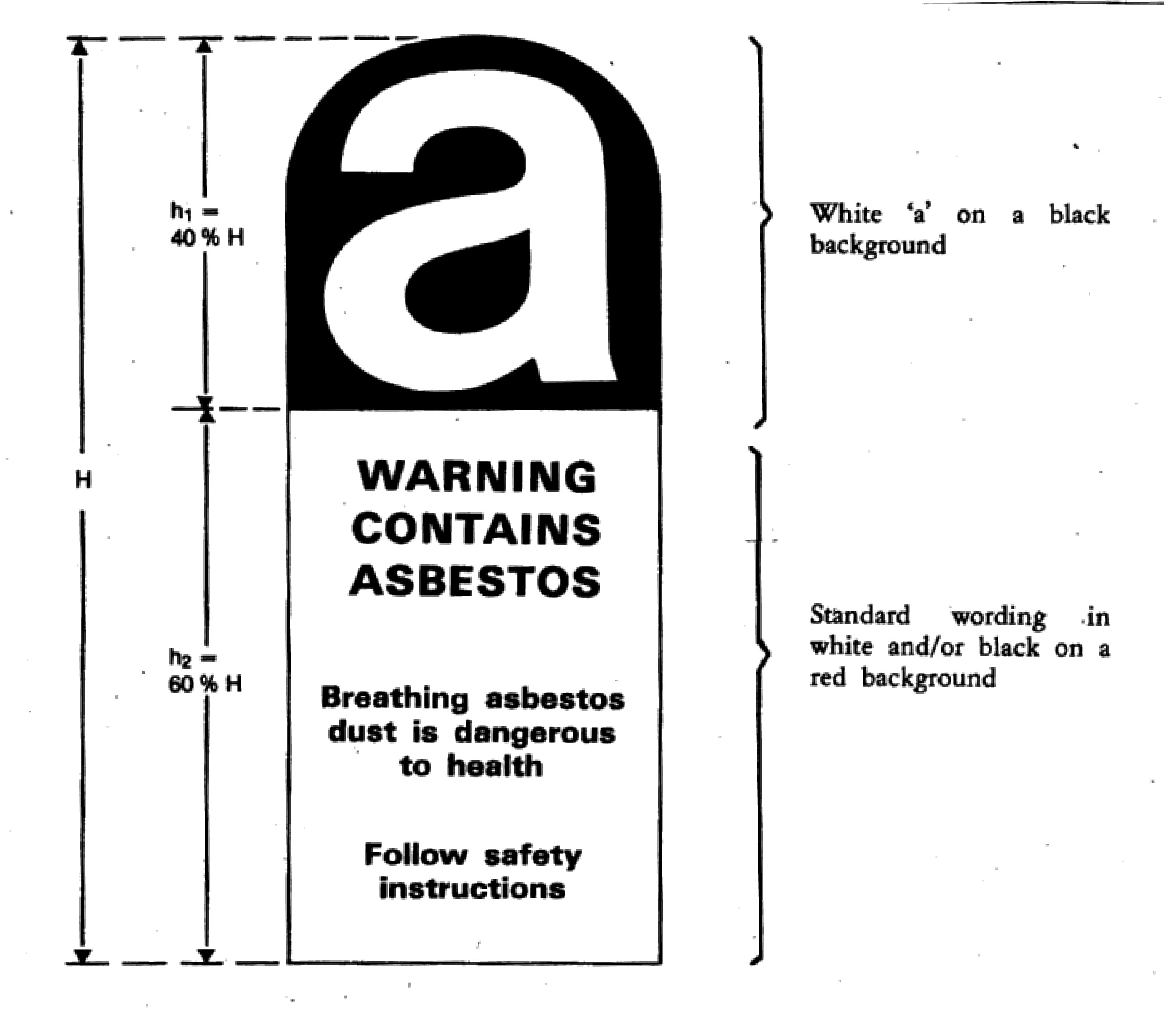 Text of image h1 = 40 % H a White ‘a’ on a black background H WARNING CONTAINS ASBESTOS Standard wording in white and/or black on a red background h2 = 60 % H Breathing asbestos dust is dangerous to health Follow safety instructions |
2. | The label mentioned in this Appendix shall be affixed in accordance with the following rules: on each of the smallest units supplied; if an article has asbestos-based components, it is sufficient for these components only to bear the label. The labelling may be dispensed with if smallness of size or unsuitability of packaging make it impossible for a label to be affixed to the component. |
3. | Labelling of packaged articles containing asbestos 3.1. The following particulars shall appear on clearly legible and indelible labelling on the packaging of packaged articles containing asbestos: Where additional safety information is provided on the packaging, this shall not weaken or contradict the particulars given in accordance with points (a) and (b). 3.2. Labelling in accordance with 3.1 shall be effected by means of: 3.3. Articles containing asbestos and which are packaged only in loose plastic wrapping or the like shall be regarded as packaged articles and shall be labelled in accordance with 3.2. If articles are separated from such packages and placed on the market unpackaged, each of the smallest units supplied shall be accompanied by labelling particulars in accordance with 3.1. the symbol and relevant indications of danger in accordance with this Annex; safety instructions which must be selected in accordance with the particulars in this Annex, inasmuch as they are relevant for the particular article. a label firmly affixed to the packaging, or a (tie-on) label securely attached to the package, or direct printing of the packaging. |
4. | Labelling of unpackaged articles containing asbestos For unpackaged articles containing asbestos, labelling in accordance with 3.1 shall be effected by means of: or, if the abovementioned is not reasonably practicable as in the case of, for example, smallness of size of the article, the unsuitable nature of the article's properties or certain technical difficulties by means of a hand-out with labelling in accordance with 3.1. a label firmly affixed to the article containing asbestos, a (tie-on) label securely attached to such an article, direct printing on the articles, |
5. | Without prejudice to Community provisions on safety and hygiene at work, the label affixed to the article which may, in the context of its use, be processed or finished, shall be accompanied by any safety instructions which may be appropriate for the article concerned, and in particular by the following: operate if possible out of doors or in a well-ventilated place, preferably use hand tools or low-speed tools equipped, if necessary, with an appropriate dust-extraction facility. If high-speed tools are used, they should always be equipped with such a facility, if possible, dampen before cutting or drilling, dampen dust and place it in a properly closed receptacle and dispose of it safely. |
6. | The labelling of any article intended for domestic use which is not covered by Section 5 and which is likely, during use, to release asbestos fibres shall, if necessary, contain the following safety instruction: ‘replace when worn’. |
7. | The labelling of articles containing asbestos shall be in the official language or languages of the Member State(s) where the article is placed on the market. |
Appendix 8
Entry 43 — Azocolourants — List of aromatic amines
List of aromatic amines
CAS No | Index No | EC No | Substances | |
1. | 92-67-1 | 612-072-00-6 | 202-177-1 | biphenyl-4-ylamine 4-aminobiphenyl xenylamine |
2. | 92-87-5 | 612-042-00-2 | 202-199-1 | benzidine |
3. | 95-69-2 | 202-441-6 | 4-chloro-o-toluidine | |
4. | 91-59-8 | 612-022-00-3 | 202-080-4 | 2-naphthylamine |
5. | 97-56-3 | 611-006-00-3 | 202-591-2 | o-aminoazotoluene 4-amino-2',3-dimethylazobenzene 4-o-tolylazo-o-toluidine |
6. | 99-55-8 | 202-765-8 | 5-nitro-o-toluidine | |
7. | 106-47-8 | 612-137-00-9 | 203-401-0 | 4-chloroaniline |
8. | 615-05-4 | 210-406-1 | 4-methoxy-m-phenylenediamine | |
9. | 101-77-9 | 612-051-00-1 | 202-974-4 | 4,4'-methylenedianiline 4,4'-diaminodiphenylmethane |
10. | 91-94-1 | 612-068-00-4 | 202-109-0 | 3,3'-dichlorobenzidine 3,3'-dichlorobiphenyl-4,4'-ylenediamine |
11. | 119-90-4 | 612-036-00-X | 204-355-4 | 3,3'-dimethoxybenzidine o-dianisidine |
12. | 119-93-7 | 612-041-00-7 | 204-358-0 | 3,3'-dimethylbenzidine 4,4'-bi-o-toluidine |
13. | 838-88-0 | 612-085-00-7 | 212-658-8 | 4,4'-methylenedi-o-toluidine |
14. | 120-71-8 | 204-419-1 | 6-methoxy-m-toluidine p-cresidine | |
15. | 101-14-4 | 612-078-00-9 | 202-918-9 | 4,4'-methylene-bis-(2-chloro-aniline) 2,2'-dichloro-4,4'-methylene-dianiline |
16. | 101-80-4 | 202-977-0 | 4,4'-oxydianiline | |
17. | 139-65-1 | 205-370-9 | 4,4'-thiodianiline | |
18. | 95-53-4 | 612-091-00-X | 202-429-0 | o-toluidine 2-aminotoluene |
19. | 95-80-7 | 612-099-00-3 | 202-453-1 | 4-methyl-m-phenylenediamine |
20. | 137-17-7 | 205-282-0 | 2,4,5-trimethylaniline | |
21. | 90-04-0 | 612-035-00-4 | 201-963-1 | o-anisidine 2-methoxyaniline |
22. | 60-09-3 | 611-008-00-4 | 200-453-6 | 4-amino azobenzene |
Appendix 9
Entry 43 — Azocolourants — List of azodyes
List of azodyes
CAS No | Index No | EC No | Substances | |
1. | Not allocated Component 1: CAS-No: 118685-33-9 C39H23ClCrN7O12S.2Na Component 2: C46H30CrN10O20S2.3Na | 611-070-00-2 | 405-665-4 | A mixture of: disodium (6-(4-anisidino)-3-sulfonato-2-(3,5-dinitro-2-oxidophenylazo)-1-naphtholato)(1-(5-chloro-2-oxidophenylazo)-2-naphtholato)chromate(1-); trisodium bis(6-(4-anisidino)-3-sulfonato-2-(3,5-dinitro-2-oxidophenylazo)-1-naphtholato)chromate(1-) |
Appendix 10
Entry 43 — Azocolourants — List of testing methods
List of testing methods
European standardisation organisation | Reference and title of the harmonised standard | Reference of the superseded standard |
CEN | EN ISO 17234-1:2015 Leather – Chemical tests for the determination of certain azo colorants in dyed leathers – Part 1: Determination of certain aromatic amines derived from azo colorants | EN ISO 17234-1:2010 |
CEN | EN ISO 17234-2:2011 Leather – Chemical tests for the determination of certain azo colorants in dyed leathers – Part 2: Determination of 4-aminoazobenzene | CEN ISO/TS 17234:2003 |
CEN | EN ISO 14362-1:2017 Textiles – Methods for determination of certain aromatic amines derived from azo colorants – Part 1: Detection of the use of certain azo colorants accessible with and without extracting the fibres | EN 14362-1:2012 |
CEN | EN ISO 14362-3:2017 Textiles – Methods for determination of certain aromatic amines derived from azo colorants – Part 3: Detection of the use of certain azo colorants, which may release 4-aminoazobenzene | EN 14362-3:2012 |
Appendix 11
Entries 28 to 30 — Derogations for specific substances
Substances | Derogations |
1. (a) Sodium perborate; perboric acid, sodium salt; perboric acid, sodium salt, monohydrate; sodium peroxometaborate; perboric acid (HBO(O2)), sodium salt, monohydrate; sodium peroxoborate CAS No 15120-21-5; 11138-47-9; 12040-72-1; 7632-04-4; 10332-33-9 EC No 239-172-9; 234-390-0; 231-556-4 (b) Perboric acid (H3BO2(O2)), monosodium salt trihydrate; perboric acid, sodium salt, tetrahydrate; perboric acid (HBO(O2)), sodium salt, tetrahydrate; sodium peroxoborate hexahydrate CAS No 13517-20-9; 37244-98-7; 10486-00-7 EC No 239-172-9; 234-390-0; 231-556-4 | Detergents as defined by Regulation (EC) No 648/2004 of the European Parliament and of the Council (1). The derogation shall apply until 1 June 2013. |
▼M82 | |
2. Cumene CAS No 98-82-8 EC No 202-704-5 | As a substance on its own or as a constituent of other substances in either of the following: (a) kerosene used as aviation fuel conforming to DEF STAN 91-091, ASTM specification D1655 or equivalent recognised standards and marketed under descriptions such as Jet-A, Jet-A1 or JP-(x); (b) gasoline used as aviation fuel conforming to DEF STAN 91-090, ASTM D910, ASTM D7547 or equivalent recognised standards. |
(1) OJ L 104, 8.4.2004, p. 1. | |
Appendix 12
Entry 72 — restricted substances and maximum concentration limits by weight in homogeneous materials:
Substances | Index- No | CAS No | EC No | Concentration limit by weight |
Cadmium and its compounds (listed in Annex XVII, Entry 28, 29, 30, Appendices 1-6) | — | — | — | 1 mg/kg after extraction (expressed as Cd metal that can be extracted from the material) |
Chromium VI compounds (listed in Annex XVII, Entry 28, 29, 30, Appendices 1-6) | — | — | — | 1 mg/kg after extraction (expressed as Cr VI that can be extracted from the material) |
Arsenic compounds (listed in Annex XVII, Entry 28, 29, 30, Appendices 1-6) | — | — | — | 1 mg/kg after extraction (expressed as As metal that can be extracted from the material) |
Lead and its compounds (listed in Annex XVII, Entry 28, 29, 30, Appendices 1-6) | — | — | — | 1 mg/kg after extraction (expressed as Pb metal that can be extracted from the material) |
Benzene | 601-020-00-8 | 71-43-2 | 200-753-7 | 5 mg/kg |
Benz[a]anthracene | 601-033-00-9 | 56-55-3 | 200-280-6 | 1 mg/kg |
Benz[e]acephenanthrylene | 601-034-00-4 | 205-99-2 | 205-911-9 | 1 mg/kg |
benzo[a]pyrene; benzo[def]chrysene | 601-032-00-3 | 50-32-8 | 200-028-5 | 1 mg/kg |
Benzo[e]pyrene | 601-049-00-6 | 192-97-2 | 205-892-7 | 1 mg/kg |
Benzo[j]fluoranthene | 601-035-00-X | 205-82-3 | 205-910-3 | 1 mg/kg |
Benzo[k]fluoranthene | 601-036-00-5 | 207-08-9 | 205-916-6 | 1 mg/kg |
Chrysene | 601-048-00-0 | 218-01-9 | 205-923-4 | 1 mg/kg |
Dibenz[a,h]anthracene | 601-041-00-2 | 53-70-3 | 200-181-8 | 1 mg/kg |
α, α,α,4-tetrachlorotoluene; p-chlorobenzotrichloride | 602-093-00-9 | 5216-25-1 | 226-009-1 | 1 mg/kg |
α, α,α-trichlorotoluene; benzotrichloride | 602-038-00-9 | 98-07-7 | 202-634-5 | 1 mg/kg |
α-chlorotoluene; benzyl chloride | 602-037-00-3 | 100-44-7 | 202-853-6 | 1 mg/kg |
Formaldehyde | 605-001-00-5 | 50-00-0 | 200-001-8 | 75 mg/kg |
1,2-benzenedicarboxylic acid; di-C 6-8-branched alkylesters, C 7-rich | 607-483-00-2 | 71888-89-6 | 276-158-1 | 1 000 mg/kg (individually or in combination with other phthalates in this entry or in other entries of Annex XVII that are classified in Part 3 of Annex VI to Regulation (EC) No 1272/2008 in any of the hazard classes carcinogenicity, germ cell mutagenicity or reproductive toxicity, category 1A or 1B |
Bis(2-methoxyethyl) phthalate | 607-228-00-5 | 117-82-8 | 204-212-6 | 1 000 mg/kg (individually or in combination with other phthalates in this entry or in other entries of Annex XVII that are classified in Part 3 of Annex VI to Regulation (EC) No 1272/2008 in any of the hazard classes carcinogenicity, germ cell mutagenicity or reproductive toxicity, category 1A or 1B |
Diisopentylphthalate | 607-426-00-1 | 605-50-5 | 210-088-4 | 1 000 mg/kg (individually or in combination with other phthalates in this entry or in other entries of Annex XVII that are classified in Part 3 of Annex VI to Regulation (EC) No 1272/2008 in any of the hazard classes carcinogenicity, germ cell mutagenicity or reproductive toxicity, category 1A or 1B |
Di-n-pentyl phthalate (DPP) | 607-426-00-1 | 131-18-0 | 205-017-9 | 1 000 mg/kg (individually or in combination with other phthalates in this entry or in other entries of Annex XVII that are classified in Part 3 of Annex VI to Regulation (EC) No 1272/2008 in any of the hazard classes carcinogenicity, germ cell mutagenicity or reproductive toxicity, category 1A or 1B |
Di-n-hexyl phthalate (DnHP) | 607-702-00-1 | 84-75-3 | 201-559-5 | 1 000 mg/kg (individually or in combination with other phthalates in this entry or in other entries of Annex XVII that are classified in Part 3 of Annex VI to Regulation (EC) No 1272/2008 in any of the hazard classes carcinogenicity, germ cell mutagenicity or reproductive toxicity, category 1A or 1B |
N-methyl-2-pyrrolidone; 1-methyl-2-pyrrolidone (NMP) | 606-021-00-7 | 872-50-4 | 212-828-1 | 3 000 mg/kg |
N,N-dimethylacetamide (DMAC) | 616-011-00-4 | 127-19-5 | 204-826-4 | 3 000 mg/kg |
N,N-dimethylformamide; dimethyl formamide (DMF) | 616-001-00-X | 68-12-2 | 200-679-5 | 3 000 mg/kg |
1,4,5,8-tetraaminoanthraquinone; C.I. Disperse Blue 1 | 611-032-00-5 | 2475-45-8 | 219-603-7 | 50 mg/kg |
Benzenamine, 4,4′-(4-iminocyclohexa-2,5- dienylidenemethylene)dianiline hydrochloride; C.I. Basic Red 9 | 611-031-00-X | 569-61-9 | 209-321-2 | 50 mg/kg |
[4-[4,4′-bis(dimethylamino)benzhydrylidene]cyclohexa-2,5-dien-1-ylidene]dimethylammonium chloride; C.I. Basic Violet 3 with ≥ 0,1 % of Michler's ketone (EC no. 202-027-5) | 612-205-00-8 | 548-62-9 | 208-953-6 | 50 mg/kg |
4-chloro-o-toluidinium chloride | 612-196-00-0 | 3165-93-3 | 221-627-8 | 30 mg/kg |
2-Naphthylammoniumacetate | 612-071-00-0 | 553-00-4 | 209-030-0 | 30 mg/kg |
4-methoxy-m-phenylene diammonium sulphate; 2,4-diaminoanisole sulphate | 612-200-00-0 | 39156-41-7 | 254-323-9 | 30 mg/kg |
2,4,5-trimethylaniline hydrochloride | 612-197-00-6 | 21436-97-5 | — | 30 mg/kg |
Quinoline | 613-281-00-5 | 91-22-5 | 202-051-6 | 50 mg/kg |
Appendix 13
Entry 75- List of substances with specific concentration limits:
Substance name | EC No | CAS No | Concentration limit (by weight) |
Mercury | 231-106-7 | 7439-97-6 | 0,00005 % |
Nickel | 231-111-4 | 7440-02-0 | 0,0005 % |
Organometallic tin | 231-141-8 | 7440-31-5 | 0,00005 % |
Antimony | 231-146-5 | 7440-36-0 | 0,00005 % |
Arsenic | 231-148-6 | 7440-38-2 | 0,00005 % |
Barium (^{}) | 231-149-1 | 7440-39-3 | 0,05 % |
Cadmium | 231-152-8 | 7440-43-9 | 0,00005 % |
Chromium‡ | 231-157-5 | 7440-47-3 | 0,00005 % |
Cobalt | 231-158-0 | 7440-48-4 | 0,00005 % |
Copper (^{}) | 231-159-6 | 7440-50-8 | 0,025 % |
Zinc (^{}) | 231-175-3 | 7440-66-6 | 0,2 % |
Lead | 231-100-4 | 7439-92-1 | 0,00007 % |
Selenium | 231-957-4 | 7782-49-2 | 0,0002 % |
Benzo[a]pyrene | 200-028-5 | 50-32-8, 63466-71-7 | 0,0000005 % |
Polycyclic-aromatic Hydrocarbons (PAH), classified in Part 3 of Annex VI to Regulation (EC) No 1272/2008 as carcinogen or germ cell mutagen category 1A, 1B or 2 | 0,00005 % (individual concentrations) | ||
Methanol | 200-659-6 | 67-56-1 | 11 % |
o-Anisidine (^{}) | 201-963-1 | 90-04-0 | 0,0005 % |
o-toluidine (^{}) | 202-429-0 | 95-53-4 | 0,0005 % |
3,3'-dichlorobenzidine (^{}) | 202-109-0 | 91-94-1 | 0,0005 % |
4-methyl-m- phenylenediamine (^{}) | 202-453-1 | 95-80-7 | 0,0005 % |
4-chloroaniline (^{}) | 203-401-0 | 106-47-8 | 0,0005 % |
5-nitro-o-toluidine (^{}) | 202-765-8 | 99-55-8 | 0,0005 % |
3,3'-dimethoxybenzidine (^{}) | 204-355-4 | 119-90-4 | 0,0005 % |
4,4'-bi-o-toluidine (^{}) | 204-358-0 | 119-93-7 | 0,0005 % |
4,4'-Thiodianiline (^{}) | 205-370-9 | 139-65-1 | 0,0005 % |
4-chloro-o-toluidine (^{}) | 202-441-6 | 95-69-2 | 0,0005 % |
2-naphthylamine (^{}) | 202-080-4 | 91-59-8 | 0,0005 % |
Aniline (^{}) | 200-539-3 | 62-53-3 | 0,0005 % |
Benzidine (^{}) | 202-199-1 | 92-87-5 | 0,0005 % |
p-toluidine (^{}) | 203-403-1 | 106-49-0 | 0,0005 % |
2-methyl-p-phenylenediamine (^{}) | 202-442-1 | 95-70-5 | 0,0005 % |
Biphenyl-4-ylamine (^{}) | 202-177-1 | 92-67-1 | 0,0005 % |
4-o-tolylazo-o-toluidine (^{}) | 202-591-2 | 97-56-3 | 0,0005 % |
4-methoxy-m- phenylenediamine (^{}) | 210-406-1 | 615-05-4 | 0,0005 % |
4,4'-methylenedianiline (^{}) | 202-974-4 | 101-77-9 | 0,0005 % |
4,4'-methylenedi-o-toluidine (^{}) | 212-658-8 | 838-88-0 | 0,0005 % |
6-methoxy-m-toluidine (^{}) | 204-419-1 | 120-71-8 | 0,0005 % |
4,4'- methylene-bis-[2-chloro aniline] (^{}) | 202-918-9 | 101-14-4 | 0,0005 % |
4,4'-oxydianiline (^{}) | 202-977-0 | 101-80-4 | 0,0005 % |
2,4,5-trimethylaniline (^{}) | 205-282-0 | 137-17-7 | 0,0005 % |
4-Aminoazobenzene (^{}) | 200-453-6 | 60-09-3 | 0,0005 % |
p-Phenylenediamine (^{}) | 203-404-7 | 106-50-3 | 0,0005 % |
Sulphanilic acid (^{}) | 204-482-5 | 121-57-3 | 0,0005 % |
4-amino-3-fluorophenol (^{}) | 402-230-0 | 399-95-1 | 0,0005 % |
2,6-xylidine | 201-758-7 | 87-62-7 | 0,0005 % |
6-amino-2-ethoxynaphthaline | 293733-21-8 | 0,0005 % | |
2,4-xylidine | 202-440-0 | 95-68-1 | 0,0005 % |
Pigment Red 7 (PR7)/CI 12420 | 229-315-3 | 6471-51-8 | 0,1 % |
Pigment Red 9(PR9)/CI 12460 | 229-104-6 | 6410-38-4 | 0,1 % |
Pigment Red 15 (PR15)/CI 12465 | 229-105-1 | 6410-39-5 | 0,1 % |
Pigment Red 210(PR210)/CI 12477 | 612-766-9 | 61932-63-6 | 0,1 % |
Pigment Orange 74 (PO74) | 85776-14-3 | 0,1 % | |
Pigment Yellow 65 (PY65)/CI 11740 | 229-419-9 | 6528-34-3 | 0,1 % |
Pigment Yellow 74 (PY74)/CI 11741 | 228-768-4 | 6358-31-2 | 0,1 % |
Pigment Red 12 (PR12)/CI 12385 | 229-102-5 | 6410-32-8 | 0,1 % |
Pigment Red 14 (PR14)/CI 12380 | 229-314-8 | 6471-50-7 | 0,1 % |
Pigment Red 17 (PR17)/CI 12390 | 229-681-4 | 6655-84-1 | 0,1 % |
Pigment Red 112 (PR112)/CI 12370 | 229-440-3 | 6535-46-2 | 0,1 % |
Pigment Yellow 14 (PY14)/CI 21095 | 226-789-3 | 5468-75-7 | 0,1 % |
Pigment Yellow 55 (PY55)/CI 21096 | 226-789-3 | 6358-37-8 | 0,1 % |
Pigment Red 2 (PR2)/CI 12310 | 227-930-1 | 6041-94-7 | 0,1 % |
Pigment Red 22 (PR22)/CI 12315 | 229-245-3 | 6448-95-9 | 0,1 % |
Pigment Red 146 (PR146)/CI 12485 | 226-103-2 | 5280-68-2 | 0,1 % |
Pigment Red 269 (PR269)/CI 12466 | 268-028-8 | 67990-05-0 | 0,1 % |
Pigment Orange16 (PO16)/CI 21160 | 229-388-1 | 6505-28-8 | 0,1 % |
Pigment Yellow 1 (PY1)/CI 11680 | 219-730-8 | 2512-29-0 | 0,1 % |
Pigment Yellow 12 (PY12)/CI 21090 | 228-787-8 | 6358-85-6 | 0,1 % |
Pigment Yellow 87 (PY87)/CI 21107:1 | 239-160-3 | 15110-84-6, 14110-84-6 | 0,1 % |
Pigment Yellow 97 (PY97)/CI 11767 | 235-427-3 | 12225-18-2 | 0,1 % |
Pigment Orange 13 (PO13)/CI 21110 | 222-530-3 | 3520-72-7 | 0,1 % |
Pigment Orange 34 (PO34)/CI 21115 | 239-898-6 | 15793-73-4 | 0,1 % |
Pigment Yellow 83 (PY83)/CI 21108 | 226-939-8 | 5567-15-7 | 0,1 % |
Solvent Red 1 (SR1)/CI 12150 | 214-968-9 | 1229-55-6 | 0,1 % |
Acid Orange 24 (AO24)/CI 20170 | 215-296-9 | 1320-07-6 | 0,1 % |
Solvent Red 23 (SR23)/CI 26100 | 201-638-4 | 85-86-9 | 0,1 % |
Acid Red 73 (AR73)/CI 27290 | 226-502-1 | 5413-75-2 | 0,1 % |
Disperse Yellow 3/CI 11855 | 220-600-8 | 2832-40-8 | 0,1 % |
Acid Green 16 | 603-214-8 | 12768-78-4 | 0,1 % |
Acid Red 26 | 223-178-3 | 3761-53-3 | 0,1 % |
Acid Violet 17 | 223-942-6 | 4129-84-4 | 0,1 % |
Basic Red 1 | 213-584-9 | 989-38-8 | 0,1 % |
Disperse Blue 106 | 602-285-2 | 12223-01-7 | 0,1 % |
Disperse Blue 124 | 612-788-9 | 61951-51-7 | 0,1 % |
Disperse Blue 35 | 602-260-6 | 12222-75-2 | 0,1 % |
Disperse Orange 37 | 602-312-8 | 12223-33-5 | 0,1 % |
Disperse Red 1 | 220-704-3 | 2872-52-8 | 0,1 % |
Disperse Red 17 | 221-665-5 | 3179-89-3 | 0,1 % |
Disperse Yellow 9 | 228-919-4 | 6373-73-5 | 0,1 % |
Pigment Violet 3 | 603-635-7 | 1325-82-2 | 0,1 % |
Pigment Violet 39 | 264-654-0 | 64070-98-0 | 0,1 % |
Solvent Yellow 2 | 200-455-7 | 60-11-7 | 0,1 % |
(1) Soluble. ‡Chromium VI. | |||
Appendix 14
1. Measurement of formaldehyde released to indoor air from articles referred to in paragraph 1, first subparagraph, of entry 77
The formaldehyde released from articles referred to in paragraph 1, first subparagraph of entry 77 shall be measured in the air of a test chamber under the following cumulative reference conditions:
the temperature in the test chamber shall be (23 ± 0,5) 0C;
the relative humidity in the test chamber shall be (45 ± 3) %;
the loading factor, expressed as the ratio of the total surface area of the test piece to the volume of the test chamber, shall be (1 ± 0,02) m2/m3. This loading factor corresponds to the testing of wood-based panels; for other material or products, if such a loading factor is clearly not realistic under foreseeable conditions of use, loading factors in accordance with Section 4.2.2 of EN 16516 (*1) may be used;
the air exchange rate in the test chamber shall be (1 ± 0,05) h-1;
an appropriate analytical procedure for measuring the formaldehyde concentration in the test chamber shall be used;
an appropriate method for sampling of the test pieces shall be used;
the formaldehyde concentration in the air of the test chamber shall be measured at least twice per day throughout the test with a time interval between two consecutive samplings of 3 hours at a minimum; the measurement shall be repeated until sufficient data are available to determine the steady state concentration;
the duration of the test shall be sufficiently long to allow the determination of the steady state concentration and shall not exceed 28 days;
the steady state concentration of formaldehyde measured in the test chamber shall be used to verify the compliance with the limit value of formaldehyde released from articles referred to in paragraph 1, first subparagraph, of entry 77.
If data from a test method using the reference conditions specified above are not available or suitable for the measurement of the formaldehyde released from a specific article, data obtained from a test method using non-reference conditions may be used, where there is a scientifically valid correlation between the results of the test method used and the reference conditions.
2. Measurement of formaldehyde concentration in the interior of vehicles referred to in paragraph 2, first subparagraph, of entry 77
For road vehicles, including trucks and buses, the formaldehyde concentration shall be measured in ambient mode in accordance with the conditions specified in ISO 12219-1 (*2) or ISO 12219-10 (*3), and the concentration measured shall be used to verify the compliance with the limit value referred to in paragraph 2, first subparagraph, of entry 77.
Appendix 15
Entry 78 – Rules on proving degradability
This appendix lays down the rules for proving degradability of polymers for the purposes of entry 78, namely the permitted test methods and the pass criteria for those methods. The test methods were designed to measure biotic degradation, although it cannot be excluded that some abiotic degradation takes place during the test and contributes to the test results.
The tests shall be conducted by laboratories complying with the principles of good laboratory practice provided for in Directive 2004/10/EC or other international standards recognised as being equivalent by the Commission or the Agency or accredited to ISO 17025.
1. Test methods
The permitted test methods are organised into five groups, on the basis of their design and underlying rationale. Meeting the pass criteria in any of the permitted test methods in groups 1 to 3 is sufficient to demonstrate that the polymer or polymers contained in the tested material and subject to the test are degradable and are therefore excluded from the scope of entry 78. Where group 4 or group 5 tests are used to demonstrate degradability of polymers for uses other than agricultural and horticultural uses, the pass criteria shall be met in three environmental compartments chosen as follows:
Compartment 1: fresh, estuarine or marine water;
Compartment 2:
fresh, estuarine or marine sediment; or
fresh, estuarine or marine water/sediment interface
Compartment 3: soil.
1.1. Group 1. Screening test methods and pass criteria to demonstrate ready biodegradation
1.1.1. Permitted test methods in group 1:
‘Ready Biodegradability’ (OECD TG 301 B, C, D, F)
‘Ready Biodegradability – CO2 in sealed vessels (Headspace Test)’ (OECD TG 310).
1.1.2. Pass criteria: 60 % mineralisation measured, over 28 days, as evolved CO2 or consumed O2. The 10-day window requirement mentioned in the T1 and T2 test guidelines does not need to be fulfilled.
1.2. Group 2. Modified and enhanced screening test methods and pass criteria to demonstrate ready biodegradation
1.2.1. Permitted test methods in group 2:
‘Ready Biodegradability’ (OECD TG 301 B, C, D, F);
‘Ready Biodegradability – CO2 in sealed vessels (Headspace Test)’ (OECD TG 310);
‘Biodegradability in Seawater’ (OECD TG 306).
1.2.2. For group 2 test methods, the test duration can be extended to up to 60 days and larger test vessels used.
1.2.3. Pass criteria: 60 % mineralisation measured, over 60 days, as consumed O2 (allowed for T1 and T2 tests only) or evolved CO2. The 10-day window requirement mentioned in the T1 and T2 test guidelines does not need to be fulfilled.
1.3. Group 3. Screening test method and pass criteria to demonstrate inherent degradation
1.3.1. Permitted test method in group 3:
‘Inherent Biodegradability: modified MITI Test (II)’ (OECD 302C).
1.3.2. The pre-adaptation of the inoculum mentioned in the T4 test guideline shall not be allowed.
1.3.3. Pass criteria: ≥ 70 % mineralisation measured as consumed O2 or evolved CO2 within 14 days.
1.4. Group 4. Screening test methods and pass criteria to demonstrate degradation relative to a reference material
1.4.1. Permitted test methods in group 4:
‘Determination of the ultimate aerobic biodegradability of plastic materials in an aqueous medium – Method by analysis of evolved carbon dioxide.’ (EN ISO 14852:2021);
‘Determination of the ultimate aerobic biodegradability of plastic materials in an aqueous medium – Method by measuring the oxygen demand in a closed respirometer.’ (EN ISO 14851:2019);
‘Plastics – Determination of aerobic biodegradation of non-floating plastic materials in seawater/sediment interface – Method by analysis of evolved carbon dioxide’ (EN ISO 19679:2020);
‘Plastics – Determination of aerobic biodegradation of non-floating plastic materials in seawater/sandy sediment interface – Method by measuring the oxygen demand in closed respirometer’ (EN ISO 18830:2016);
‘Plastics – Determination of the ultimate aerobic biodegradability of plastic materials in soil by measuring the oxygen demand in a respirometer or the amount of carbon dioxide evolved’ (EN ISO 17556:2019);
‘Plastics – Determination of the aerobic biodegradation of non-floating materials exposed to marine sediment – Method by analysis of evolved carbon dioxide’ (ISO 22404:2019).
1.4.2. The specifications laid down in ISO 22403:2020 ‘Plastics – Assessment of the intrinsic biodegradability of materials exposed to marine inocula under mesophilic aerobic laboratory conditions – Test methods and requirements’ shall be taken into account when applying T7 and T8.
1.4.3. For group 4 test methods, the pre-adaptation of the inoculum shall not be allowed. The result shall be reported as the maximum level of degradation determined from the plateau phase of the degradation curve, or as the highest value if the plateau has not been reached. The form, size and surface area of the reference material shall be comparable to that of the test material. The following materials may be used as reference materials:
positive controls: biodegradable materials such as micro-crystalline cellulose powder, ashless cellulose filters or poly-β-hydroxybutyrate.
negative controls: non-biodegradable polymers such as polyethylene or polystyrene.
1.4.4. Pass criteria: ultimate degradation of ≥ 90 % relative to the degradation of the reference material within:
6 months in aquatic tests, or,
24 months in soil, sediment or water/sediment interface tests.
1.5. Group 5. Simulation test methods and pass criteria to demonstrate degradation under relevant environmental conditions
1.5.1. Permitted test methods in group 5:
‘Aerobic and Anaerobic Transformation in Soil’ (OECD TG 307);
‘Aerobic and Anaerobic Transformation in Aquatic Sediment Systems’ (OECD TG 308);
‘Aerobic Mineralisation in Surface Water – Simulation Biodegradation Test’ (OECD TG 309)
1.5.2. The required test temperatures shall be 12 °C for fresh/estuarine water, fresh/estuarine water sediment and soil, and 9 °C for marine water and marine sediment because these are the average temperatures for those compartments in the Union.
1.5.3. Pass criteria:
the degradation half-life in marine, fresh or estuarine water is less than 60 days;
the degradation half-life in marine, fresh or estuarine sediment is less than 180 days;
the degradation half-life in soil is less than 180 days.
2. Specific requirements for demonstrating the degradability of polymers in products for agricultural and horticultural applications
2.1. Fertilising products containing polymers which are coating agents or increase the water retention capacity or the wettability of the product
The degradability of polymers which are coating agents or increase the water retention capacity or the wettability in fertilising products, as defined in Article 2, point (1), of Regulation (EU) 2019/1009, which do not fall within the scope of that Regulation shall be demonstrated in accordance with the delegated acts referred to in Article 42(6) of that Regulation. In the case of absence of such delegated acts, such polymers shall not be placed on the market in fertilising products which do not fall within the scope of Regulation (EU) 2019/1009 after 17 October 2028.
2.2. Agricultural and horticultural products other than fertilising products referred to in paragraph 2.1
Where group 4 or group 5 test methods are used, the degradability of polymers in products for agricultural or horticultural applications other than fertilising products referred to in point 2.1 shall be demonstrated in at least two environmental compartments chosen as follows:
Compartment 1: fresh, estuarine or marine water;
Compartment 2: soil.
To be considered degradable for the scope of entry 78, a polymer in a product for agricultural or horticultural applications other than a fertilising product referred to in point 2.1 shall achieve 90 % degradation in:
soil within 48 months after the end of that product functionality period; the functionality period is the time following the product application during which the product exerts its function.
water within:
12 months plus the product functionality period, where group 4 test methods are used; or
16 months plus the product functionality period, where group 5 test methods are used.
To this end, the pass criteria for group 4 and 5 test methods shall be modified to indicate the percentage of degradation (for group 4) or the half-life (for group 5) that needs to be observed at the end of the standard test duration in order to achieve the conditions laid down in the previous paragraph.
The modified pass criteria of group 4 and 5 test methods are set in Tables A and B, respectively.
Table A
Group 4 pass criteria for polymers in products for agricultural or horticultural applications, listed by duration of the functionality period (FP) and type of test
Test method | Criterion assessed | Pass criterion (FP = 0) | Pass criterion (1 month FP) | Pass criterion (2 month FP) | Pass criterion (3 month FP) | Pass criterion (6 month FP) | Pass criterion (9 month FP) |
T9 (soil) | Target degradation after 24 months | ≥ 68,4 % | ≥ 67,6 % | ≥ 66,9 % | ≥ 66,2 % | ≥ 64,1 % | ≥ 62,1 % |
T5 and T6 (surface water) | Target degradation after 6 months | ≥ 68,4 % | ≥ 65,4 % | ≥ 62,7 % | ≥ 60,2 % | ≥ 53,6 % | ≥ 48,2 % |
Table B
Group 5 pass criteria for polymers in products for agricultural or horticultural applications, listed by duration of the functionality period (FP) and type of test
Test method | Criterion assessed | Pass criterion (FP = 0) | Pass criterion (1 month FP) | Pass criterion (2 month FP) | Pass criterion (3 month FP) | Pass criterion (6 month FP) | Pass criterion (9 month FP) |
T11 (soil, 48 months + FP) | Degradation half-life (DegT50) | DegT50 ≤ 440 days | DegT50 ≤ 449 days | DegT50 ≤ 458 days | DegT50 ≤ 467 days | DegT50 ≤ 495 days | DegT50 ≤ 522 days |
T13 (surface water, 16 months + FP) | Degradation half-life (DegT50) | DegT50 ≤ 147 days | DegT50 ≤ 156 days | DegT50 ≤ 165 days | DegT50 ≤ 174 days | DegT50 ≤ 202 days | DegT50 ≤ 229 days |
For functionality periods not covered in Tables A or B, the pass criteria shall be calculated using the exponential decay formulas indicated below.
Group 4, T9 (soil):
The target degradation over 24 months (TD24m) shall be calculated as follows:
TD24m = 1 – exp(-λ × c × 24)
Group 4, T5 and T6 (surface water)
The target degradation over 6 months (TD6m) shall be calculated as follows:
TD6m = 1 – exp(-λ × c × 6)
Group 5, T11 (soil) and T13 (surface water):
The degradation half-life (DegT50) observed at the end of the group 5 test duration shall be calculated as follows:
DegT50 = ln(2)/λ
where:
is the average number of days per month, calculated as:
c = 365,25/12
λ
is the degradation rate, calculated as:
λΤ9/T11 = ln(0,1)/-t90,T9/T11
λΤ5/T6 = ln(0,1)/-t90,T5/T6
λΤ13 = ln(0,1)/-t90,T13
t
is the time- to- 90 %-degradation, calculated as:
t90,T9/T11 = c × (48 + FP)
t90,T5/T6 = c × (12 + FP)
t90,T13 = c × (16 + FP)
FPis the functionality period, expressed in months.
3. Specific requirements for the test material to be used in degradation tests
The test shall be performed on a test material consisting of a polymer or polymers contained in or building a continuous coating on particles (‘polymer particles’) comparable in terms of composition, form, size and surface area to the polymer particles present in the product or, if not technically feasible, to the polymer particles that are disposed of or released to the environment.
By way of derogation from the first paragraph, polymers used for encapsulation may be tested in any of the following forms:
in the form placed on the market;
in the form of isolated coating;
in the form placed on the market where the organic core of the material is replaced by an inert material such as glass.
The test material shall be of comparable thickness to the solid polymer coating of the particle placed on the market. When the degradation is assessed in relation to a reference material, as referred to in point 1.4.3, the form, size and surface area of the reference material shall be comparable to that of the test material.
Where the test material contains more than one polymer and test methods from groups 1, 2 or 3 are used to prove degradation, the degradation of each of the polymers shall be demonstrated in either of the following ways:
separately testing the degradation of the test material and of each polymer in the test material using the permitted test methods and pass criteria set out in this Appendix,
testing the degradation of the test material using the permitted test methods and pass criteria set out in this Appendix and, during testing, demonstrating, by any appropriate means, that all polymers in the test material contribute to the degradation observed during testing and that each polymer meets the pass criteria in the relevant permitted test method set out in this Appendix.
Where the test material is composed of a single polymer but contains other non-polymeric organic substances in concentration higher than 10 % by weight of the test material, and test methods from groups 1, 2 or 3 are used to prove degradation, either of the following conditions shall apply:
the degradation of the test material and of the polymer in the test material shall be tested separately using the permitted test methods and pass criteria set out in this Appendix;
the degradation of the test material shall be tested using the permitted test methods and pass criteria set out in this Appendix and, during testing, it shall be demonstrated, by any appropriate means, that the polymer contributes to the degradation of the test material observed during testing and meets the pass criteria in the relevant permitted test method set out in this Appendix.
Appendix 16
Entry 78 – Rules on proving solubility
This appendix lays down the permitted test methods and the test conditions to prove that a polymer is soluble for the purposes of entry 78. The tests shall be conducted by laboratories complying with the principles of good laboratory practice provided for in Directive 2004/10/EC or other international standards recognised as being equivalent by the Commission or the Agency or accredited to ISO 17025.
Permitted test methods:
OECD Guideline 120
OECD Guideline 105
The test shall be performed on a test material consisting of a polymer or polymers contained in or building a continuous coating on particles (‘polymer particles’) comparable in terms of composition, form, size and surface area to the polymer particles present in the product or, if not technically feasible, to the polymer particles that are disposed of or released to the environment.
By way of derogation from the third paragraph, for polymer particles that have all dimensions greater than 0,25 mm or have a length to diameter ratio greater than 3 and are longer than 0,25 mm, the size of the polymer particles to be tested shall be reduced in accordance with OECD guideline 120, so that at least one dimension of the polymer particle or, for polymer particles that have a length to diameter ratio greater than 3 the length of the polymer particle, is between 0,125 mm and 0,25 mm. For polymer particles containing inorganic substances in addition to a polymer or polymers, such as polymer particles encapsulated with inorganic substances or polymer particles where a polymer is grafted onto an inorganic carrier, it shall be sufficient to demonstrate that the polymer meets the pass criterion. To this end, it is allowed to test the solubility of the polymer or the polymers prior to the formation of the polymer particles.
The conditions for the solubility test shall be the following:
Temperature 20 °C
pH 7
Loading: 10 g/1 000 mL
Test time: 24 h
Pass criterion: solubility > 2 g/L.