DATA QUALITY MANAGEMENT (DQM) TARGETS, IMPLEMENTATION OF EXCEPTIONS, ATTRIBUTES, DQM THRESHOLD BASIS AND TIMELINE
The Centralised Securities Database (CSDB) DQM framework is based, first, on DQM targets that represent benchmarks for assessing the quality of output feed data and, second, on DQM metrics that measure the level to which a certain DQM target has been reached and thereby identify and prioritise, for each respective DQM target, the output feed data that need to be verified. It is also based on DQM thresholds that define the minimum level of verification that needs to be conducted in relation to a DQM target and on DQM exceptions that are identified via a specified rule and that present (potential) data quality issues to be verified or corrected in order to reach the respective DQM threshold.
The DQM targets, DQM metrics, implementation of DQM exceptions, attributes and DQM threshold basis are specified in the following table. In the CSDB, a list of DQM exceptions will be made available for each DQM target that must be verified in order to reach the DQM threshold. The ECB and the national central banks of the Member States whose currency is the euro (hereinafter the ‘NCBs’) will verify the DQM exceptions defined in this Annex, for which DQM exception rules are implemented in the CSDB.
Table 1
DQM target | DQM metrics | Implementation of DQM exceptions | Output feed data attributes | DQM threshold basis |
Target 1: Data stability – stock data | Concept: The metric will be defined for each country of residence/sector combination as a volume weighted ‘index of change’, weighted with monetary amounts. An index value of 1 indicates that the respective attribute has not changed for any of the underlying securities, while an index value of 0 indicates that the respective attribute has changed for all securities. If an index drops below 1, individual securities will be identified with the changed attribute that has caused the index drop with a view to verifying the change until the threshold is met. Events triggering an index change: For discrete attributes, any month-on-month difference in the attribute is considered to trigger an index change. For continuous attributes, any month-on-month difference larger than a specified threshold is considered to trigger an index change. Coverage: This DQM metric covers all investment fund shares, equity and debt securities including certificates. | Target 1 assesses the stability of stock data. Any month-on-month difference triggering an index change triggers a DQM exception for the output feed data attributes covered by Target 1. Unverified DQM exceptions must not decrease the share of stable data beyond the DQM threshold for each of the following European System of Accounts (ESA 2010) (2) issuer sectors: — S.11 ‘non-financial corporations’ — S.121 ‘the central bank’ — S.122 ‘deposit-taking corporations except the central bank’ — S.123 ‘money market funds (MMFs)’ — S.124 ‘non-MMF investment funds’ — S.125 ‘other financial intermediaries, except insurance corporations and pension funds’ — S.126 ‘financial auxiliaries’ — S.127 ‘captive financial institutions and money lenders’ — S.128 ‘insurance corporations (IC)’ — S.129 ‘pension funds (PF)’ — S.13 ‘general government’ | Explicit attributes: Issue date, maturity date for debt, nominal currency, quotation basis, ESA 2010 instrument classification, primary asset classification 2, CSDB issuer identifier, issuer domicile country, (1) ESA 2010 issuer sector, issuer European Classification of Economic Activities (NACE) classification, entity status, amount outstanding, number outstanding, security status, coupon-related attributes, accrued income factor, price value, price value type, monthly average price, issue price, redemption price, instrument supplementary information, last split factor, last split date. | Amounts outstanding or market capitalisation in euro, expressed as share of stock data. |
Target 2: Data accuracy – CSEC aggregate statistics | Conceptual background: CSEC aggregate statistics for end-month stocks and monthly flows are produced from CSDB output data on a daily basis, as specified in Annex IV to this Guideline. As CSEC aggregate statistics consist of a large number of different aggregates, including higher-level and overlapping aggregates, the verification of CSEC aggregate statistics must focus on sets of ‘CSEC priority series’, i.e. the lowest-level CSEC aggregate statistics that are subject to DQM requirements, as specified in Annex IV to this Guideline. Verifying the sets of priority series will ensure that all higher-level aggregates that are based on these series and to a significant extent also related overlapping aggregates are verified as well. Concept: For each country, the metric must identify the ‘CSEC priority series’ and must relate them, as a percentage of amounts outstanding or market capitalisation, to the total economy aggregates for stocks at market value for that country. It must be possible to access disaggregated data at the level of the individual securities underlying the CSEC aggregate statistics. The sets of CSEC priority series must be verified and confirmed until the threshold is met. Coverage: The metric covers debt securities and listed shares that are within the scope of CSEC aggregate statistics. | Target 2 assesses the data quality of the CSEC aggregate statistics Any CSEC priority series for debt securities and listed shares triggers a DQM exception for Target 2. Unverified DQM exceptions shall not exceed the DQM threshold for debt securities and listed shares. | Implicit attributes: Issue date, maturity date for debt, nominal currency, quotation basis, ESA 2010 instrument classification, primary asset classification 2, issuer domicile country, (3) ESA 2010 issuer sector, entity status, amount outstanding, number outstanding, tranche amount, tranche issue date, tranche issue price, security status, coupon-related attributes, price value, issue price, redemption price, instrument supplementary information. | Stocks at market value of CSEC priority series expressed as a share of stocks at market value of the CSEC total economy aggregates of that country (separately calculated for debt securities and listed share aggregates). |
Target 3a: Data accuracy – support correct sector allocation and data extraction by issuer | Conceptual background: The CSDB links issuer and instrument information on a relational basis which can be described as ‘one to many’, i.e. one issuer can be related to many instruments, while each instrument is related to only one issuer. This instrument-issuer link is made via individual issuer identifiers provided by the different input data providers. These identifiers differ between the data providers as there is, so far, no common standard but they should be consistent. If input data providers provide inconsistent (clashing) issuer identifiers for the same instrument, i.e. if they disagree on the issuer, the instrument cannot be allocated to a definite issuer and ends up in a ‘clash group’. Clash groups can still be classified correctly by country and sector but there is no consistent link to the relevant issuer of the instrument. Instruments in clash groups prevent the consistent and reliable extraction of all instruments issued by a certain issuer. Instruments in clash groups increase the risk of misclassification by country of residence or sector. Concept: For each country of residence the metric must identify the instruments in clash groups and relate them as a percentage share in terms of counts or in terms of monetary amounts to all instruments for that country. Coverage: The metric covers all instruments in the CSDB. | Target 3a assesses the correct identification of the issuer population. Any disagreement on the issuer of an instrument, i.e. instruments in ‘clash groups’, triggers a DQM exception for Target 3a. Where there is a DQM exception, the instruments for this exception must not exceed the DQM threshold. | Explicit attributes: Issuer identifier used for grouping. | Amounts outstanding and market capitalisation in euro referring to instruments in clash groups, expressed as a percentage share of all instruments. |
Target 3b: Data accuracy – support correct sector allocation and data extraction by issuer | Conceptual background: The CSDB links issuer and instrument information on a relational basis which may be described as ‘one to many’, i.e. one issuer can be related to many instruments while each instrument is related to only one issuer. This instrument-issuer link is made via individual issuer identifiers which are provided by the different input data providers. These identifiers differ between the data providers as there is, so far, no common standard but they should be consistent. If no data provider provides an issuer identifier for a given instrument, there is a risk that this instrument will not be allocated to a definite issuer and will end up in a ‘stand-alone group’ consisting only of this instrument. Stand-alone groups may still be classified correctly by country and sector but there is no consistent link to the relevant issuer of the instrument. Instruments in stand-alone groups prevent the consistent and reliable extraction of all instruments issued by a certain issuer. Instruments in stand-alone groups increase the risk of misclassification by country of residence or sector, given that they are often provided with incomplete information. Concept: For each country of residence the metric must identify the instruments in stand-alone groups and relate them as a percentage share in terms of counts or in terms of monetary amounts to all instruments for that country. Coverage: The metric covers all instruments in the CSDB. | Target 3b assesses the correct identification of the issuer population. Any lack of reliable information on the issuer of an instrument, i.e. instruments in ‘stand-alone groups’, triggers a DQM exception for Target 3b. Where there is a DQM exception, the instruments for this exception must not exceed the DQM threshold. | Explicit attributes: Issuer identifier used for grouping. | Amounts outstanding and market capitalisation in euro referring to instruments in stand-alone groups, expressed as a percentage share of all instruments. |
(1) Input data for issuer attributes is transmitted to the CSDB from the Register of Institutions and Affiliates Database (RIAD) data set on a regular basis in accordance with Article 4 of this Guideline. (2) As established by Regulation (EU) No 549/2013. (3) Input data for issuer attributes is transmitted to the CSDB from the RIAD data set on a regular basis. RIAD input data is linked with the CSDB data in accordance with Article 4(7) of this Guideline. | ||||
When performing their tasks under Article 8 of this Guideline, the ECB and NCBs must adhere to the following timetable for the verification of DQM exceptions and correction of data quality issues for DQM targets 1, 2, 3a and 3b:
Table 2
Type of DQM | Reference months subject to DQM | Type of data subject to DQM | DQM targets, for which exceptions must be verified and data quality issues be corrected | Deadline for verification of all exceptions to reach the DQM thresholds |
Initial DQM | Reference month of current production round | End-month preview output feed data | DQM targets 1, 3a and 3b | End of the third working day following the reference month subject to initial DQM |
Initial CSEC aggregate statistics | DQM target 2 | End of the seventh working day following the reference month subject to initial DQM | ||
Regular DQM | All earlier reference months | Output feed data | DQM targets 1, 3a and 3b | End of the third working day following the reference month subject to initial DQM |
Regular CSEC aggregate statistics | DQM target 2 | End of the seventh working day following the reference month subject to initial DQM |
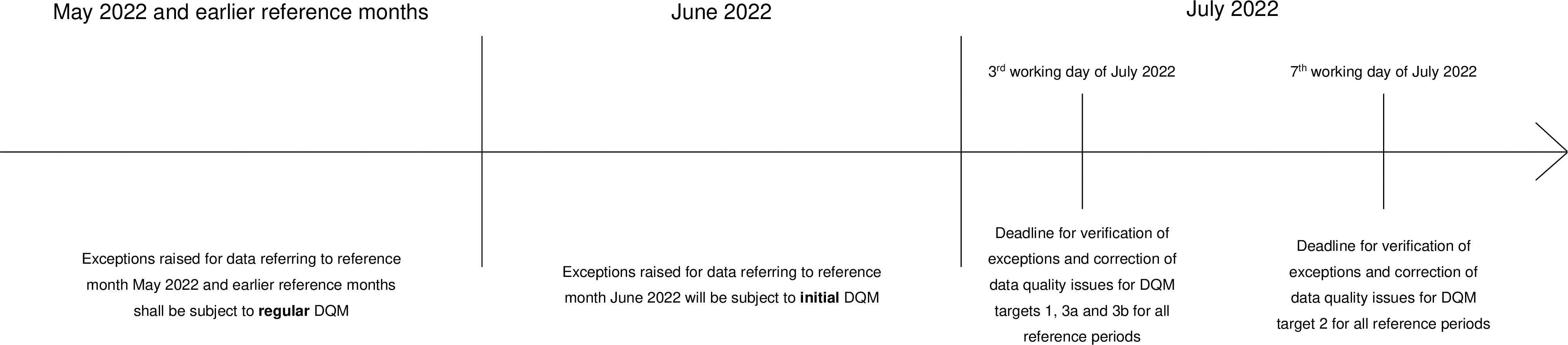
A specific example of the timetable for the verification of DQM exceptions and correction of data quality issues for DQM targets 1, 2, 3a and 3b is provided in the following diagram. The example illustrates the case of the production round for reference month June 2022. In this case, the ECB and NCBs must conduct initial DQM of DQM exceptions referring to reference month June 2022 by the third working day of July 2022 in the case of DQM exceptions for DQM targets 1, 3a and 3b and by the seventh working day of July 2022 in the case of DQM exceptions for DQM target 2. Similarly, the ECB and NCBs must conduct the regular DQM of DQM exceptions referring to reference month May 2022 and any earlier reference months by the third working day of July 2022 in the case of DQM exceptions for DQM targets 1, 3a and 3b and by the seventh working day of July 2022 in the case of DQM exceptions for DQM target 2.
Figure
Example of the timeline for the verification of DQM exceptions for reference month June 2022.