CSEC AGGREGATE STATISTICS
Introduction
Centralised Securities Database (CSDB)-based securities issues statistics (hereinafter ‘CSEC’) provide stock and flow aggregates on securities issuances by residents of the Member States whose currency is the euro (hereinafter the ‘euro area Member States’) and of the Member States whose currency is not the euro (hereinafter the ‘non-euro area Member States’) in all currencies, as well as by residents of the rest of the world (RoW) in euro, broken down by sector of the issuer, instrument type, interest rate type, maturity, and currency of denomination.
National central banks of the Member States whose currency is the euro (hereinafter the ‘NCBs’) are responsible for verifying CSEC aggregate statistics related to issuers resident in their countries. The ECB is responsible for verifying CSEC aggregate statistics related to issuers resident outside the euro area, unless an NCB of a Member State whose currency is not the euro (hereinafter a ‘non-euro area NCB’) has accepted the responsibility of verifying the CSEC aggregate statistics related to issuers resident in its Member State.
The methodology for compiling CSEC aggregate statistics follows as closely as possible the international standards defined in the ‘Handbook on Securities Statistics’ of the Bank for International Settlements, the European Central Bank (ECB) and the International Monetary Fund (3) and in the ESA 2010 (4). Exceptional cases where the methodology deviates from these statistical standards are specifically highlighted. The detailed CSEC calculation rules will be defined in the compilation guide agreed by the ESCB Statistics Committee and published in the ECB’s website.
1. Coverage and classifications
1.1. Residency of the issuer: CSEC aggregate statistics cover issuances by residents of euro area and non-euro area Member States in all currencies, as well as by residents of the RoW in euro. Issuances by residents of euro area and/ non-euro area Member States are broken down by issuer country and other criteria. In addition, euro area and Union level aggregates also cover issuances by supranational institutions deemed resident in the euro area and the Union as a whole respectively.
1.2. Sectors: CSEC aggregate statistics cover issuances by the following issuer sectors:
S1: total economy (all sectors combined)
S11: non-financial corporations
S12: financial corporations
S121: central banks
S122: deposit taking corporations except the central bank
S12M: financial corporations other than deposit taking corporations
S12P: financial corporations other than deposit taking corporations, insurance corporations and pension funds
S124: non-money market fund investment funds
S125: other financial intermediaries, except insurance corporations and pension funds
S125A: financial vehicle corporations engaged in securitisation
S125W: other financial intermediaries except insurance corporations and pension funds (excluding financial vehicle corporations engaged in securitisation)
S126: financial auxiliaries
S127: captive financial institutions and money lenders
S12Q: insurance corporations and pension funds
S13: general government
S1311: central government (excluding social security funds)
S13M: state and local government (excluding social security funds)
S1314: social security funds
S1M: households and non-profit institutions serving households
1.3. Instrument type: CSEC aggregate statistics cover issuances of debt securities and listed shares (5). Issuances of unlisted shares, other equity, shares/units issued by money market funds (MMF) and shares/units issued by non-MMF investment funds are excluded.
Issuances of debt securities and listed shares include only securities identified with an International Securities Identification Number (ISIN) code. Issuances of non-negotiable instruments including loans, transactions in securities as part of repurchase agreements, and government investments in the capital of international organisations that are legally constituted as corporations with share capital are excluded.
1.4. Interest rate type: CSEC aggregate statistics cover issuances of debt securities of all interest rate types with the following breakdowns:
Fixed coupon: Debt securities for which at the date of issue the contractual nominal coupon payments are fixed in terms of the currency of denomination for the life of the debt security and the principal repayment is fixed in terms of the currency of denomination and time. This includes stepped debt securities for which at the date of issue different coupons are prefixed throughout the life of the security.
Zero coupon: Single-payment debt securities without coupon payments, usually sold at a discount.
Inflation-linked variable rate: Debt securities for which coupon or principal payments are linked to price indices.
Interest rate-linked variable rate: Debt securities for which coupon or principal payments are linked to interest rate benchmarks or bond yields.
Asset price-linked variable rate: Debt securities for which coupon or principal payments are linked to any other financial assets, commodities, or indices different from price indices or interest rate benchmarks. This includes debt securities linked to baskets of securities, currencies, business events such as issuer defaults, and other types of assets or events.
Debt securities that contain a variable coupon combined with a fixed coupon are classified under the relevant variable interest rate category.
1.5. Maturity: CSEC aggregate statistics cover issuances of debt securities of all maturities. The maturity breakdown for issuances of debt securities classifies debt securities by original maturity and to some extent by residual maturity.
1.6. Currency of denomination: CSEC aggregate statistics cover issuances by euro area residents broken down into euro and ‘other currencies’, issuances by residents of non-euro area Member States broken down into euro, ‘national currency other than euro’ and ‘other currencies’, and issuances by RoW residents in euro. The table below summarises the currency breakdowns.
Currency of denomination | Issuances by euro area residents | Issuances by non-euro area Member State residents | Issuances by RoW residents |
In euro | ✓ | ✓ | ✓ |
In national currency other than euro | N/A | ✓ | |
In other currencies | ✓ | ✓ |
2. Stock and flow concepts
CSEC aggregate statistics provide information on stocks (i.e. outstanding amounts) and flows (i.e. gross issuances, redemptions, revaluations, and other changes in volume including reclassifications). The equation below illustrates the link between stocks and flows:
Stocks (t) = Stocks (t-1) + Gross issuances (t) - Redemptions (t) + Revaluations (t) + Other changes in volume (t)
2.1. Stocks: CSEC aggregate statistics on stocks cover positions of debt securities and listed shares that are outstanding at the end of the reference period.
2.2. Gross issuances: CSEC aggregate statistics on gross issuances cover new issuances of debt securities and listed shares during the reference period. Issuances refer to the situation where an issuer sells newly created debt securities or listed shares to holders. A security is considered to have been issued when the issuer transfers it to a holder, usually in exchange for currency or transferable deposits, or when it has been effectively issued but retained by the original issuer (6). In addition, for aggregates on debt securities at nominal and market value, gross issuances also include accrued interest. Gross issuances are not recorded in the event of a sole listing of a corporation on a stock exchange where no new capital is raised (7). Issues of securities which can later be converted into other instruments must be recorded as issues in their original instrument category; on conversion they are to be recorded as having been redeemed from this instrument category, with an identical amount then treated as gross issues in a new category.
2.3. Redemptions: CSEC aggregate statistics on redemptions cover cancellations of debt securities and listed shares during the reference period. Redemptions include debt securities that have reached their maturity date or have been redeemed early, as well as listed shares that have been formally cancelled. In addition, for aggregates of debt securities at nominal and market value redemptions also include paid coupon. Redemptions are not recorded in the event of a sole delisting from a stock exchange (8).
2.4. Revaluations: CSEC aggregate statistics on revaluations cover revaluations for debt securities and listed shares accrued during the reference period. Revaluations may occur as a result of market developments of prices and exchange rates.
2.5. Other changes in volume: CSEC aggregate statistics on other changes in volume cover other changes in volume for debt securities and listed shares due to changes in the quantity or physical characteristics of securities or changes in the classification of securities. Changes in classification comprise changes in the institutional sector of the issuer, changes of the reference area in which an issuer is domiciled, changes to the structure of institutional units, and changes in the classification of assets. Other changes in volume are derived as a residual from the stock-flow equation.
The detailed calculation rules for stocks and flows will be defined in the compilation guide agreed by the ESCB Statistics Committee and published on the ECB’s website.
3. Statistical treatment of specific instrument categories
In compiling CSEC aggregate statistics, the following treatment of specific instrument categories should be applied:
Depository receipts: To avoid double counting, issuances of depository receipts must be excluded from CSEC aggregate statistics.
Issuances with multiple ISIN codes: To avoid double counting, issuances, which are identified by multiple ISIN codes (e.g. because different portions of a security are issued under different regulatory rules or deposited with different depositories), must be included in CSEC aggregate statistics only to the extent that the respective outstanding amounts are not already covered under a different ISIN code.
Stripped debt securities: To avoid double counting, issuances of stripped debt securities must be included in CSEC aggregate statistics only to the extent that the respective outstanding amounts are not already covered by the respective original debt security.
Holdings of own securities: CSEC aggregate statistics must be compiled on a gross basis and cover own holdings of securities, including (i) securities sold in the market and bought back by the issuer and (ii) securities which have been effectively issued but retained by the issuer (9).
4. Valuation
For debt securities and listed shares, CSEC aggregate statistics are compiled at market value. For debt securities only, CSEC aggregate statistics are also compiled at face value and for stocks of debt securities at nominal value. The table below summarises the valuation methods used for compiling CSEC aggregate statistics:
Type of instrument | Stocks and flows at market value | Stocks and flows at face value | Stocks at nominal value |
Debt securities | ✓ | ✓ | ✓ |
Listed shares | ✓ | N/A | N/A |
5. Overview of breakdowns
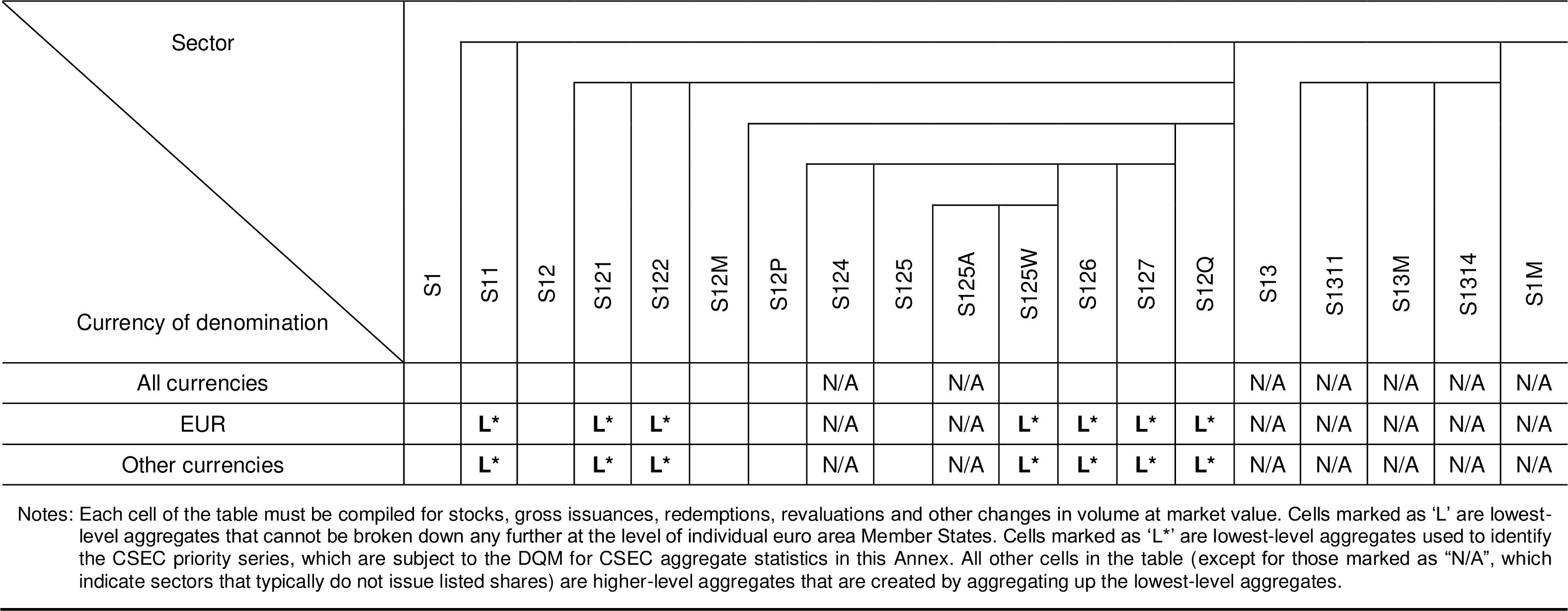
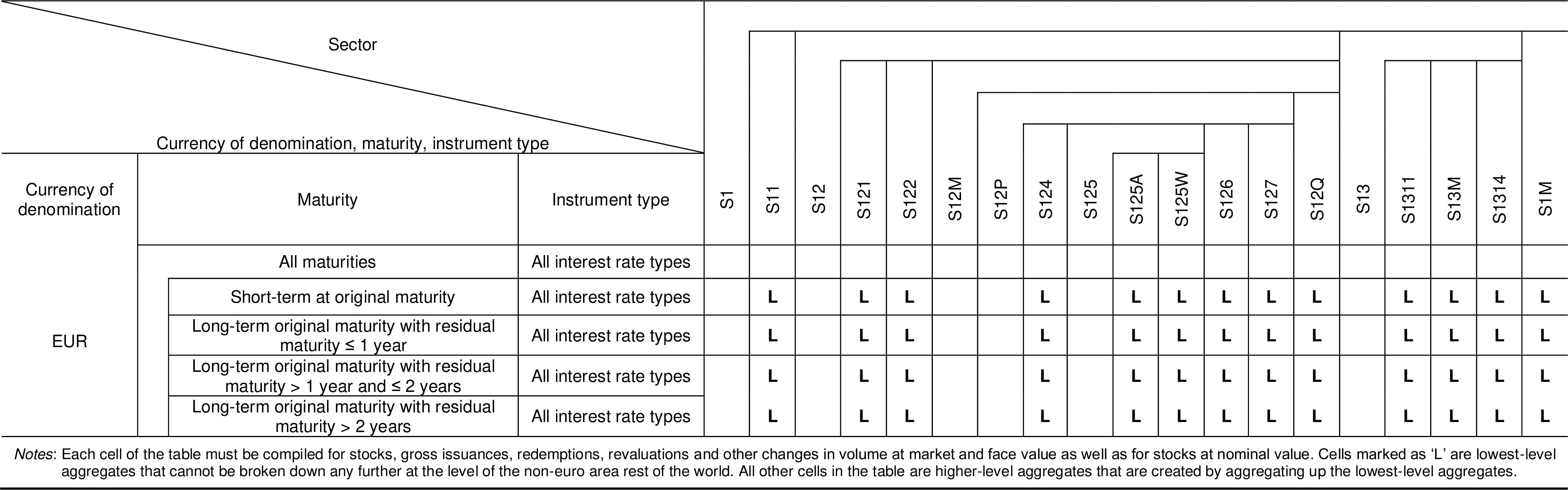
For the issuances of each individual euro area Member State, and of the euro area as a whole, CSEC aggregate statistics are measured in euro and compiled in accordance with the breakdowns defined in the following tables. The sector codes used in the tables have the meanings defined in Section 1 on ‘Coverage and classifications’.
Table A1
Debt securities hierarchy 1 – Main maturity and interest rate type breakdowns for individual euro area Member States and the euro area as a whole
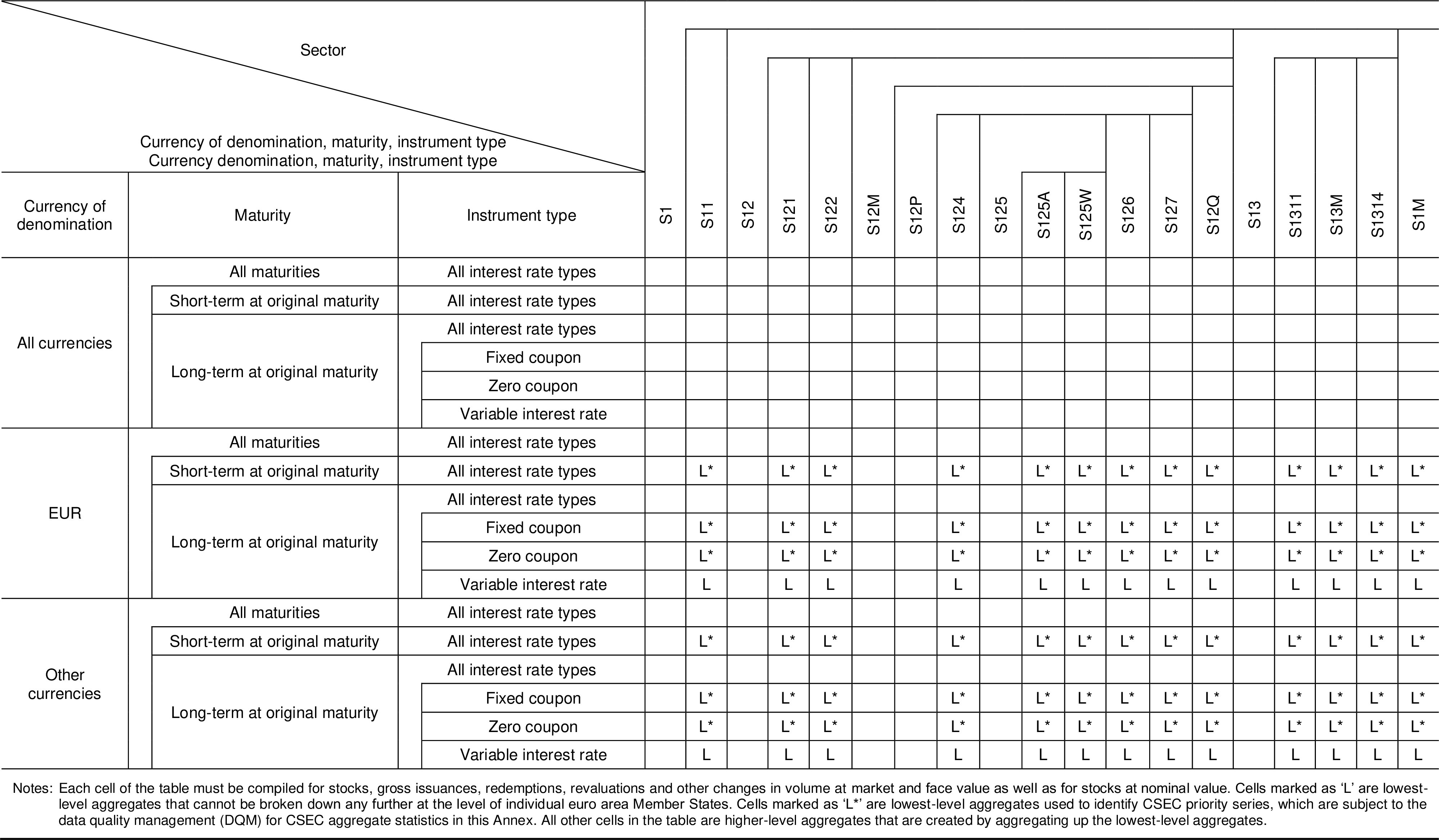
Table A2
Debt securities hierarchy 2 – Detailed interest rate type breakdowns for individual euro area Member States and the euro area as a whole
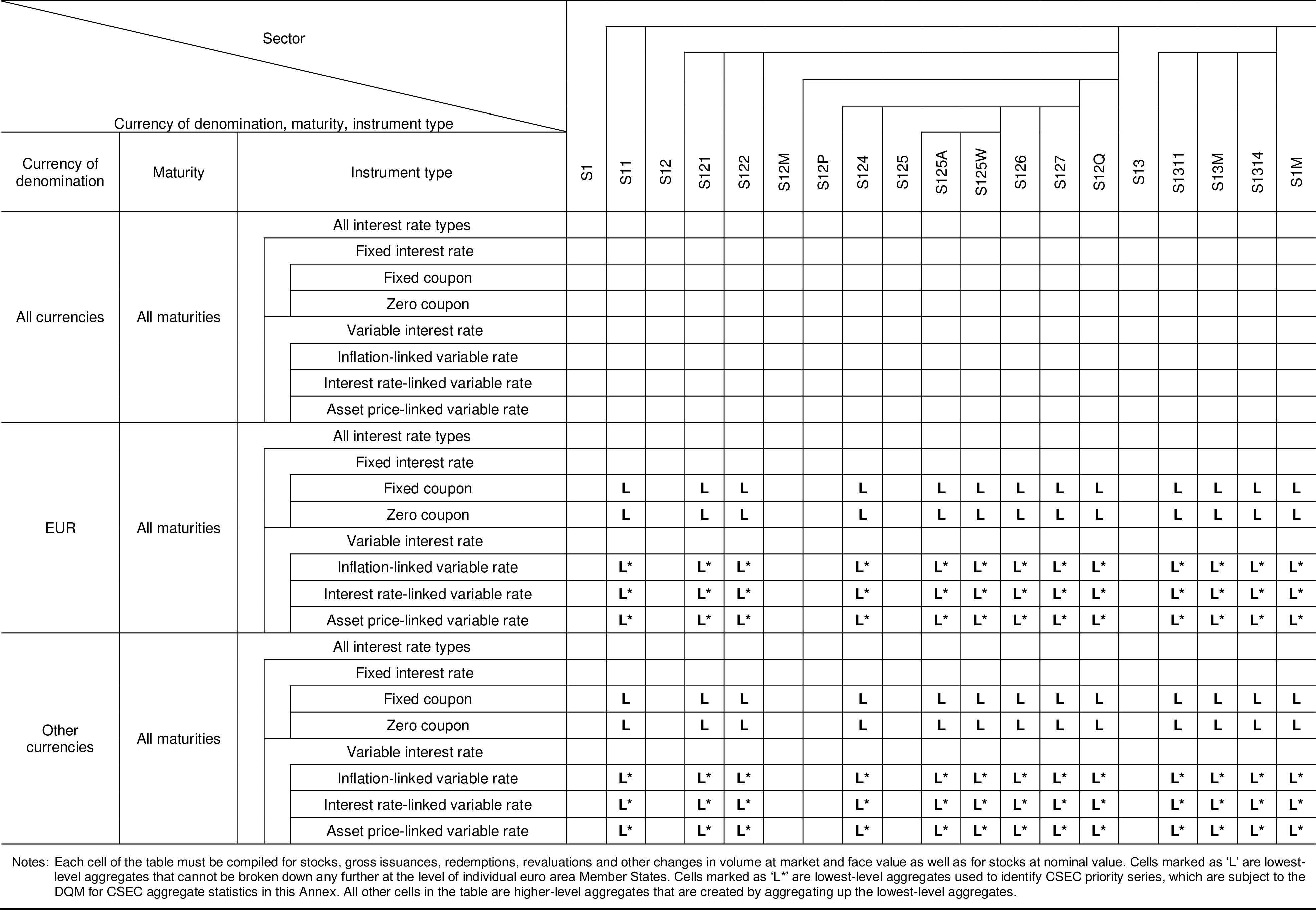
Table A3
Debt securities hierarchy 3 – Detailed original maturity breakdowns for individual euro area Member States and the euro area as a whole
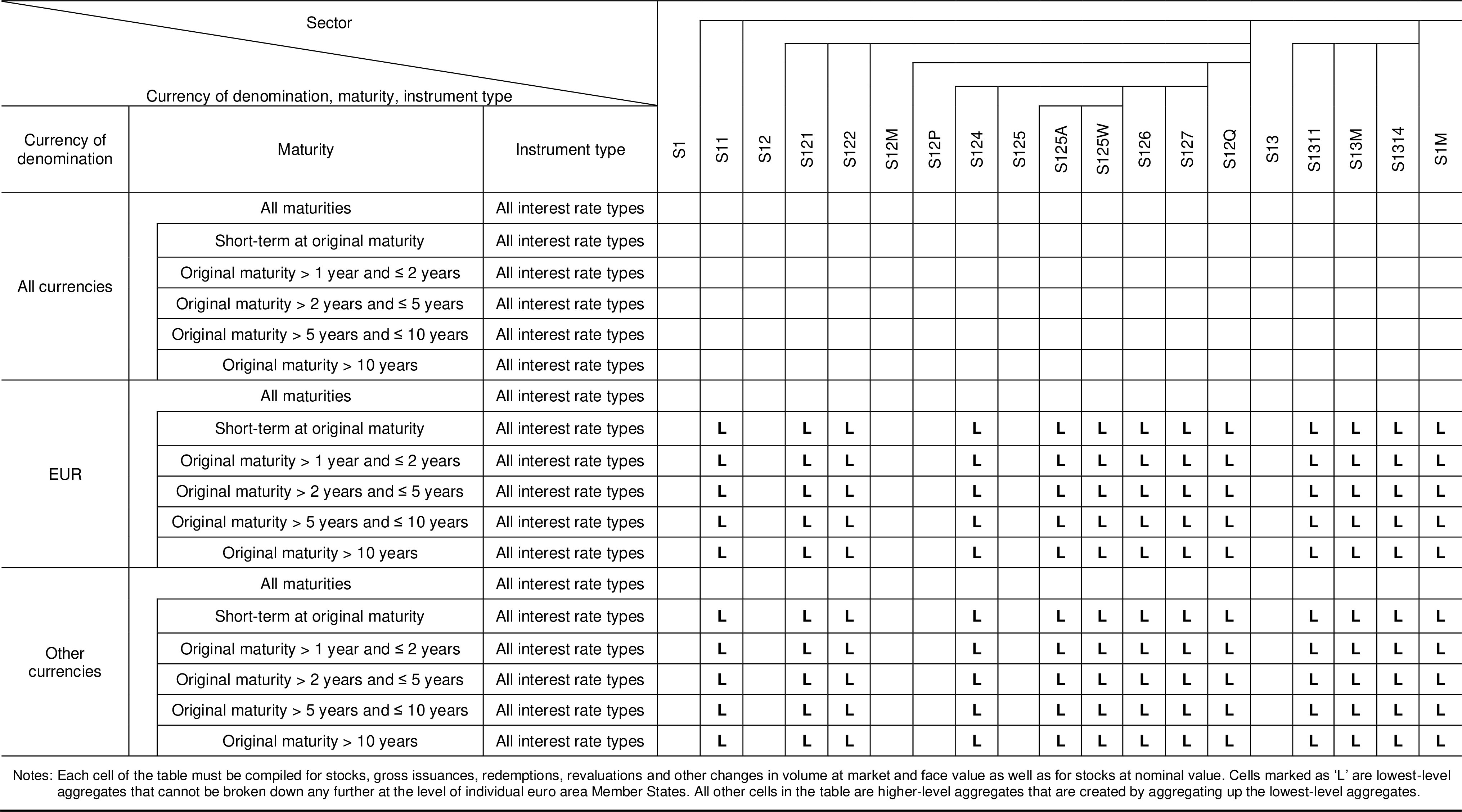
Table A4
Debt securities hierarchy 4 – Detailed residual maturity breakdowns for individual euro area Member States and the euro area as a whole
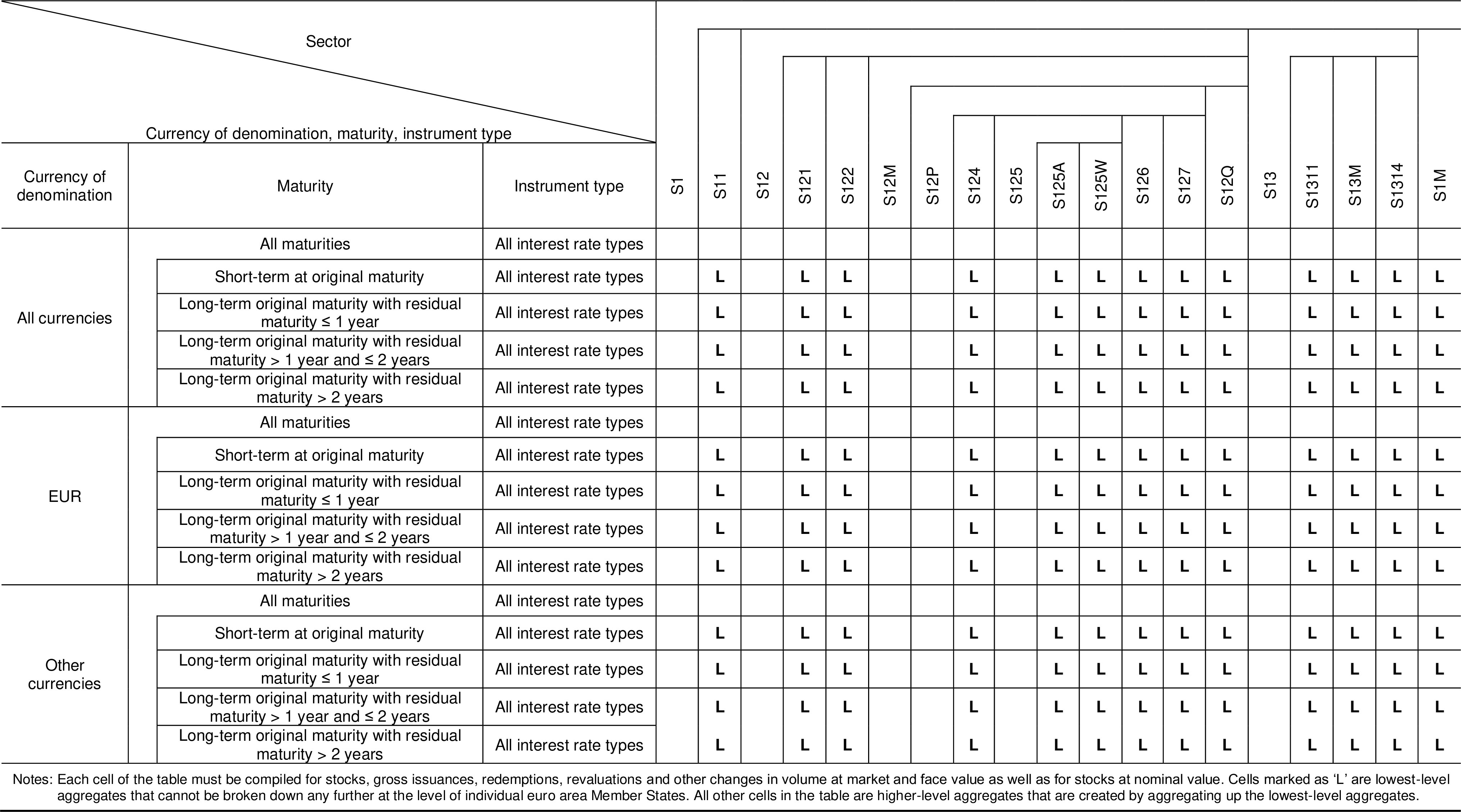
Table A5
Listed shares breakdowns for individual euro area Member States and the euro area as a whole
For the debt securities issuances of the non-euro area rest of the world, CSEC aggregate statistics must be measured in euro and be compiled in accordance with the breakdowns defined in the following tables. The sector codes used in the tables have the meanings defined in Section 1 on ‘Coverage and classifications’.
Table A6
Debt securities hierarchy 1 – Main maturity and interest rate type breakdowns for the non-euro area rest of the world
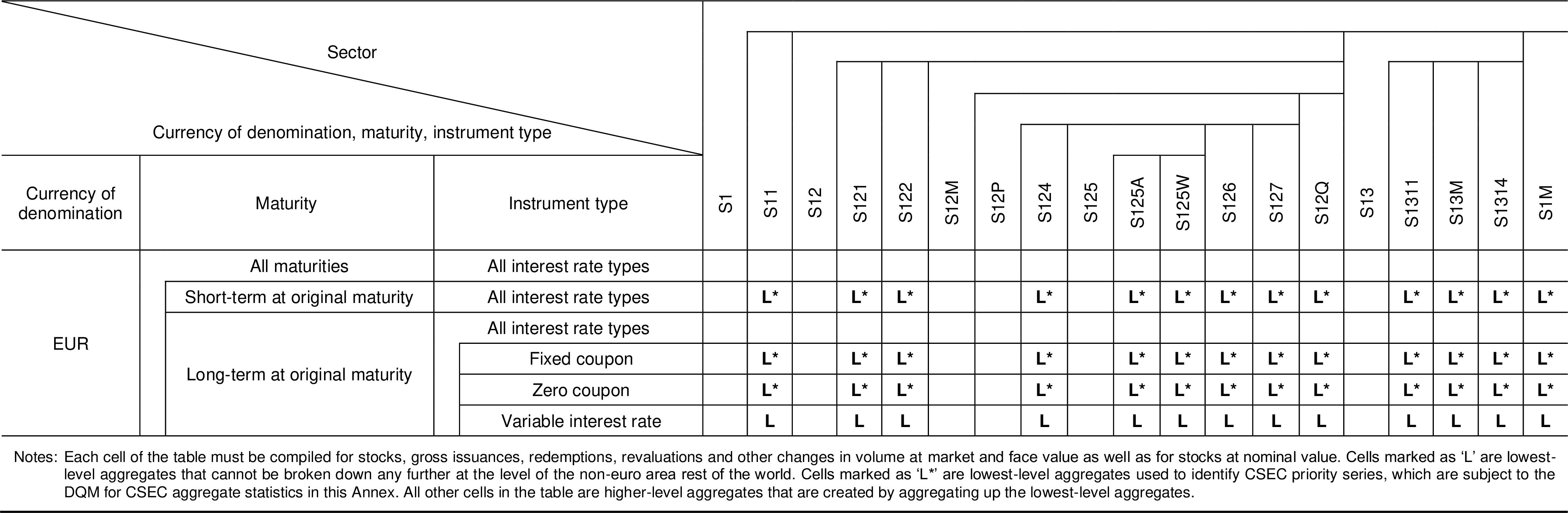
Table A7
Debt securities hierarchy 2 – Detailed interest rate type breakdowns for the non-euro area rest of the world
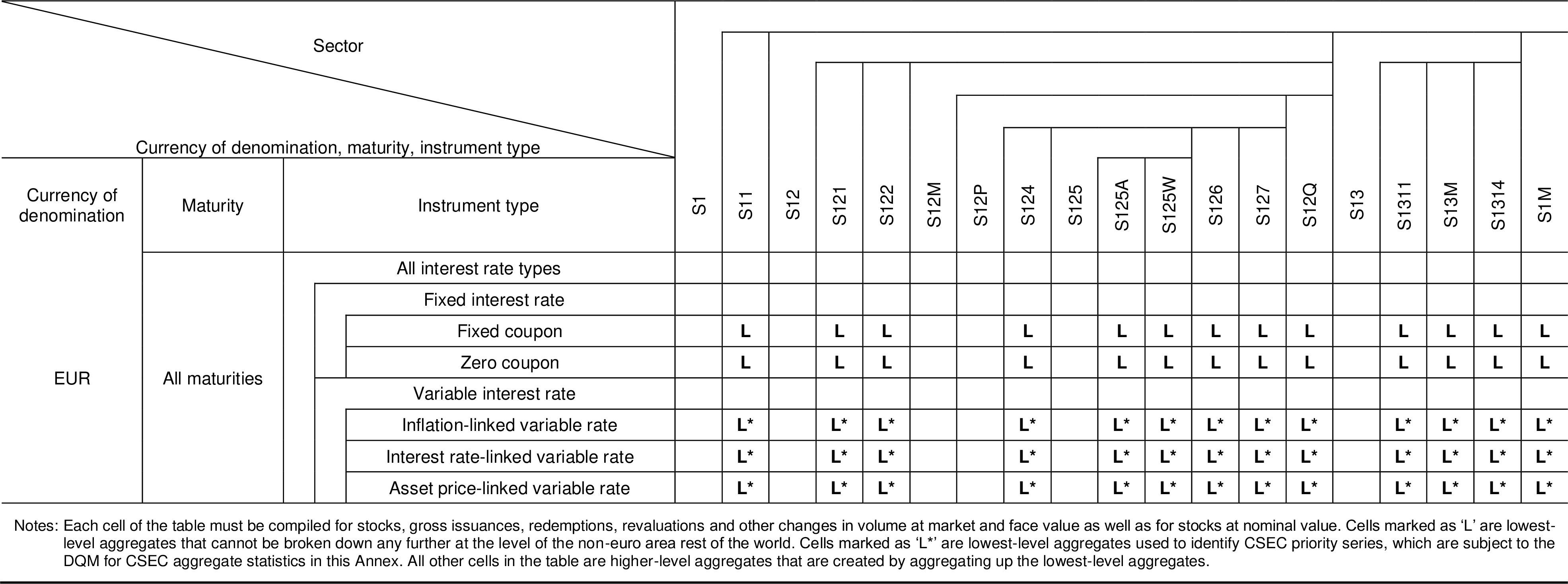
Table A8
Debt securities hierarchy 3 – Detailed original maturity breakdowns for the non-euro area rest of the world
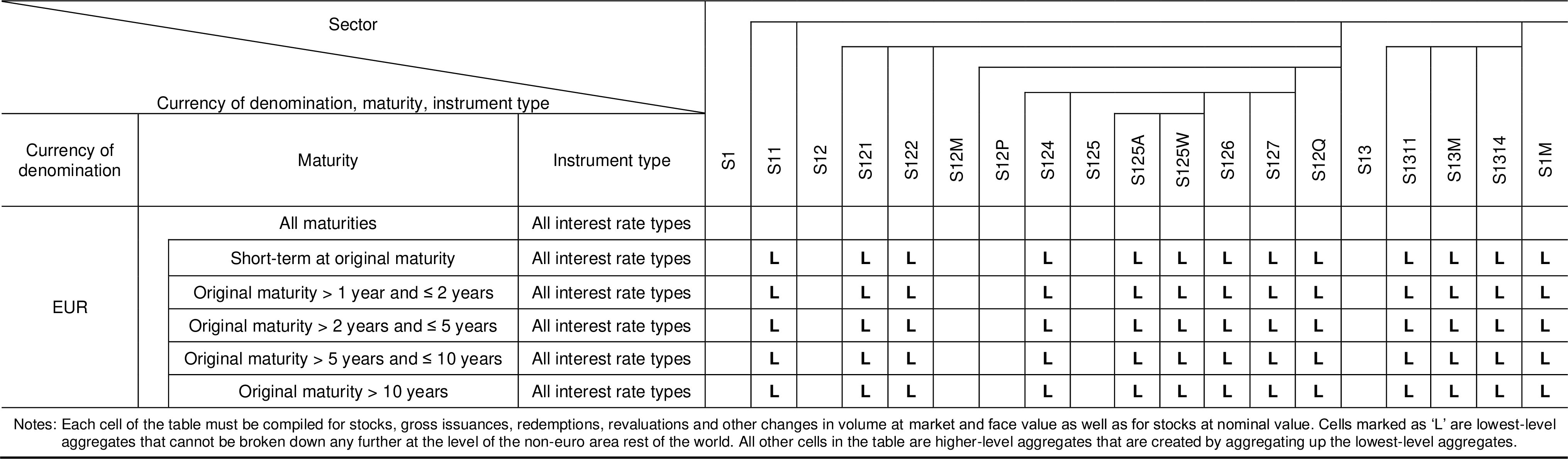
Table A9
Debt securities hierarchy 4 – Detailed residual maturity breakdowns for the non-euro area rest of the world
6. Compilation process for CSEC aggregate statistics
CSEC aggregate statistics are centrally and automatically compiled based on the item-by-item data included in the CSDB. The compilation process produces the lowest-level aggregates indicated in Tables A1 to A9 (cells identified with the letter ‘L’ or ‘L*’). All other aggregates defined in Tables A1 to A9 are produced by further aggregating up these lowest-level aggregates.
7. Verification and DQM of CSEC aggregate statistics
The ECB will use its best efforts to compile and make available the CSEC aggregate statistics on a daily basis to enable the regular verification of the aggregates.
Verification of initial and regular aggregates
In accordance with the timetable in Table 2 of Annex II to this Guideline, the ECB and the NCBs must verify the initial and regular CSEC aggregate statistics by the end of the seventh working day of the calendar month following the reference month of the current production round to ensure that all sets of CSEC priority series have been verified.
The ECB and NCBs must use their best efforts in verifying the initial CSEC aggregate statistics based on information that is readily available to them and must examine the respective aggregates for their plausibility. Initial CSEC aggregate statistics must be flagged as ‘provisional values’ in the disseminated data.
The ECB and NCBs must thoroughly verify the regular CSEC aggregate statistics based on all currently available information including other benchmark data available outside the CSDB. Regular CSEC aggregate statistics must be flagged as ‘normal values’ in the disseminated data.
Prioritisation of verification work
In order to ensure an efficient verification workflow and to avoid duplication of verification work, the verification of CSEC aggregate statistics must focus on the ‘CSEC priority series’, i.e. the most relevant lowest-level CSEC aggregate statistics. Verifying the priority series will ensure that all higher-level aggregates that are based on these series, and to a significant extent also any related overlapping aggregates, are verified as well.
CSEC priority series represent the most relevant CSEC aggregate statistics for a country as measured by their outstanding amounts expressed as a share of amounts outstanding to the CSEC total economy aggregates for debt securities and as measured by their market capitalisation expressed as a share of market capitalisation to the CSEC total economy aggregates for listed shares. Priority series are defined as those lowest-level CSEC aggregate statistics for stocks at market value that are required to reach the Target 2 DQM threshold for that country.
For debt securities, CSEC aggregate statistics cover four overlapping hierarchies as defined in Tables A1 to A4 and A6 to A9. In order to avoid duplication of work, the identification of CSEC priority series for debt securities is based on the lowest-level ‘short-term at original maturity’ aggregates and ‘long-term at original maturity’ aggregates for ‘fixed coupon’ and ‘zero coupon’ as defined in Tables A1 and A6, as well as the lowest-level ‘inflation-linked variable rate’, ‘interest rate-linked variable rate’ and ‘asset price-linked variable rate’ aggregates as defined in Tables A2 and A7. This ensures a detailed verification of the breakdowns by instrument type as well as a high-level verification of the breakdowns by maturity (i.e. short-term vs. long-term at original maturity).
For listed shares, the identification of CSEC priority series is based on the lowest-level aggregates defined in Table A5.
The CSEC aggregate statistics must be verified at the level of ‘sets of series’, consisting of the related aggregates for the three valuation methods (i.e. market, nominal, and face value) and the five series types (i.e. stocks, gross issuances, redemptions, revaluations, and other changes in volume), which share the remaining breakdowns. This means that the verification of CSEC priority series must always cover the full set of series related to the respective CSEC priority series (‘sets of CSEC priority series’) for stocks at market value.
If sets of CSEC priority series exhibit a significant change in total outstanding amounts or market capitalisation after they have been verified but before the deadline for verification as defined by the timetable in Table 2 of Annex II to this Guideline, the CSDB must highlight the respective sets of series and the respective sets of series must be verified again.
DQM of CSEC aggregate statistics
In verifying and confirming the CSEC priority series, the ECB and NCBs must examine the time-series of the related sets of series for the following possible data quality issues:
Outliers, i.e. values that differ significantly from the other values of the respective time-series;
Stock-flow inconsistencies, i.e. reference periods during which current stocks do not equal the sum of previous stocks plus gross issuances minus redemptions plus revaluations, which could either be due to other changes in volume or data quality issues.
If the ECB and NCBs identify relevant statistical data quality issues during the verification of the initial and regular CSEC aggregate statistics, they must correct these issues in the underlying CSDB item-by-item data in due course but no later than the deadline specified in the timetable in Table 2 of Annex II to this Guideline. Corrections of the underlying item-by-item data will be reflected in the CSEC aggregate statistics that are compiled in the overnight processing for the following day.